

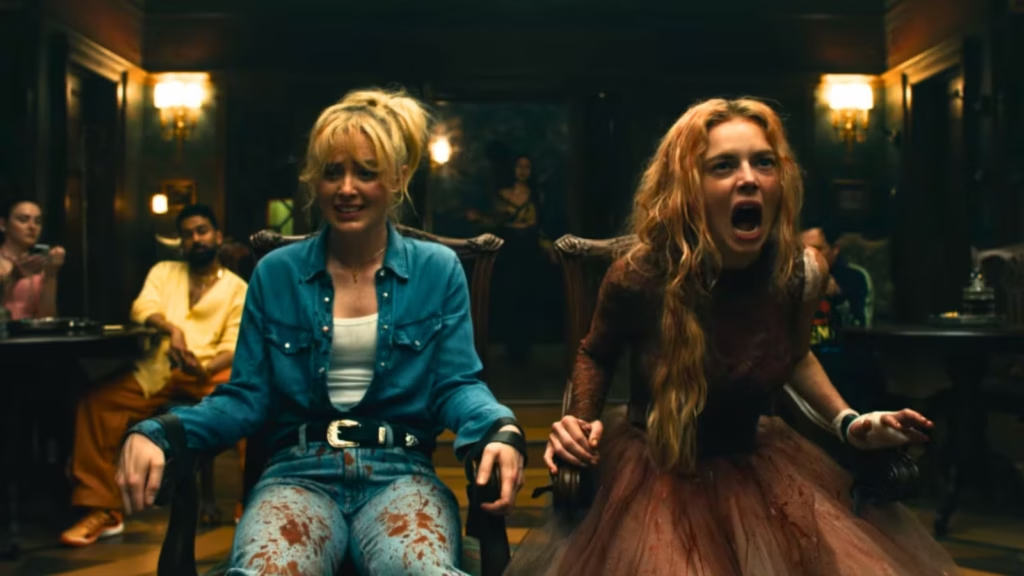
Satan’s lackeys are having a field day chasing women in the cinema. But that Most Dangerous Game has been given a new spin given that these ladies are no shrinking violets when it comes to robed evil acolytes, hellishly giving back what they get in grief and then some. One might say that real turning point to dawn struck seven years ago when bride-to-be Grace MacCaulley (Samara Weaving) found out her oddball in laws liked to prove a mate’s worth by having her sacrificially chased about the mansion in a game engineered by “Mr. Le Bail,” one whose body-blowing results had the wily, blood-soaked Ms. as the last woman standing. Now it’s like no time has passed at all for the filmmaking team of Radio Silence, as the game is afoot again for a whole new set of vile rich families bent on hunting down Grace for world-ruling power. Except Grace is now joined at the handcuff to her none-too-pleased sister Faith (Kathryn Newton), who must survive the night against the twisted aristocrats.

Playing a major part in “Ready or Not 2: Here I Come’s” fiendish payback enjoyment is Belgian-gone-Hollywood composer Sven Faulconer. Having learned his major studio craft in the company of such masters of James Newton Howard and Steve Jablonksy, Faulconer has since solely raged for the likes of Mad Mel and Hellboy. Faulconer previously went on the hunt with Ghostface for Radio Silence’s “Scream VI,” making a formidable tag-team with composer Brian Tyler when it came to relentless orchestral thrills. Now abetted with Tyler’s themes from “Ready or Not,” Faulconer is truly unleased for this sequel to more than prove his horror chops, particularly in its sub genre of blunt black humored weaponry in the service of grrrlll power and Old Scratch. With giant clock-ticking relentlessness, Faulconer conveys the maelific cello and chorus of Mr. Le Bail, which chases the strong electronic percussion and surprising emotion of Grace and Faith from mansion to estate grounds and back again to a deliciously sanguine vocal climax. Faulconer’s winning moves exceptionally intertweave themes that relish in the pulse-pounding chase as it effectively jumps from ghastly laughs to epic terror, Faulconer, surviving to dawn with grand guignol energy to spare that ends up holding a winning card on his composing career.

What led you to film composing? And how did you make the transition from Belgium toHollywood?
Although I grew up playing the clarinet, I spent even more time experimenting on our old upright piano. As a teenager, I became increasingly fascinated with music technology, exploring software and synthesizers. By the time I reached college, my interests had expanded significantly; I founded a symphony orchestra and played keyboards in a funk band, immersing myself in both classical and contemporary styles. During my final year, I studied abroad in Rome through the Erasmus exchange program, where I lived with a Sicilian film director. It was there that I first discovered my passion for film scoring and experienced the unique power of music to elevate storytelling into something greater than the sum of its parts. Afterward, I moved to California and began attending film festivals to connect with filmmakers and built relationships with composers in Los Angeles. At the same time, I further developed my craft by enrolling in the film scoring program at UCLA. A few years later, I was offered a position as a studio runner with the composer of Ridley Scott’s film “Robin Hood.: This opportunity opened the door to several short-term roles, eventually leading to a position as an assistant at James Newton Howard’s studio.
What did you pick up from working as a programmer, arranger and additional composer on any number of big ticket action and genre films working for the likes of James, Steve Jablonsky and Henry Jackman? What makes for a good team player in that respect?
I worked with James Newton Howard for over seven years and I learned an incredible amount during that time. In my view, he’s one of the true master composers and the experience gave me a deep understanding of the entire film scoring process. From early on, he included me in playback meetings which provided rare insight into how he approaches collaboration; how he handles feedback, navigates revisions and maintains such a high level of commitment and work ethic. I also saw firsthand how crucial the relationship between director and picture editor can be in shaping those conversations. Beyond that, I had the opportunity to travel with him and work at some of the world’s most renowned scoring stages, collaborating with top-tier musicians and engineers. That exposure helped me develop a strong grasp of the recording side of the process. On several projects, he also trusted me with opportunities to write additional music and contribute to developing unique tonal palettes, particularly with synthesizers. When I eventually decided to focus on my own projects, I continued writing additional music for other composers. It was incredibly rewarding to collaborate with such a diverse range of creative talents, each bringing their own distinct style, strengths and creative process. Over time, I was able to shape my own approach by drawing from all of these influences and experiences. A key part of being a successful collaborator, I’ve found, is the ability to clearly understand feedback from the director and translate it into meaningful musical revisions. Strong communication, reliability and versatility are equally important, as is the ability to adapt to ifferent creative roles. Having collaborated with the same directors across multiple projects, I’ve found that the ability to continually reinvent myself – and to approach each score with a fresh, original perspective – is an invaluable skill.

Your score for Mel Gibson’s “Blood Father” really caught my attention back in 2016. It was certainly an unusual biker film that stretched his action persona. Tell us about that experience.
I love that you bring up that score! It was a fantastic experience, my first time scoring a film with a major actor and a project that I genuinely loved. Jean-François Richet, the director, was a big admirer of James Newton Howard and when he approached him, James recommended me forthe project. That endorsement alone was enough for Jean-François to bring me on board. James was incredibly supportive throughout the process. He generously allowed me to use his studio for playbacks and gave me the time and flexibility I needed to complete the score while I was still working for him. It really speaks to his generosity and the profound impact he’s had on my career. I also vividly remember a moment with Jean-François where we landed on a very simple musical idea that became central to the emotional father-daughter scenes. The film also featured some great suspense sequences, which were a lot of fun to score in a more hybrid style. “Blood Father” has really stood the test of time and Mel is fantastic in it; it’s great to see it still resonating, with a well-deserved 89% on Rotten Tomatoes.
How did you come into Brian Tyler’s circle? And what stood out about his scoring to you?
I was introduced to Brian through our agency, Gorfaine/Schwartz, and our first collaboration came while he was developing some truly bold ideas for one of his projects. I contributed to a particularly intense, haka-inspired piece, which was a memorable experience in itself. From the outset, I was struck by the sheer scale and quality of his productions: the breadth of his musical range, combined with the intricacy of his synth work and electronic percussion programming, was genuinely intimidating. His scores have a level of detail and energy that’s hard to match. I had also seen a video of his “Crazy Rich Asians” concert, where he opened with a phenomenal jazz piano solo, then jumped onto the drum kit and ultimately conducted the grand finale. That performance really captured the versatility and musicianship he brings to everything he does.

Your first scoring for Radio Silence was with Brian on “Scream VI.” What was it like getting under the cloak of Ghostface, and what did you discover about the team and their tastes in genre music?
Several years after our initial collaboration, Brian was looking for a composer to co-score “Scream VI,” and he ultimately brought me on board; an incredible opportunity and a real honor. I’d watched the original “Scream” in college and vividly remember making the whole theater crack up when I jumped up and shouted during one of the scares. Brian had composed the score for the previous film, so the themes he developed for “Scream 5” became the foundation for the sequel. However, the scope of the story expanded significantly with the action moving to New York City and featuring huge set pieces like the ladder sequence and the introduction of the shrine. This gave us the chance to elevate the musical scale as well, incorporating a bigger orchestral sound and elements like choir.
Matt Bettinelli-Olpin and Tyler Gillett, the directors of both films, are strong advocates for traditional scoring approaches and on “Scream VI” they gave us a great deal of creative freedom to take things even further. Collaborating with Brian and presenting our ideas as a team to Matt and Tyler was an incredibly rewarding experience. I especially remember the brainstorming sessions where we’d develop new musical ideas together right there with the directors in the room, it was such a dynamic and creative process. It also makes a huge difference working on a film that’s so well written and thoughtfully directed; it really creates the space for that kind of collaboration to thrive. Their ability to connect with audiences is exceptional and it makes composing for their films especially enjoyable.

You scored another horror icon with “Hellboy: The Crooked Man,” which took an unusual,“unplugged” approach for a slimmed-down sequel. Tell us about that experience.
I had an incredible time working with Brian Taylor (the director, not to be confused with Brian Tyler). I really connected with the creative direction he took this one in, which felt close to the original folk-horror comic miniseries created by Mike Mignola and illustrated by Richard Corben. His musical tastes pushed me into a truly unexpected creative space. Together, we developed a unique sonic palette that included a wide range of originally recorded creepy textures, small string ensemble effects, baritone guitar and an assortment of unconventional percussion, evendown to the rattling of an actual jawbone. It was one of those rare projects where I had to reinvent my approach, gradually shaping the score to align with the very specific sonic world the director envisioned. And, much like “Scream 6,” having grown up loving Guillermo del Toro’s first “Hellboy,” it feels surreal to have played a role in such an iconic franchise.

Right before “Ready or Not 2” you scored “Psycho Killer.”
That’s right, another really great experience, this time with a script by Andrew Kevin Walker, the prolific writer of “Se7en.” In this film, the narrative splits between the detective trying to catch our slasher and the slasher himself as his plan unfolds. The real challenge was finding distinct tonal identities for these two worlds while being able to transition between them seamlessly. There are also a few genuinely surprising moments where the story takes an unexpected turn and the score dives into pretty dark territory. Those were especially fun and any chance to fully lean into that kind of darkness is always a thrill.

Directors Matt Bettinelli-Olpin and Tyler Gillett on the set of Ready or Not 2: Here I Come PIEF WEYMAN/SEARCHLIGHT PICTURES
Tell me about your particular collaboration with Radio Silence on “Ready or Not 2” and what they wanted the sequel and its score to accomplish.
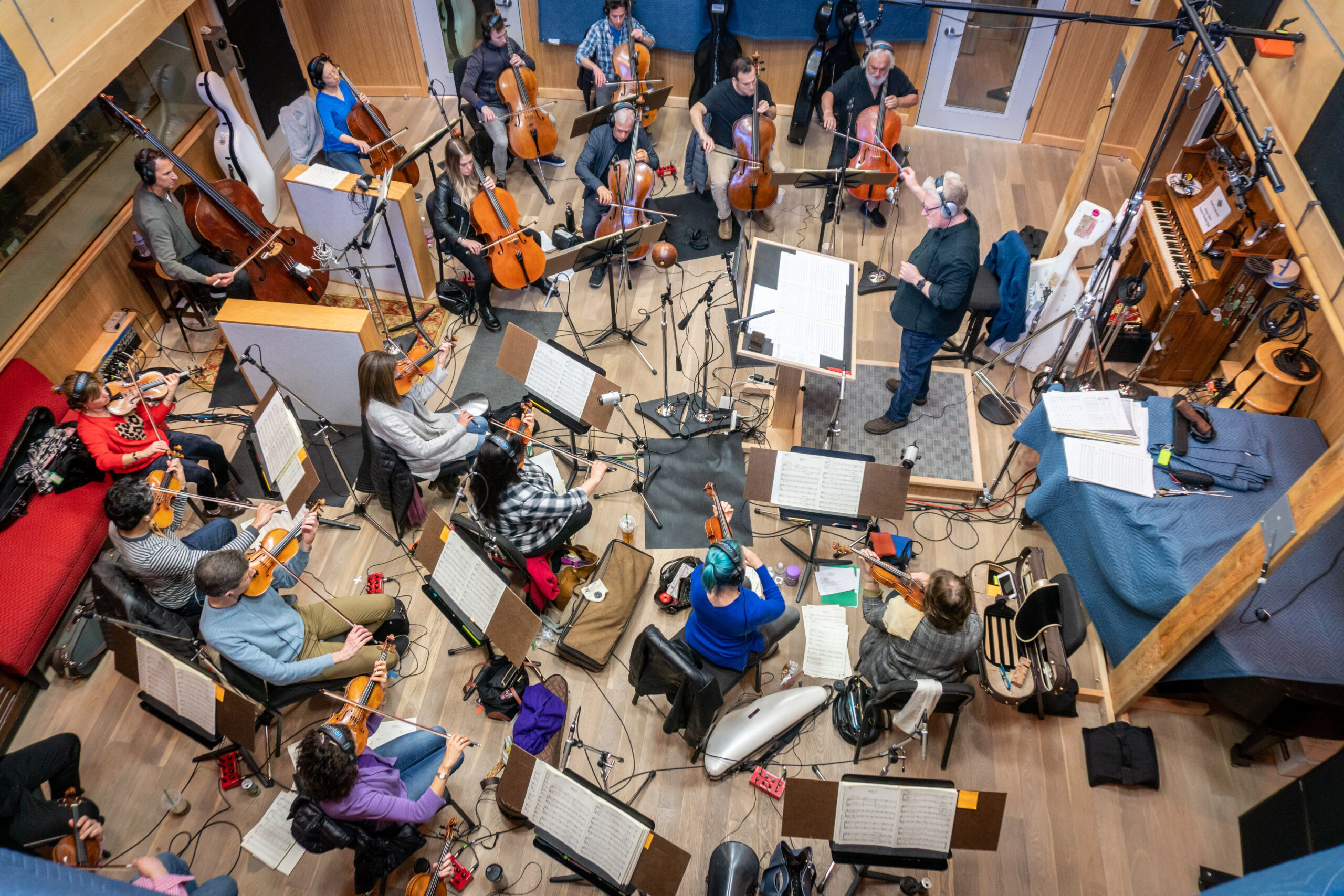
One of our earliest conversations centered on the tone of the first film and how much they loved the direction Brian Tyler took with the score, grounding it in a more classical, traditional orchestral language. Just as “Ready or Not 2” picks up where the original left off, I wanted the score to feel like a natural continuation of that musical world. That meant building on a similar palette while allowing it to expand and evolve alongside the film’s growing scope. As the mythology opens up on a much larger scale, the directors Matt and Tyler encouraged me to develop a new satanic motif, something that could drift through the story in an almost ethereal, ever-present way. We found that the wealth and privilege embodied by these powerful families paired beautifully with a baroque-inspired chamber string sound. Working with antique instruments like the viola da gamba, we explored textures that felt both refined and deeply unsettling. The cello, in particular, offered an incredible range of colors for shaping this motif. From that foundation, I was able to build a broader satanic theme, one that captures both the tragedy and the darkness of the High Council’s pact with the devil.
This is certainly a more emotional sequel given the sisters angle. How did that play into the score?
That’s absolutely right, it was the very first thing Matt and Tyler brought up, that at its core the film is about the sisters and their emotional bond, a story deeply rooted in love. It was crucial for Matt and Tyler that I develop a theme for Grace and Faith, something intimate and deeply human that could exist in contrast to the film’s more sinister musical world. What I found particularly interesting was how the instrumentation began to overlap. The same palette used for the satanic material gradually made its way into the sisters’ theme. There’s an especially moving moment in the film where that theme is simply carried by an ensemble of cellos alone, giving it a warmth and vulnerability that still feels connected to the film’s darker undercurrents.
The violence here is definitely more brutal, especially when it comes to the physical punishment delivered upon the heroines.
Yeah, and not just for our heroines but for some of the family members as well (“Bath time!”). Interestingly enough, during some of these moments, like the scene between Titus and Faith, the score actually pulls back more than you might expect. Rather than pushing the intensity, it leaves space. The performances, the editing and the sound design do much of the heavy lifting in those scenes, carrying the weight of the brutality in a way that feels more immediate and unsettling.

Given that the devil cultist element is front and center here, what kind of Satanic musical instruments and approaches did you want to amp up with such “Old Scratch” scoring favorites as the cello and black mass chorus?
As mentioned earlier, the range of articulations on the cello, combined with the distinctive character of those older fretted baroque viols, gave us a really compelling palette of sounds, one that we could weave throughout the film and gradually develop over time. As the story progresses and moves deeper into full-fledged satanic ritual and sacrifice, those themes begin to expand as well, unfolding across a much broader orchestral canvas. By the time we reach the third act, the scale opens up significantly, with choir becoming a much more prominent and defining element of the score.
Who was your favorite “family” member to play? And what’s your favorite “kill” here?
I’m not sure there’s one particular family member I’d single out. I had a lot of fun weaving the Satanic motif in and out of the score, it indirectly represents Mr. Le Bail’s influence over all the family members, so it appears in all sorts of subtle and varied ways throughout the film. One of the most enjoyable aspects was playing with its tone. In the book signing sequence for example, Matt and Tyler wanted something much lighter and more playful, almost a magical take on the theme. Then later, when Francesca shows up, it shifts again, reflecting that slightly lighter yet still confrontational energy. Those moments were a great opportunity to really have fun with the material and let the music mirror what’s happening on screen in a more flexible, expressive way. As for my favorite kill, I think the very first one is hard to beat as it really sets the tone for everything that follows. I also love Faith’s reaction right after, which is when she finally stops doubting everything Grace had been telling her. Her “What the fuck!” lands perfectly. Another standout for me is the moment just before the poncho joke, it’s such a great tonal setup.

Tell us about playing Sarah Michelle Geller’s character Ursula, who’s given surprising emotionalcomplexity?
Her character was really fascinating, especially given her arc and the way her relationships with Titus and Grace evolve over the course of the film. The scene toward the end between her and Grace, capturing those subtle emotional shifts between them, was especially fun to score. Her scenes with Titus on the other hand span a wide emotional spectrum: at times light with a hint of comedy, at others rooted in grief or shifting from dominance to pure fear and darkness. It created such a rich and dynamic range to explore musically.

How did you want to capture the officious manner of Elijah Wood’s lawyer?
Matt and Tyler were very clear that any “opening of the doors” needed to feel like a major event, which naturally tied into the Lawyer’s character. Along the way, a fun B-section of the satanic theme emerged and organically became the musical idea we’d lean on whenever something significant or weighty happened in connection to Mr. Le Bail’s pact. That motif ended up threading through many of the Lawyer’s key scenes – whether he was outlining the bylaws, explaining the rules, or guiding the family through the next steps – so it gradually became synonymous with his presence. By the third act, as the mythology expands on a much larger scale, it felt right to elevate that material with a fuller orchestral and choral treatment. At the same time, there are plenty of lighter moments with the Lawyer, so finding that balance – shifting between a more serious, ominous tone and the character’s playful edge – was a really enjoyable part of the process.
The pacing here is certainly more uptempo given that the sole game is The Most Dangerous Game aspect. How do you think that ups the rhythmic ante?
Yeah, it definitely did in certain places. A great example is that opening sequence of the game, where Grace and Faith are handcuffed together while the families race to try to reach them first. The goal there was to maintain the pace with a steady pulse through those first few minutes. At the same time, there’s so much happening within that sequence; it shifts from panic between the sisters to bickering, to a lighter beat between Ursula and Titus, to something as unexpected as launching a drone etc. It’s a great example of how the pacing needs to stay consistently high while the music still adapts stylistically to hit each of those shifting moments. That balance is such a fun challenge, and honestly one of the things I love most about scoring films like these. In the end, the hope is always that the score amplifies the right emotions and draws the audience in, without ever feeling manipulative.

How did you want to interweave Brian’s original themes with your own while expanding on them?
There were definitely key moments that called for bringing back thematic material from the first film. With the introduction of Faith, and Grace recounting the events of the original story, it felt natural and really fun to reintroduce the main theme, then gradually evolve it until the satanic motif weaves in and transforms it into something new. Putting the wedding dress on again was another great opportunity for a musical callback. And of course, the return of the “Hide and Seek” song later in the film leading into Grace’s incredibly badass shotgun moment was a highlight. Those moments of continuity were really satisfying, both narratively and musically, as they helped tie everything together while still pushing the score forward.
One thing that set Brian’s scores for Radio Silence’s “Ready or Not” and the two “Scream” movies apart was his combination of synth and orchestral percussion. How did you want to play that here
I’d say in many ways it mirrors the approach of the first film. Since Matt and Tyler were so fond of that tone, it felt right for synths and percussion to play a similar role here as well. They especially loved the use of low synth textures and there are some great moments where a dark, bendy low-end swell almost acts like a call-and-response to the satanic motif. There are definitely plenty of hybrid elements woven into the broader orchestral palette, but for the most part, the synths stay in a supporting role rather than taking the foreground, which was very much a conscious choice for this score.

“Ready or Not 2” has no small amount of humorous irony to it. How did you want to capture those nasty laughs here, while also getting across the life-or-death seriousness?
Well, it’s definitely one of the things that made scoring this film especially exciting. Because the tone shifts so rapidly and so often, the music had to move seamlessly between extremes: bloody character explosions to playful mischief, magical mystery to melancholy and moments of tenderness to the ominous weight of satanic ritual. That constant transformation became one of the most rewarding challenges of the score. That said, a big part of why it works so well really comes down to the filmmaking itself. The writing lays a strong foundation, and Matt and Tyler managed to capture such fantastic performances from the cast. A lot of the magic also happens in the edit; by the time I step in, so much of the heavy lifting has already been done, which makes navigating those wild tonal swings much more intuitive. For many of those moments, the humor actually comes from playing things completely straight: scoring the kills with total seriousness and then leaving space for the jokes to land. That contrast ended up working really well in this film.
How did you want to play the “ticking clock” element, and what inspiration was the gear-laden centerpiece?
I always knew that the big clock was gonna get some really cool and original sound design, but a lot of that really came together later in post. I remember being blown away by the sound design of those sequences when I first saw the film at SXSW. The clock plays an important role in the film’s mythology, so there are definitely moments where the score expands in scale around it. That said, the “ticking clock” aspect of the music is used quite sparingly and only at specific points. When it does appear, it’s shaped tonally by that same baroque-inspired palette tied to the satanic theme. In those moments, I experimented with shorter, more articulated gestures on cello and bass viol: things like ricocheting the bow off the strings or using very tight spiccato strokes. Rather than treating it as a full ensemble effect, it often comes through in a more exposed, almost soloistic way, which gives it a more precise and pointed sense of motion.

“Ready or Not Here I Come” singularly establishes you as a composing force. How does that feel, and what challenges would you like from this point?
Wow, that’s a pretty big statement and definitely very flattering, so thank you for that. It’s been an incredible opportunity. I’m so proud of the final result and having had the chance to work with such a great team. Matt, Tyler, and the producers were fantastic collaborators throughout the process. I also feel really fortunate to have stepped in where Brian Tyler’s score for the first film left off. I have a lot of gratitude toward him, not only for setting such a strong musical foundation, but also for bringing me on to co-score “Scream 6” and ultimately vouching for me to take on “Ready or Not 2.”
As for the future, I don’t think this experience necessarily changes the kinds of challenges I’m looking for, those have stayed fairly consistent for me. Every film brings its own unique set of demands and that’s really what keeps things exciting; it’s always an opportunity to grow, expand your skill set and, in a way, reinvent yourself as a composer. Those challenges can be creative, budgetary, or even political, so it’s a very varied line of work. I’m also very conscious of not getting boxed into one specific genre, it’s something I actively think about as I look for new and interesting projects. Ultimately, most of the opportunities I’ve gotten have come through building strong relationships. So being trusted with a project at this level, working closely with the directors and contributing to something for such a passionate fanbase has without a doubt been one of the highlights of my career so far.

If there’s somehow another “Ready or Not” sequel, where would you like to see the chase go?
There was a really funny social media post by Sarah Michelle Gellar and Elijah Wood where they were reading fan mail, and one fan suggested that there could an entirely different set of satanic pacts with Mr. Le Bail; different families, different stories. Maybe Grace could show up as the badass who helps a whole new bunch of unfortunate victims. I thought that was a pretty fun idea!
Now having scored a “Ready or Not” film, how would you personally survive, or hunt down your prey on game night?
Well, if I’m the hunter, it all depends on when my family joined the pact. If it dates back centuries, I’d probably start brushing up on my bow-and-arrow skills. If it’s more recent, I’d be reading up on EMP weapons. And if I’m the one being hunted, I’d definitely focus on tree-climbing and wall-jumping, handcuffed siblings or not. Honestly, I still think Grace and Faith could’ve put a bit more thought into that strategy from the very start!
Buy Sven Faulconer’s score for “Ready or Not 2: Here I Come” on Hollywood Records HERE. Visit Sven Faulconer’s web site HERE
Special thanks to Kurt Nishimura