


Inside a 20-year career encompassing over 120 scores, Joseph Trapanese has travelled to many strange worlds and put uncountable characters in no small end of inconceivable fates they must struggle out of – be it gang-ridden apartment buildings (“The Raid”), neon game grids (“Tron: Uprising”), an alien AI post apocalypse (“Oblivion”) or bizarre psychological experiments (“Spiderhead”). But “Whalefall” takes the cake as it puts the composer in the role of an ersatz Jonah who must puzzle his way out of beast-filled anatomy as much as his own tormented relationship with a recently passed father – a man very much alive in his mind even as his son’s oxygen runs out. How the past provides the key to escape provides an impressive musical journey through the belly of the psychological and very physical belly of the beasts. Trapanese at first tracks the journey with the creative electronics that put him on the Hollywood map, alongside father-son lyricism that pushes new emotional territory. As “Whalefall” counts down its air supply, Trapanese progressively unleashes a full, adventurous orchestra, behemoth mysticism and most importantly lyrical realization that coming to terms with one’s inner demons will provide the ultimate, desperately needed release. The result is Trapanese’s most impressive and epic score yet, one that traverses many different territories for frequent directing collaborator Brian Duffield’s impressive combination of high concept peril and very personal reconciliation, as given intimate, personal depth by Trapanese.

“Whalefall” is your biggest collaboration yet with writer/director Brian Duffield, whose work is often based on fantastical high concepts. I was especially blown away with your first movie, “Spontaneous,” which used spontaneous combustion as a teen metaphor for dealing with death, a theme you’d both return to with “Whalefall.”
Thank you. That is exactly right. “Whalefall” is full of metaphors, and not least among them are death, legacy and emotional inheritance. The whole time I was working on the film, I was thinking about my dad, and about being a dad. It’s by far my most personal score. I believe anyone who goes to see this in a dark theater will immediately come out reflecting on their family, and of families of all kinds. It’s not just sons and fathers. It’s all kinds of families, no matter what that means. It is such a powerful statement.

What was it like playing another beast for Brian with the animated King Kong series “Skull Island?”
“Skull Island” had a lot of freedom. Brian was busy making movies, and this was something Netflix came to him with and kind of let him run wild with. I don’t think anyone expected it to be anything more than a popcorn rush for [Legendary] and Netflix. There’s something much deeper there. You can see hints of where we went with “Whalefall,” because “Skull Island” is very much a father-and-son story as well, about someone trying to please their dad and follow in their dad’s footsteps. In “Skull Island” we got to wrap these daddy issues in tribal percussion and wood flutes. In “Whalefall” we got to wrap them in swirling glass and antiphonal bass ensembles. Anytime I get to explore these bigger themes wrapped in cinematic fun, and do crazy stuff like that, I just feel so lucky.

Your music was front and center in Brian’s “No One Will Save You,” which is a very personal alien invasion as dealt with by a mute woman.
“No One Will Save You” and “Whalefall” were such tremendous gifts to score, because the music was an additional character. I’m extremely lucky to have a collaborator in Brian, who’s become a close friend and wants music to be a partner in his filmmaking. There’s no back seat for the music. As he’s writing, as he’s shooting, as he’s editing, he’s thinking about how music can be part of the story. The amount of trust, belief and confidence involved in that is humbling to me, and I’m thankful for it.

“Whalefall” is such a crazy combination of genres, between earnest family drama, creature feature and nature survival film. How important was the score to make these elements musically cohesive?
It was incredibly important. We started our journey on this film thinking of high-concept stuff: interesting ways for the score to be incredibly unique and experiential in its sounds and tones, and custom-built instruments. There are always elements like that, finding unique sounds is something I’m very passionate about. But at the end of the day, the score didn’t begin to make sense, nor did the movie, until the music had license to be classic and to have the cinematic depth and range that, when I began, I wasn’t sure we’d have, because we were in this whale’s stomach and in this tight, enclosed space. A lot of the time, music to me is so subjective and experiential. I started out with the idea that the music would be inside the whale with Jay. It wasn’t until we allowed the music to lift Jay out of the stomach, and to experience his grief and his emotional journey, that things began to make sense and come together. I’ll always remember “Whalefall” for that. It was one of the most difficult projects I’ve ever worked on, by far.
The idea of being swallowed by a whale is crazy in and of itself and could be taken in a more outrageous “Sharknado”-esque direction than this film does. Did that also make it important for the score not to strain believability in how you play the action?
Rather than play too deeply into the action, we always kept the emotion at the forefront. Obviously, there are parts of the film that are super intense. The squid scene had to have a certain amount of intensity and visceral feeling. We wanted to blow the audience away with that experience, so we leaned into it there. There’s a sincere, earnest quality to the music that allows the audience to be present with Jay’s emotion, and I’m really proud of that. It’s been awesome to see this film with an audience and hear them react to these moments of deep emotional trauma and release. That’s been the most rewarding part of the process.

Tell us about the main themes of “Whalefall.”
“Whalefall” is very classic in a way, in a leitmotif way. There’s an “emotional mission” theme, which is more of a leitmotif: a simple arpeggiated figure. You’ll hear it at the beginning of the movie when Jay is heading out to the ocean, and as he’s putting ideas together in the stomach, trying to find ways to get out of the whale. It represents his struggle to get out of the whale. But at the core of the film there are three real themes. This movie really is about Mitt and Jay, and those are the two main themes. The Mitt theme opens the movie, and second is the Jay theme. They often go head-to-head, and you’ll hear them repeated throughout. It’s not until we reach the third act that you hear the third theme, which to me encompasses Jay and Mitt making peace in the whale. That is the whale theme, or the theme of nature, which brings it all together. I’m proud of how I was able to weave those themes in and out of this score. And there’s an end credits suite where those three themes are treated almost like a verse, chorus and bridge.
There’s a magic to diving itself, of interacting with an alien world. Tell us about capturing that sense of wonder, as well as Jay’s haunted purpose in going on a dangerous solo dive.
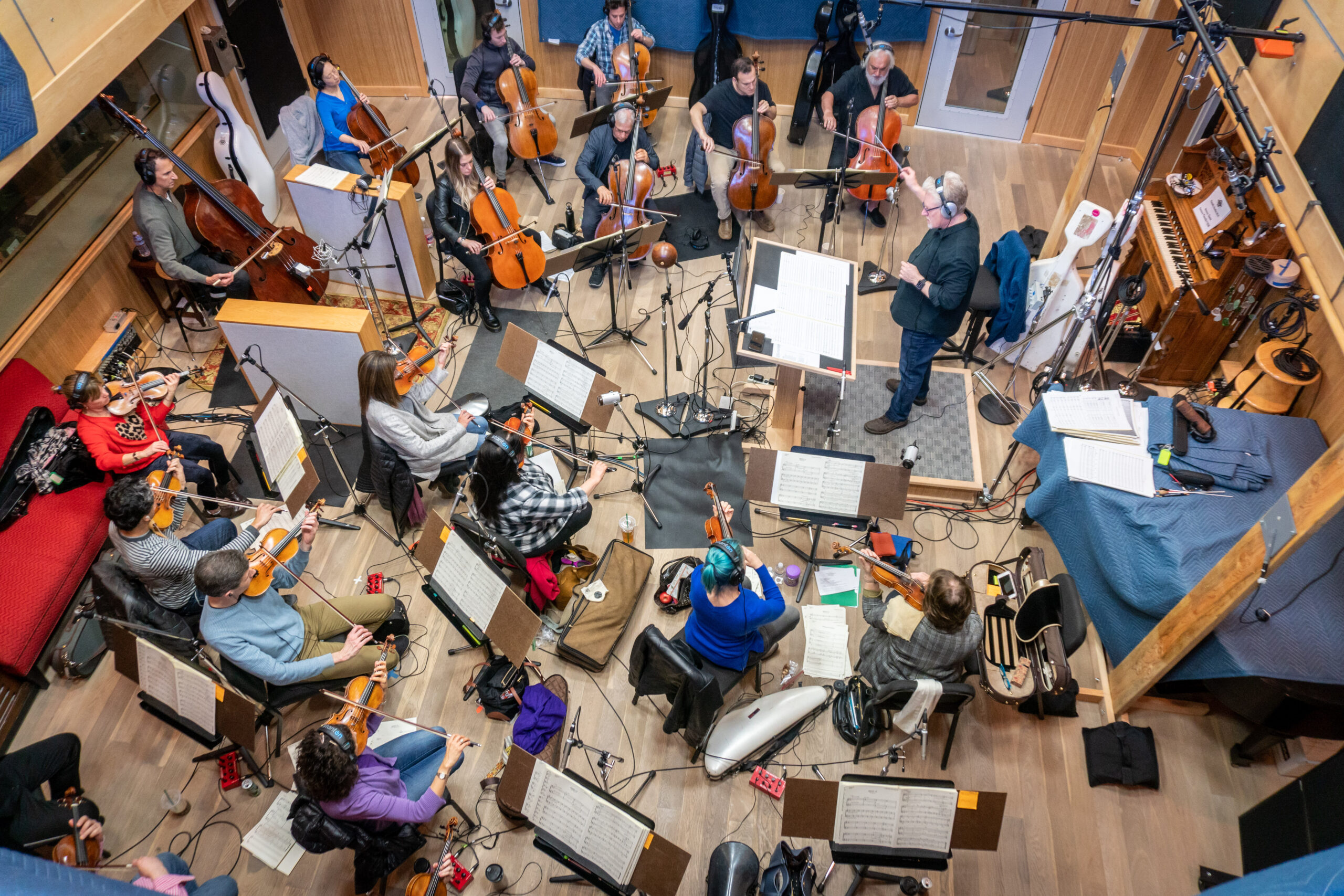
Early in the film you’ll hear the sounds of Jay diving on the track “Monterey Canyon”. In this, the sounds of the ocean are coming together: these cello solos, glass instruments from Jonny Rogers, and choirs of antiphonal basses. Traditional symphonic instruments are mixed with some non-traditional elements, like microtonal violins bending up and down in the distance. I had the violins facing the back of the room, so they felt like they were in the deep, distant ocean, coming together to create the sound of the water. That was important to me: to create a sense of location and a real depth of field, from the intimate solo instruments all the way to the back of the scoring stage, which is where we placed those magical microtonal violins.

Your career has been distinguished by your sampled and electronic explorations. How did they play into “Whalefall,” and how did you balance them with the score’s growing symphonic nature?
Yes, I sampled quite a few instruments. A lot of the Johnny Rogers glass tones were recorded and then played back via samplers. And there are a lot of sub-basses, textures and electronic manipulation happening. In a few instances, I took the orchestra and detuned it electronically to create a more foreign, alien sound. Not quite as crazy as I went on the film “No One Will Save You,” but a similar idea. To me, that is the role of a modern composer: to harmonize the classic and the modern into something that feels both timeless and very aware of its time. That is how I sum up what I do. It’s a willingness to try new things and dip into modern tools, while not sacrificing what works in the classic symphonic sound that connects us to our audience in a timeless way.
Talk about your use of voices, and what you wanted them to represent.
Yes, from the beginning. That was actually one of the earliest ideas I had after reading the book: I wanted to use male voices. And like many early ideas, it’s a good clue, but it doesn’t quite work out. I first played Brian some music with male voices on set, on headphones, and he looked at me and said, “I’m not sure this is the sound of the film.” First of all, the set was really intense and difficult. It was a miracle I was able to get some of his time. It was an intense shoot, and I was honored to be there and experience it. But that moment also got me thinking that the male voices were a little too direct.
It wasn’t until I tried female voices that something magical happened. The female voices became almost a counterbalance to this very masculine story of Mitt and Jay. They were like a Greek chorus commenting on the action we were seeing. So, you’ll hear the choir, especially the female wordless choir, throughout the film in moments where something special, something turning, something of deep change is happening on screen. These inflection points: keep an ear out for that. It became a special part of the film. Between that and the willingness to be classic, those sounds unlocked the nature of the score for me.

How did you want to musically bring the tormented relationship between Jay and Mitt down to earth, while also reflecting the tenderness beneath his gruff exterior?
It was a conscious decision not to have the music between Jay and Mitt be gruff. There’s already a lot of gruffness there. But one of the things Jay is trying to make peace with is knowing that his dad loved him deeply, and he loved his dad deeply, but they were never able to express it properly while Mitt was alive. So my goal musically was to bring a sense of that warmth to the screen, even though we might not see it directly on screen. I also thought a lot about my own dad. My dad was very much like Mitt: a bit of a hard-ass, and it was hard for him to express his pride in me and his love for me. I had to make peace with that after he passed, as well. So this score was incredibly personal to me. While there’s nothing I could point to as a direct one-for-one between Mitt and my dad, it was definitely something I thought about a lot, and it became part of the composing experience.
Of course, a big silent character is the whale itself, who more than likely realizes it’s unintentionally swallowed Jay. How did you want to convey its speed, weight and intelligence?
My goodness. There was already so much happening on screen that there wasn’t much I could do, other than in the track “Consumed.” There, I leaned into the brass, the basses, and the cellos to give it weight. I recorded and mixed those right up front, along with percussion and timpani. You’ll hear this machine-like percussion chewing up the orchestra. That was the analogy: I wanted to make clear that even though the whale is organic in nature, there’s this almost mechanical drive. These whales are so big and need to consume so many calories a day just to survive, they become eating machines. Jay just happens to get caught up in the whale’s mouth with a giant squid.
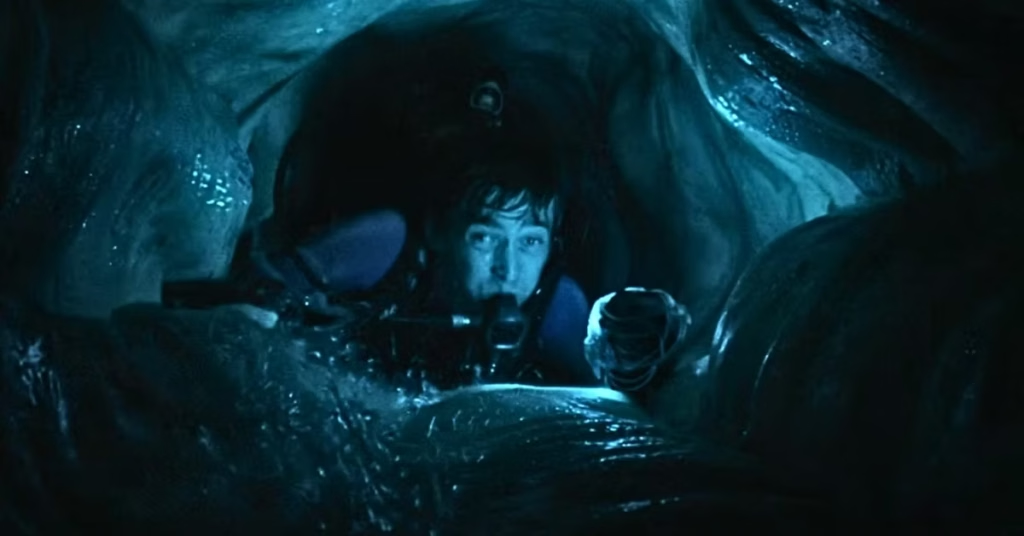
Once Jay is inside the whale, there’s an almost mystical bond between them. Tell us about capturing that.
That is those microtonal violins and those glass textures. There’s even a bit of a synthesizer called the Osmose in there. I love this synthesizer because it uses something called MIDI Polyphonic Expression, where each note can have its own shape. As you press on the keys, you can move your thumb or your pinky or your index finger a certain way, and the pitch will bend microtonally. You’ll hear some of those bendy synthesized sounds merging with the microtonal violins in a special way. That, to me, represents the mysticism of nature. The piano is stepped; each note is fixed in place in the pitch spectrum. To get to that mystic place, I used these violins, these synthesizers and this glass, which don’t necessarily have a fixed pitch.
There’s a truly uncomfortable “yuck” and “squishy” factor to Jay dealing with muscles and digestive juices, not to mention a decaying giant squid, yet with a sense of surreal innards discovery. How did you want to get that across?
My goodness, I try not to think about that too much, because I’d probably get sick myself if I thought about it the whole time! I was thinking more about the emotional headspace Jay was in and his desperation to get out, and not much about the disgust.

“Whalefall” also must be one of the most muffled-scream, cry-of-anguish-filled movies I’ve heard. Did that make it difficult to play around Jay’s predicament?
Honestly, this was one of the most rewarding sonic experiences I’ve had, because Brian values sound from the beginning. Not just music: he’s talking to the sound designers early on. So, I had a lot of meetings with Chris Terhune, Will Files and their team, just to understand what they were doing. We’d be in the editorial space together with Brian and our editor, Pietro Scalia. Where we ultimately got to be a symphonic landscape of music and sound. That is due to Brian Duffield knowing what he wanted and knowing how to direct us to steer around each other and make space for each other. That was really important. And luckily, the dub stage was literally a five-minute walk from my studio. I was there all the time, hanging out with the team and seeing what they were up to, so I could translate that into my world. I’m proud of that collaborative spirit.
How did you want to get across the ticking-clock element that Jay’s got to deal with, as well as the descending and ascending ocean pressure?
At the risk of sounding like a simpleton, there are literally clocks. There are these rhythmic elements, col legno figures, continuous quarter notes giving you that ticking-clock feel. The mission theme has quite a bit of ticking-clock rhythm to it, and you’ll hear the mission motif’s triplets playing against them. So, you hear a ticking clock, tick, tick, tick, along with the counterpoint of Jay’s struggle, the desperate angst he has to get out of the whale.
As for ascending and descending with the whale: my goodness, again at the risk of sounding overly programmatic, when he’s descending you hear descending chromatic scales. I have a great video on my Instagram of the string orchestra playing that track. It was really special. And as he’s being lifted up by the sperm whale pod, there’s a simple ascending scale harmonized by the brass, with melodic horns and cellos sitting on top of it. It kind of summarizes how I approach film scoring: I like to use simple gestures and simple ideas to get to a profound place of deep, universal, and profound human emotion.

In that respect, how did you want to play the emotional maturation of Jay in the whale, not to mention his growing MacGyver skills?
You’ll hear that in the third act as he begins to talk to his dad. The sound of the human voice comes to the forefront as a key component of the score in a way that we haven’t heard earlier. There is an intimacy and delicacy in that music. Jay had to realize that he can’t fight the whale; he must work with it and harmonize with nature. So the music becomes more direct and lyrical. There is also the return of the more percussive elements and ticking clock of the score alongside that emotional mission motif. The orchestra and rhythmic elements begin to synchronize in a way we haven’t heard before; the music literally represents the renewed focus and revelations of Jay’s experience.
I was really impressed with the ultimately fatal orca attack and the fellow sperm whale rescue. Tell us about scoring that sequence, and the whale’s transcendent voyage to the surface afterwards.
I’m so glad you picked up on that. It was such an important part of the film to me. Scoring that sequence was incredibly difficult. Not because of anything musical, but because of the mind space Jay and Mitt are in, and the profundity of that. Especially for me, as a fairly new dad. Holding your baby and telling them you love them, knowing you can’t be perfect, and that you’re going to do your best to give them the tools they need to contribute in life. How do you deal with that? I honestly don’t know! The only thing I could do was break the music down into the simplest elements: ascending major scales, harmonized with some of the chords we’re using in the film. But it’s leaning into that emotion and letting that carry you forward. I try to not think about it too hard. My goal as a composer is, yes, to be smart about things and come up with interesting tools and methods to get places, but then to enter a flow state where I can meditate on that feeling and get somewhere profound. I’m honored that you picked up on that.

Talk about scoring the climax of Jay finally figuring out how to get out of the whale, as intercut with him coming to terms with the relationship with his father.
Another difficult sequence! I leaned hard on Pietro Scalia, our editor, as well as Brian Duffield, to help walk me through that sequence and map it out. I even spoke quite a bit with Steve Asbell, head of 20th Century Studios, who was involved in talking to us about the end of the movie. That was a collaborative experience: finding the right energy, the right balance of emotion, and the right points to hold back and where to push.
It’s such a beautiful sequence, not because of anything I did, but because of the collaboration involved in getting there. There’s such tremendous power in things coming together in time and space to create a moment like that, and I can only take credit for so much. So much of it came from true collaboration between the filmmakers, and from leaning on them to help me understand how to score the scene. I’m sure Austin [Abrams] would say the same thing. He was stuck in that whale bladder day after day after day. Those days kind of blend together, much like they do when you’re composing, and you lean on the filmmakers to help you navigate the arc of the film. I’m really proud of what we achieved there.

Do you think this movie will make people scared of whales, let alone diving, or even going to the beach?
No, I don’t think so. We often talked about how this film is the opposite of “Jaws.” We’re not trying to make you scared of the whale; we’re trying to make you fall in love with the magic of whales. There’s something about the whale that represents the timelessness of life: life passing through generations of these giant beings, full of wisdom, perhaps. I hope it makes people more curious about whales, and more curious about themselves and their legacy.
Regardless of what kind of family you have, “Whalefall” will leave people thinking about the emotions you inherit from your family, as well as what you’ll leave behind after you’re long gone. I love to think of this movie as equal parts popcorn and equal parts universal human emotional story. That, to me, is where the score lives, and it’s the most ideal form of filmmaking: we go to the theater for a great time, and we leave feeling changed somehow, thinking about ourselves and our families in a new way.

See “Whalefall” in theaters, with Joseph Trapanese’s score on Hollywood Records HERE. Visit Joseph Trapanese’s website HERE
Special thanks to Rebekah Alperin at Costa Communications
Leave a Reply