

As a devilishly sly meta making of slasher film, “Faces of Death” shoots, stabs and hacks the hand that feeds, and scores it on any number of levels. Based on the infamous video nasty of 1978 that purported to show real carnage from executions to mass shootings and the culinary delights of live monkey brains. That only one small scoop ended up being appallingly real as opposed to being then-convincingly staged was no matter to the the legions that back in the day proved their stomach churning courage with this VHS initation. Though that carnage is now positively demure when compared with what kids can find on the stroll through the web, a cineaste maniac Arthur (Dacre Montgomery) decides to up the ante by doing a bloodily slavish remake of FOD for real. But his shooting schedule, done for the delight of internet voyeurs, is threatened by dogged pursuit of the Nancy Drew-ish heroine Margot (Barbie Ferreira), a cat and mouse game that ultimately places her in a dead-on set from hell.
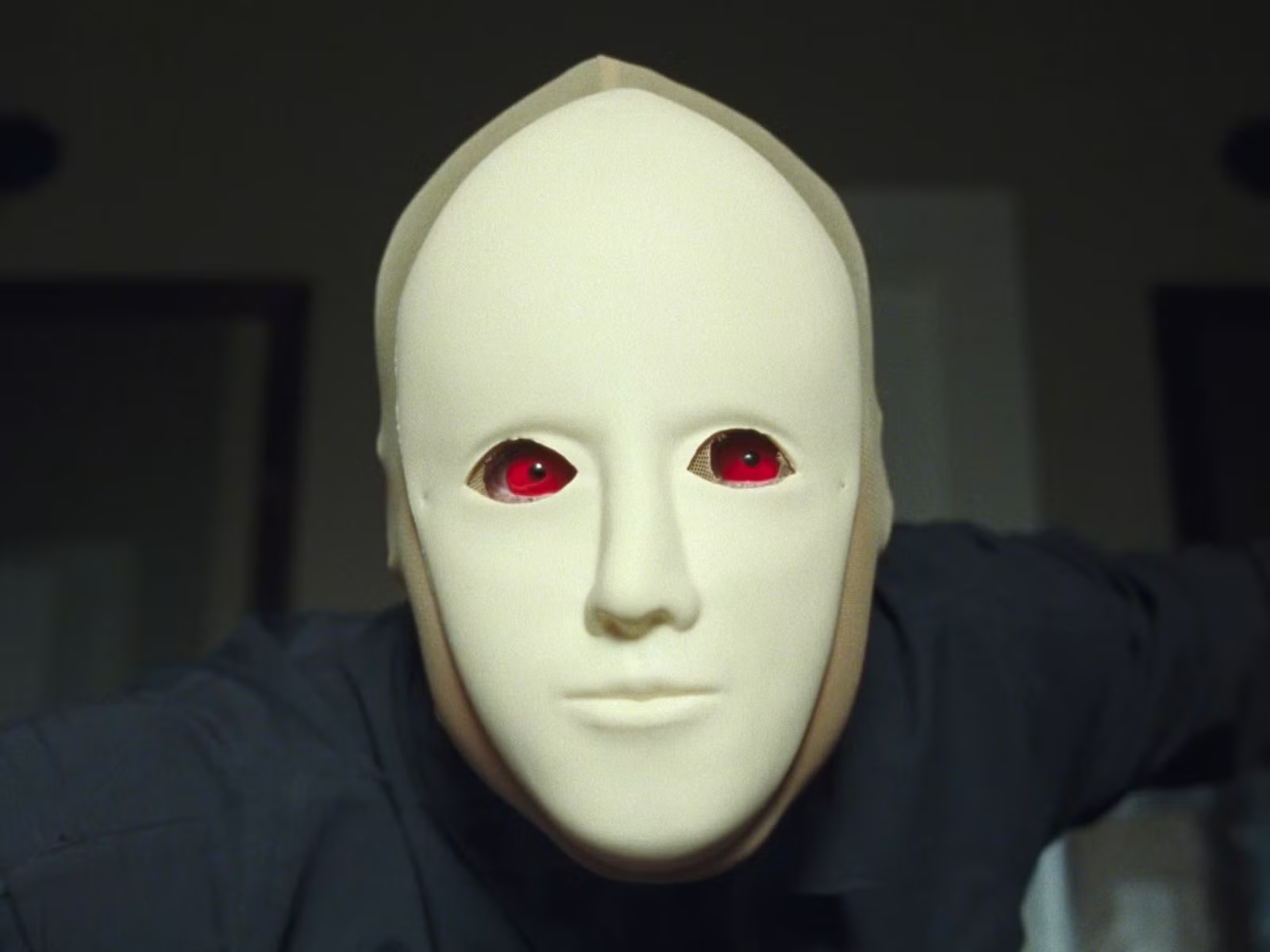
Conjured by the team of on and off-camera writer Isa Mazzei and writer-director Daniel Goldhaber, “Faces of Death” continues their theme of morality plays alongside composer Gavin Brivik, whose music otherwise accompanies the equally sanguine, but more healthfully minded hit show “The Pitt.” Starting with the Kafka-esque Camgirl tale of “Cam” for the couple and then segueing to activists plotting “How to Blow Up a Pipeline,” “Faces of Death” returns to the pitfalls of an all-seeing audience, even as Bivrick’s experimentation gets pushed to the next, unnerving level. Capturing a pulsating 80’s Tangerine Dream vibe for “Pipline,” “Faces of Death” (now on Lakeshore Records) nails that decade’s music again, this time targeting an electronic slasher vibe. Images of white-masked killers come to mind in John Carpenter-esque electronic rhythms, with the added organic meet of violin, sax, guitar and the gleeful sampling of mutilated VHS tape. But where the genre that Brivik is feasting on would be sure to sting the kills, this “Faces of Death” doesn’t so much play the action as it does a twisted atmosphere caught between melody and dissonance, leaving the murders and internet searches to become a pulsating state of undone mind. It’s the equivalent of the eerie hypnotic beauty that keeps an eager audience glued to the computer and iPhone screens, the sounds of computer zapping brain cells as it shifts from one appalling image to the next. But like the film, Brivik’s approach is fiendishly smart in its subversion, and infernally thrilling in the composer’s experimentation at creating the suspenseful sound of a youthful hive mind energized by the next unholy thrill kill.

What was your attraction to electronic music, and how did you want to use it as a composer?
I think electronic music has so many sounds people have never heard before. The potential for experimentation is limitless. I am always searching for material that surprises people. The sad truth is that the orchestra and traditional acoustic music has been so thoroughly explored. The avant-garde composers of the mid-late 20th Century really pushed all the bounds the ensemble can play, and I think processing acoustic instruments through computers became a natural next step. I say all of this, but the truth is I still really love writing for orchestra, and I want to get an orchestral scoring job one day!
You first dealt with the disturbing effects of the web and AI in the documentary “Deepfaking Sam Altman.” In a way, do you think that set you up for some of the themes in “Faces of Death?”
I actually worked on “Faces of Death” years before that film. We started scoring “Faces of Death” in 2022-2023. It only came out recently. I think it was the opposite and it’s only become more relevant with time. But it definitely seems like I have a consistent theme in my work about the dystopian future. I think there’s also a relationship between these two movies and the first film Daniel did, “Cam, “which deals a lot with online identity.
As a social media user, did you find yourself drawn to shock videos? And did you feel “guilty” because of that, or just desensitized?
I don’t feel drawn to that content at all actually, but sadly I have seen so many insane videos that I am very desensitized. I mean, almost everybody has seen assassinations, police brutality, genocide, car crashes and fight clips. It’s beyond desensitizing at this point, and we are becoming numb. I think we should all feel a bit guilty with how far we’ve gone down this rabbit hole. We all have seen many videos like this and we all have admittedly watched content out of morbid curiosity. With all that being said, I really am not the one to seek it out. But if it’s presented to me, I do find myself watching the train wreck.

When Daniel came to you with his unique revamp of “Faces of Death” after “How to Blow Up a Pipeline,” what was your reaction?
Fuck yeah! I immediately went on eBay and bought the original VHS. Though I wasn’t extremely familiar with the original movie, I definitely was familiar with clips I had seen on YouTube. After I purchased the original VHS tape, I did watch the entire movie and felt a bit queasy after finishing it. I truthfully didn’t realize it was all staged on the first watch. Some of that stuff really holds up.
Did you find it laughable, or disturbing?
I mean it’s horrible as a movie and content wise. I found some great inspiration in the original score. There was a lot of unique orchestration and weird melodic writing. I gave some winks to it in our score. for example, there was a motif in the original score that almost sounded like children playing the violin out of tune. I wanted to imitate this technique, and forced my friend Jordan, who is an absurdly, talented violinist, to play as if she was just learning again. It was funny and she did a great job.
Beyond that, did you do a deep dive into the nether realms of social media before scoring this?
I definitely got into the darker side of tiktok, and the funny content there for research. That’s where I explored the internet culture music of hyperpop. It really came from both sides of the tiktok world of extreme distorted and aggressive electronic music, to funny samples and cute clips. I do try to steer away from this part of our world because I am already struggling with my attention and I find that the deeper I go down this realm, the worse my brain rot becomes.

What did you and Daniel want the score to accomplish?
We wanted to make the score sound as if it were playing on a very worn, and broken VHS tape. What does it sound like if that tape is playing fast forward, or at times reversed? We kept imagining the score wearing the tape down as the movie got more and more disturbing. The other half of the score lives in the modern internet culture of sampled music. The main character is a content moderator and is constantly scrolling through the deepest and darkest pockets of the internet. That’s where the Moment sample packs and hyperpop inspired us. I loved using these samples to cut between sharp transitions and play into the humor and horror of the film. The very fast tempos of hyperpop felt aligned with the idea of a destroyed tape playing in fast forward. It felt like a nice marriage of genres and sounds.

Where “How to Blow Up a Pipeline” drew from an 80s-90s Tangerine Dream vibe, this very much captures a retro 80s slasher groove. How did you want to tap into that synth energy in a way that would also be current, and what kind of gear did you use?
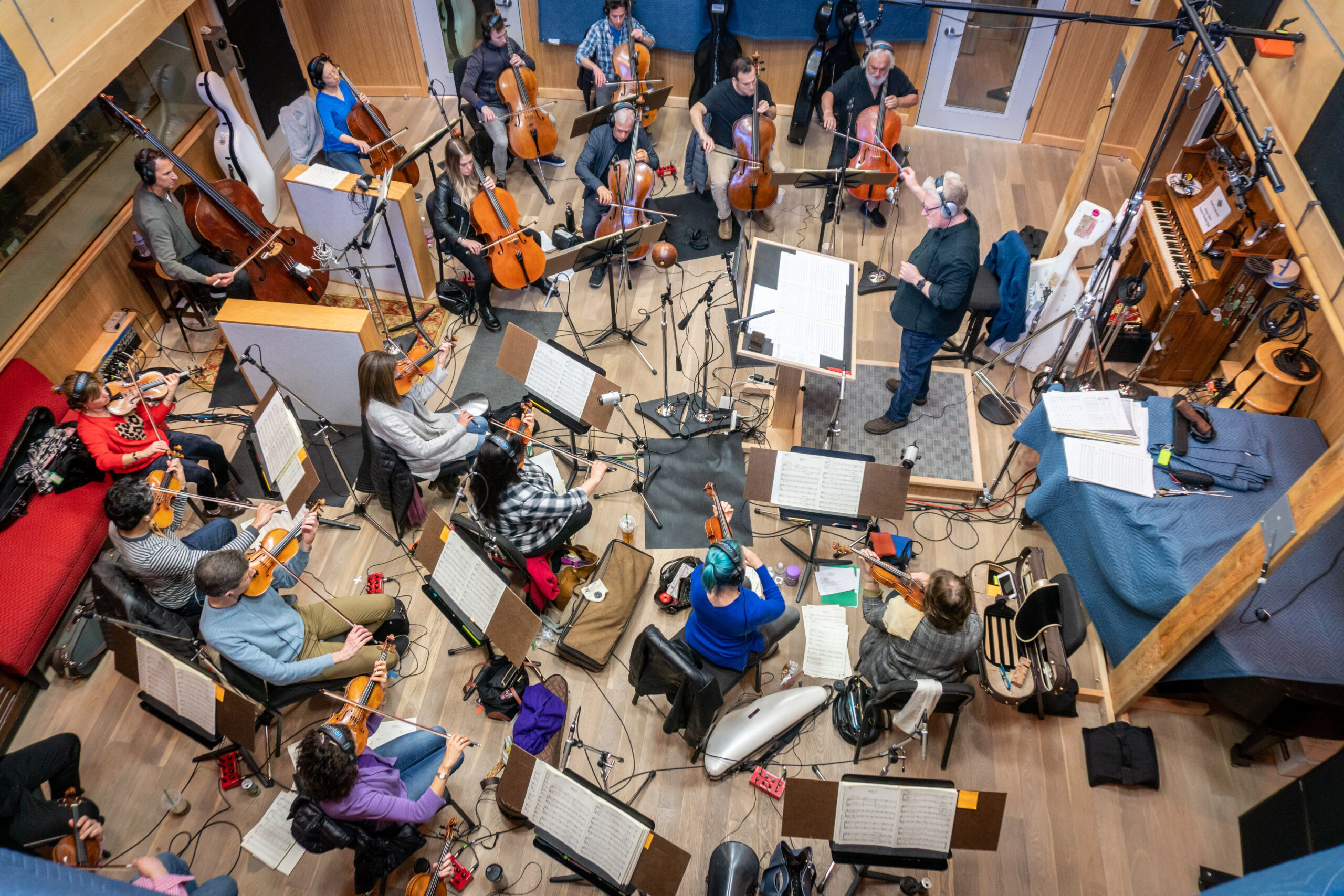
I think combining the 80s synths with modern hyperpop samples was the perfect choice for this movie. I used a lot of samples from the Splice Moment Loop packs, which feature some of the most experimental producers working today. And to contrast the electronic nature of the score and ground it in the dark world of the original movie, we brought these eerie high violins in the score alongside processed and very experimental saxophone textures. Nick Zoulek, the saxophonist would process and pitch his horn layers to make them sound otherworldly. For the late 70s and 80s synths, I used the Korg M1, Prophet 5 and 6, and emulations of the CS-80. We also ran so many of the tracks through worn cassette tapes, and VHS processing plug-ins.
What organic elements and sampling went into the score? And what were those explorations like?
We smashed VHS tapes, took apart cassettes and wrapped the VHS tape across the instrumentalists’ fingers while playing, and used contact mics to pick up the vibrations. I also would use the VHS tape for percussive sounds like putting in and out of the tape deck, or rewinding the tape and fast forwarding the sounds. If you go onto my TikTok page, you’ll see that I uploaded mini behind-the-scenes videos of how I created these sounds. I included the clips of the original sample sound and then I also attached the post processed version of that sound. I wanted to show how these found sounds made their way into the score. It’s hard to describe over text and that’s why I thought the TikTok videos helped demonstrate the techniques.

Did you want to get across a sense of hypnosis in the score to reflect audiences who can’t break away from this stuff, or dive right into it like the killer’s audience?
Yes, it’s definitely a very hypnotic and trance inducing score. I think this mostly reflects Arthur’s mindset, where he is captivated by his prey. In the first act there is a scene where Arthur is locking into Sammie’s kino videos, and I wanted to capture the addictive and hypnotic effect scrolling through videos has on a person. One of the ways I did this, was the use of cyclical arpeggios. I wanted the music to feel as if the audience was spiraling down the darkest part of the internet.
In that way, how does the music get across the methodical quality in how the killer uses technology and media savvy to stage the murders?
I think the very propulsive and techno rhythms give a sense of purpose to Arthur’s kills. I see the killer more in a light of seeking online fame and trying to do artistic work. It’s a slightly different quality to some serial killers, especially in the age of the internet fame. I know it’s a bit on the nose, but using electronic instruments and very processed sampled sounds helped us feel the Internet themes in the film.

Did you create your own backstory to the killer here?
I didn’t really but I took inspiration from his staged “Faces of Death” scenes. I honestly think we can all put our spin on what drove Arthur to this life, and I focused more on his motivation for internet fame. Even the actor didn’t create a very detailed backstory for his character. In a few interviews, he cited a more general approach to the character. Pulling From, many examples in history of the sociopathic behavior of young men and serial killers.
Many O.G. slashers are essentially Agathe Christie mysteries, and “Faces of Death” is much more of a detective story than others. Talk about getting across that investigative quality.
I can’t deny that I was inspired by David Fincher movies. Instead of going too far into jump scares, I leaned on the sense of dread in this score. I think dread is scarier than quick jump scares, and has a more lasting effect on the audience. A lot of my favorite films, lean more into the investigation and backstory of the horror rather than the slasher jump scares. I find that the story really creates the fear for me, so I have always gravitated towards films that explore that.
Where other horror scores might play attacks, stabs and shooting, your approach is way more environmental in a way that nightmarishly washes over the film. Talk about setting that tone that doesn’t “hit” the kills in a traditional way.
We played a lot with tempo in the score, and slowly speeding and slowing the score to make it sound as if the VHS was worn and disintegrating. For example, there are moments where the drums are speeding up slowly, and the synths are pitching down and slowing in speed. It really creates a nauseous feeling that is more like a bad trip than a typical slasher score. I also really love using noise music as a source of inspiration. I’ve always felt that the music that creates tone and ominous textures, frightens me more than jarring, drum hits and pointillistic music. While I appreciate both techniques, the more textural and drone-based atmosphere worked for this film.

Margot isn’t your typical “final girl” in that she herself has made a horrific mistake, and screws up in her in investigation in a way that costs people their lives. How was it to play a more interesting, go-getter heroine than what we usually get in the genre?
I think we used this main theme for Margot that encompasses this attitude she has. We used a much more melodic score than our previous collaborations. When you watch the film, you’ll first hear this main theme as Margot leaves the office and walks back to her apartment. It’s impossible to deny our inspiration from the John Carpenter films. When you hear some of those melodies in those 80s films, you’re immediately transported into that characters’ mindsets in the tone of the film. The theme that we used for Margot recurs throughout the entire movie and we played it in various instruments to try and achieve that feeling. I hope people recognized the melody when it came back a few times in the score.
Tell is about the end credit “song” “Ur Mad”
The end credit song is called “Ur mad” and it was a collaboration between Cecile Belive and me. We worked so hard to bring the sounds of the score, and the sounds of the original movie into this song. We wanted this song to feel like it was playing in fast forward off a worn VHS, similar to our concept of the score. Cecile is best known for her work with the artist SOPHIE, so I felt extremely grateful to collab with her. When you listen to the song, you’ll hear how distorted and manipulated her vocals are. We weren’t as concerned about the clarity of the lyrics and focused a lot more on the melodic rhythms and notes. Again, we really wanted this to feel as if it the song was speeding up on a tape in fast-forward. We knew that we would lose some clarity by doing this.

“How to Blow Up a Pipeline” is about a group of young adults who are determined, better and worse, to try and change the world. “Faces” is about a generation of kids sitting around and absorbing toxic imagery, or having no interest in anything beyond than beyond pushing their social media brand. Did that contrast between the two films strike you, and how do you think it’s reflected in their scores?
I think the biggest contrast is the genres of these movies. “Pipeline” is a lot more like a William Friedkin film, while “Faces of Death” is a lot closer to a David Fincher film. “Faces” is an investigation and a cat and mouse thriller. “Pipeline” is a lot more of a heist film and I think the film score roles are both reflective of those narrative arcs. I love that there is a level of continuity between the two films, which is mostly the synth-based approach in the score. But when you think about the two composers who worked on both of those movies, Tangerine Dream and Trent Reznor and Atticus Ross, they definitely is a relationship between them as well. I just think at the end of the day a lot of my inspirations have those unconventional approaches to music and heavily feature synthesizers.
Did you ever find yourself getting disturbed scoring “Faces of Death,” and how did you deal with your own mental health during the process?
I was greatly disturbed by the content in “Faces of Death” and the process of making the film was also very stressful. To cope with all the stress I got very into ice baths and a lot of meditation. I remember for one of the cues I worked on there was over 67 revisions and rewrites….

Have you been surprised by the good reviews that “Faces of Death” has gotten, especially from reviewers who might not otherwise go for the genre? And what do you think that says about the uniquely smart road this “sequel” has taken?
I’m extremely surprised and also very grateful. We worked on this movie three years ago. I felt like there was a lot of doubt behind the film and we even started doubting our own work. But with the fan and critical response it’s really warmed our hearts and made us feel like all the pain was worth it. I’m still touched by the many fans who have reached out to me through social media and I’m just over the moon that the film is finally out in the world. There was a moment where I thought this movie may never come out and I was working through my own sadness that came with losing the work.

In a whole other gory way, you’ve been scoring the hit medical series “The Pitt.” Tell us about that experience.
“The Pitt” is an extremely different experience and the music and approach to my work is very subtle. The show really doesn’t need a heavy-handed score in my initial pitch to the team was “What does it sound like if the score is being played off the medical equipment in the ER.“ So the music is subtle and sounds like pulsing medical machine equipment with synth drones that are almost unnoticeable to the average listener. I really want people to feel immersed in the ER and not be distracted or led by music. The majority of people who watched “The Pitt” are completely unaware that there’s any score during the series. That really comes down to the stylistic approach of the showrunners and could not be more different than the approach. Daniel has in his movies. Daniel at times does not care about the dialogue and is willing to push the music so loud that we hear it over the sound effects.
“Faces of Death” is a perfect example of a film that bites and licks the hand that feeds it in satirizing and exploiting toxic media. Do you think that’s the biggest “meta” aspect of it?
Absolutely one of the biggest aspects along with the idea of internet fame, sequels and deciphering fact from fiction online. We live in a time where videos are being created by computers and are becoming more realistic every day. I think we are going to struggle as a society to decipher reality.

Gavin Bivrick and band perform “Faces of Death” live at the Silverlake Lounge
What do you think the chances are of the film “inspiring” young audiences in the wrong way? Or do you think they’re smart enough to get the point?
I don’t think the film is going to inspire anybody new, it’s already happening. The film is more of a mirror than leading anybody to a specific action. I find this is the case with the most films and this was a similar thought with “How to Blow Up a Pipeline.” At the end of the day, the people who take these radical actions have been pondering them than our film has been out. But who knows? Watch somebody be inspired prove me wrong.

In a way, do you think you’ve been scoring where society is heading? And does that scare you?
I am terrified everyday and it only gets more and more real. If you’re not scared, you’re not paying attention. Every day we all wake up to the most absurd headlines, and the current administration is basically sticking a middle finger to all of us thinking that we’re just morons. I think both “Faces of Death” and “How to Blow Up a Pipeline” show two different sides to where our society is heading. While “How to Blow Up a “Pipeline” deals with the existential climate crisis, “Faces of Death” deals a lot more with fact vs fiction in online culture. The idea that Internet fame is more valuable than anything else and the lengths that a person will go to to become famous online has never been more heightened. We have people running through the Scientology building in Los Angeles, which admittedly is super funny and I have engaged in those videos. But on the other extreme, we have pranksters injecting strangers with syringes. It’s a scary time and I think the fame that comes with the Internet has driven people to do things they never would’ve otherwise.

Watch “Faces of Death” on streaming HERE, and buy Gavin Brivik’s score on Lakeshore Records HERE. Visit Gavin’s website HERE
Special thanks to Jana Davidoff and Alix Becq-Weinstein at Rhapsody PR and Kurt Nishimua at Silverlake Media