

With female body horror the new shape of movie rage, “Slanted” takes that cascading flesh and growing madness in an unexpected direction, here in the even more terrifying realm of being a teenager with dreams of fitting their form into impossible convolutions. Written and directed by Chinese-Australian Amy Wang (“The Birch”), this distinctly American-set moral fable has Joan Huang (Shirley Chen) setting her entire existence on transforming into a white Prom Queen dream – anything but going with the flow of the immigrant parents (Vivian Wu, Fang Du) that she’s beyond embarrassed by. The solution is Ethnos Inc., a beyond polite ultra-spa company who happily will transform any ethnic person into The Man. But as all Faustian bargains prove in the movies, things begin to go wrong just as the prize comes within reach for New You gorgeous blonde Jo Hunt (McKenna Grace), all as her aghast parents can only wonder what’s become of their daughter in both body and soul.

Way more in the moralistic tradition of a very ironic ABC Afterschool Special than “The Substance,” “Slanted’s” satire is given gravity by the unusual empathy given to Joan / Jo, whose emotional payoff is every bit as moving as her gradually unfolding flesh for the time-honored realization that the best fit is being yourself, even as ethnicity is viewed as monstrous in Trump’s America. Playing Joan’s bell-and-voice dream state as much as the vanilla sterility of the in crowd she beyond desperately wants to melt into is the crafty, hypnotic score by Wang’s fellow Chinese-Australian Shirley Song. Immigrating from Sydney to work with such composers as Mychael and Jeff Danna, the aptly named Song’s gift for effervescent melody, as gradually twisted as it is here, has seen her take on God watching over “Exploding Kittens,” romance in “The Princess Switch 3,” “The Tourists Guide to Love,” “Five Blind Dates” and co-composing with Jina Hyojin An for the tween matchmaker of Netflix’s ongoing series “XO, Kitty.”
Where most scoring for “Slanted’s” type might take the equally effective paths of dissonance or berserk electronica, Song’s high school worldview of “Slanted” uses a thematically hypnotic, percussive approach for a girl seeing her enchantment turn into a very bad dream by getting exactly what she wants, all along with perky high school clique rhythm. It’s surreal scoring at once lullaby, color-changing anesthesia and a ticking clock to prom night that accomplishes the no mean girls feat of being surreal and enjoyably melodic in its alt. approach. For a girl determined to change her identity to find impossible acceptance, “Slanted” marks Shirley Song as an individualistic, ironically experimental composer in her own right for Amy Wang’s potent ethnic, and universal fable of fitting in.

Tell us what led you to composing? And what scores / composers did you particularly likes?
I started playing piano when I was six,and grew up in Sydney attending a school with an incredible music program where I was able to take one-on-one composition lessons. My high school composition teacher, James Humberstone, was actually the one who encouraged me to apply to the Sydney Conservatorium of Music and pursue composition seriously. But storytelling was always just as present in my life as music. My maternal grandparents were professional theatre directors, actors, and playwrights, so I started acting around the same time I started piano. Being around rehearsals, scripts, and performances from such a young age really shaped how I think about music. My favorite composers range from Beethoven, Chopin, to Bartok, Stravinsky and Shostakovich. When I later discovered film scores, it felt like the perfect intersection of those worlds. I grew up loving composers like John Williams and James Horner. Their scores like “Jurassic Park” and “A Beautiful Mind” had such a profound emotional impact on me!
How was it for you to move from Sydney to America?
I’m not going to lie. Moving from Sydney to the U.S. was both exciting and daunting. Sydney will always feel like home to me, but I knew that if I wanted to pursue film scoring seriously, being closer to the film and television industry was important. I continued my film scoring studies at Berklee College of Music, and that experience really helped ease the transition. When I eventually moved to Los Angeles, many of my friends and collaborators from Berklee were also making the move, so it already felt like a bit of a creative community.

Tell us about getting your start with composers Mychael and Jeff Danna on such projects as “The Addams Family” and “Onward.”
I learned a lot, I really did! Being able to be in the room and work with them on projects of that scale was incredibly valuable. Watching how they approach storytelling through music and seeing the full scoring process unfold taught me a lot.It really helped shape my confidence as a composer and gave me a much deeper understanding of how large-scale film scores come together.

What was it like scoring the Netflix cartoon “Exploding Kittens,” And do you think in a way scoring the teen matchmaking Netflix show “XO, Kitty” helped set you up for “Slanted?”
“Exploding Kittens” was such a fun and creatively wild project to work on! The show has such an absurd and irreverent sense of humor, so musically we had a lot of freedom to be playful and go big with the score. We leaned into dramatic orchestral moments but also experimented with unexpected sounds to match the show’s chaotic energy. “XO, Kitty” was a very different kind of project. That show really lives in the world of romance and coming-of-age, so the music sits in a more heartfelt and contemporary space. Honestly though, “XO, Kitty” didn’t really set me up for “Slanted.””Slanted” is tonally much darker and more satirical, and the musical approach for that film came from a completely different place creatively.
You and Amy are both from Sydney. Is that how you first met?
Actually… no! The funny thing is that we’re around the same age, graduated high school the same year, lived about ten minutes away from each other in Sydney, and even had mutual friends. But somehow we never met there, we only ended up meeting years later in Los Angeles at a house party.

“Slanted” writer-director Amy Wang
What was your reaction when you read the script for “Slanted?”
I related to it immediately! Reading the script brought up a lot of emotions and memories from growing up as an Australian born Chinese kid. I remember laughing, feeling angry at certain moments, and even tearing up. It was one of those scripts that really stays with you, and I knew right away it was a story I wanted to be part of.
What did Amy want your score to accomplish?
Amy really wanted the score to feel distinctive and unmistakably “Slanted.” It needed to have its own identity and feel unique to this world. The challenge was finding the right tone and themes, balancing the film’s humor and satire with its emotional moments and even its horror elements. We wanted the music to feel like it could only belong to this film.

Right from the start with your use of bells and female voices, there’s a dream-like quality to your score. In a way, does this both stand for the Huang’s American dream, as well as the childlike nature of Sofia that makes being The Prom Queen the be-all, end-all of her life?
Yes! The bells and female voices help create a slightly surreal atmosphere, which felt very appropriate for Joan’s world and the heightened way she sees America. At the same time, we also wanted the music to reflect her innocence, so we used bells and bowed candelabras to create a fragile, glass-like texture. Those sounds also speak to the sense of aspiration and fantasy in the film, an almost idealized version of what life could be. In that way, it connects both to the idea of the American dream and to the very intense, almost childlike importance Joan places on becoming Prom Queen.
On that note, do you think that ironic approach reflects the sterility of white society that Joan desperately wants to be a part of?
Absolutely, the opening of the film is much more dreamlike and pure because we’re really inside young Joan’s idealized vision of America when she first arrives. As the story progresses, the music starts to bend more. Notes and textures shift in ways that can feel slightly unstable and uncomfortable, reflecting the tension between Joan’s fantasy of belonging and the reality she’s experiencing.

How did you identify with Shirley, and did you ever have thoughts of transforming yourself for acceptance in white society – i.e. Hollywood?
I never really felt like I completely fit in, let’s put it that way. Growing up, I often felt like I was between two cultures and two worlds, but not fully belonging to either of them. So, in that sense, I definitely related to Joan – that feeling of wanting to belong, and wondering whether you need to change parts of yourself to be accepted, is something a lot of people who grow up between cultures can recognize.
Did you want the percussion in its way to hint at Joan’s Chinese identity?
I actually didn’t approach the percussion as a reference to Joan’s Chinese identity. Something Amy and I discussed early on was that we didn’t want the music to feel too on the nose culturally, because the story already explores that aspect very clearly. Instead, those sounds are really about tension and instability, reflecting what Joan is going through internally while also contributing to the slightly quirky, satirical tone of the score.

How did you want the score to link “Joan” and “Jo?”
Joan’s theme begins innocent, naïve and playful. There’s a lightness to it. Even as she grows into her teenage self, we use fun, bright synths. Once she becomes “Jo,” the music becomes much darker and more “nightmarish.’” However, we still bring back elements like the bells from Joan’s theme. Even as the music becomes more unsettling, those sounds remind us that underneath everything, she is still Joan.
Tell us about scoring the more surreal sequences in the film, and how did you wanted to get across that Joan’s treatment is falling apart? In that way, did you want the score to become progressively weirder?
Yes, definitely. As the film progresses, the score becomes progressively weirder. We added more scratches, more scraping textures, more bends, more warping and more dissonance. The music starts to feel increasingly distorted and uncomfortable, mirroring what Joan is going through both physically and psychologically.

What’s interesting is that Joan and Jo both remain sympathetic in spite of their mistakes, unlike other comedies, or horror movies that ask the protagonists to “pay” for wanting more from life. Was it important for the score to keep that sympathy with them?
That was definitely important to me. It’s tragic, because as teenagers, who didn’t make mistakes? It’s heartbreaking that this is how things ultimately turn out for her, so I wanted the music to reflect that as well. That’s also why vocals, bells and those fragile bowed textures were so important in the score. They add a sense of vulnerability, humanity and innocence, which helps us continue to feel sympathy for Joan even after everything she has gone through. At the end of the day, she’s still a young person trying to figure out who she is and where she belongs.

I was surprised by how moving, and poignant “Slanted” ends up being, particularly in Joan / Jo’s relationship with her Chinese parents. Was that the most important thing for you to score?
That relationship was definitely very important to me. It was so refreshing to see Amy Wang write loving Chinese parents, rather than the stereotypical “tiger mom.” The scenes between Joan and her parents are incredibly moving, and the performances are so raw and emotional that I wanted the music to support that honesty. In those moments, the score becomes warmer and more reflective. It swells, but I made sure the music remained simple, allowing the emotional weight of those relationships to really come through. At the same time, the film moves through so many different tones, from satire to horror, so the challenge was finding a musical language that could support all of those elements while still keeping Joan at the emotional center of the story.
What gear and sampling went into “Slanted?”
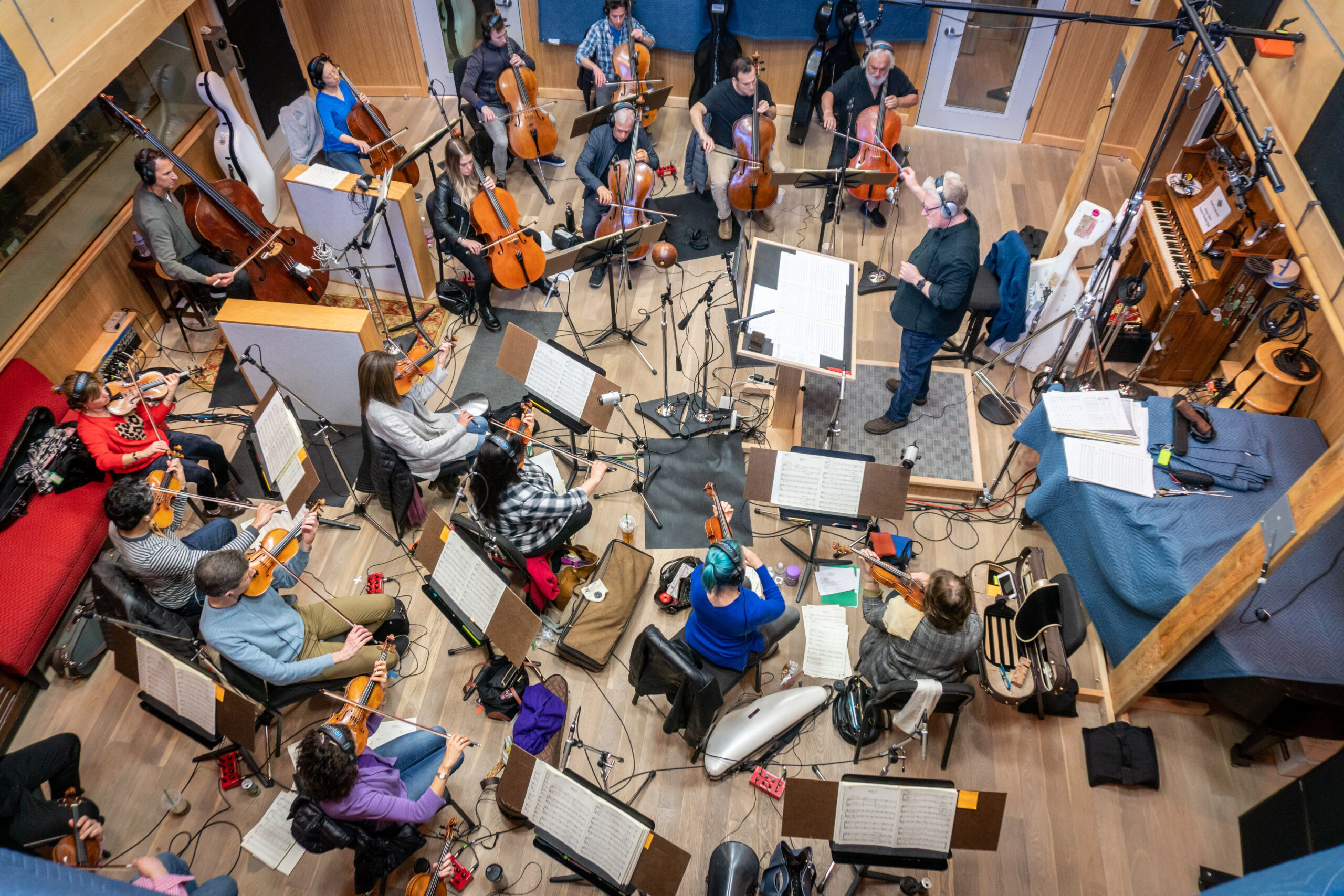
A huge shoutout to percussionist W. F. Quinn Smith. He owns a warehouse full of percussion instruments that he has invented, and I knew I needed to bring him in to record and layer a lot of the quirky percussion you hear in the score.We also did a lot of sampling, including scissor cutting, bells and scalpels on metal bowls…to add to the sterile quality of Ethnos.

It struck me what a tightrope that “Slanted” walks between its tones without falling into outright horror or satire by taking a more realistic, as such, approach to its set-up. Was that balancing act a challenge for you, particularly in not having the score hammer in a “moral” message?
In many ways, the music acts as an observer. It highlights the surrealism, the fantasy and the absurdity of the story, but hopefully without telling the audience too heavy-handedly how they should feel. Because the film walks such a delicate line between satire, horror and emotional drama, the challenge was allowing the music to support those tones without pushing the audience toward a specific moral judgement. It actually took quite a while to find the right tone for the score. From the moment I first read Amy’s script, to seeing stills, to finally watching footage and having many conversations with Amy, it was a process of gradually discovering the musical voice of the film.
Do you think with the explosion of Asian pop culture and its influence on high schoolers that Asian kids still have the same problem of feeling on the outside now – unlike that time that Joan entered public school?
I’m hopeful that Asian kids today feel more seen than when I was growing up. There is so much more Asian representation now in television, film and music, and that visibility can make a real difference! When I was younger, I really wished I had more stories and artists in mainstream Western media who looked like me. Seeing people who share your background reflected on screen can be incredibly powerful, especially when you’re trying to figure out where you belong.

Do you think the true breakthrough for any ethnic or minority composer is to be accepted on completely colorblind terms, or do you still see the “fitting in” theme of “Slanted” being a part of what some composers go through in terms of the subjects they get asked to score?
I think it’s probably a bit of both. Ideally, any composer should be able to work on a wide range of stories and be considered purely for their voice and their craft. At the same time, our backgrounds and lived experiences naturally shape the way we tell stories, and that perspective can be really valuable. That said, I do think our industry is changing and becoming more open, thanks to advocacy from organizations like the Composers Diversity Collective and the Alliance of Women Film Composers. In the end, I think the most exciting thing is when composers are trusted to tell all kinds of stories, not just the ones that reflect their own identity. After all, we are storytellers as well!
What’s ahead for you?
“XO, Kitty Season 3” will be coming out on Netflix on April 2nd! Other than that, I’m looking forward to heading back to Sydney, Australia in May, with my husband and our little one so that my family can finally meet him.

What effect would you like to see “Slanted” have on viewers, whether they’re Asian or white? And how do you think your scoring helps that?
At the end of the day, I think this story is about understanding and accepting yourself and learning to love who you are. We’ve all felt awkward at times, and we’ve all felt like outsiders. Regardless of race, it’s really about being kind to yourself. I hope the music helps support that emotional journey. Even through the satire and darker moments, the score tries to hold onto Joan’s humanity so that we can continue to empathize with her.
See “Slanted” in theaters, with Shirley Song’s soundtrack available on New Fox Music HERE. Visit Shirley’s website HERE
Leave a Reply