
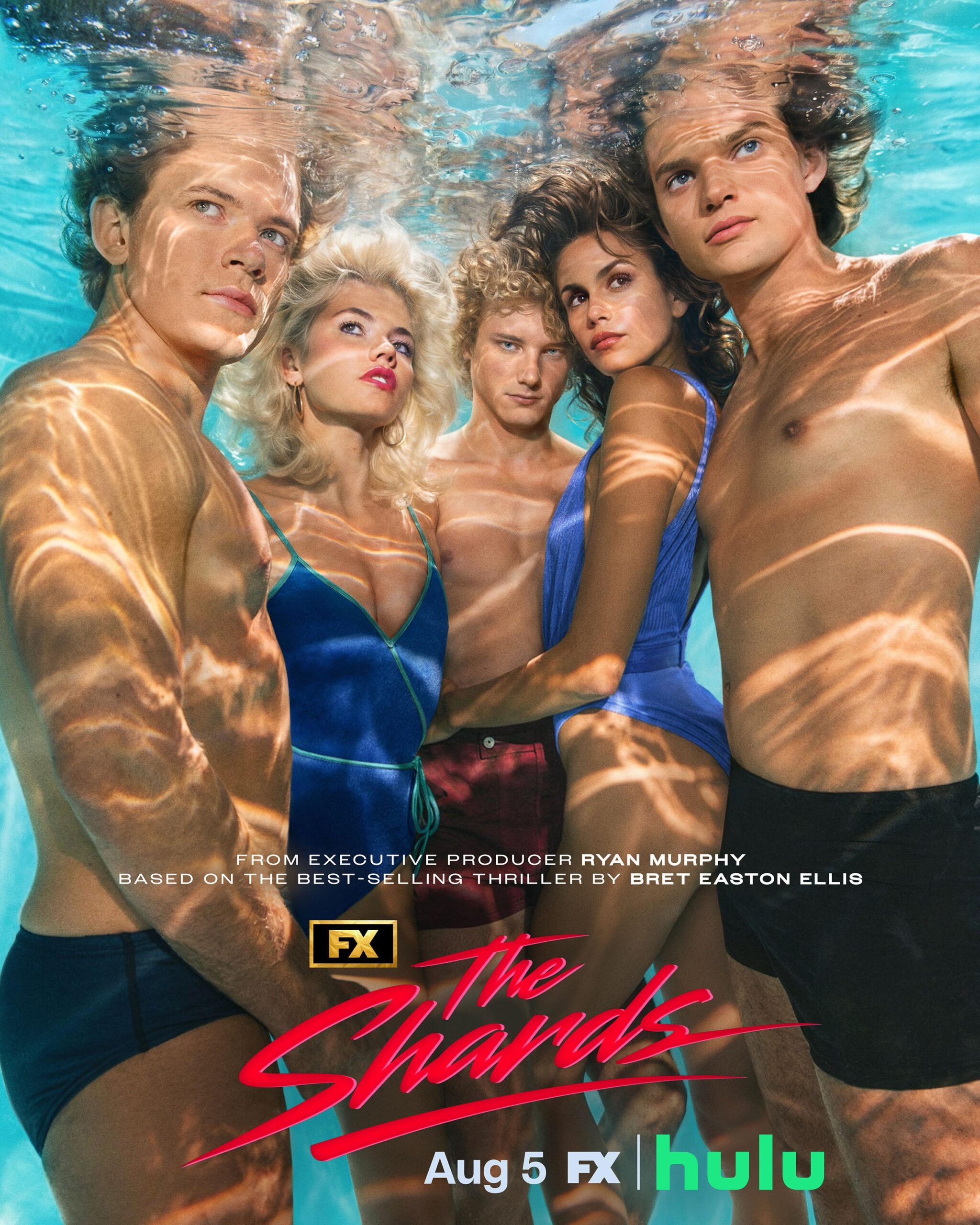

Everything is note-perfect when it comes to Ryan Murphy’s FX / Hulu adaptation of Bret Easton Elis’ 2023 circa 1981 novel “The Shards.” It’s a synergy of brands made in twisted ironic heaven for the prolific output of the mega producer and the meta poster boy of the era’s jaded Beverly Hills affluence – swimming in themes of rampant omnisexuality and spot on retro production value that give home to these gorgeous young things and their jaundiced attitudes. All reflect two artists made for each other, as exceptionally realized in “The Shards’” meta tale of a young author, his catty friendships with kids infinitely beyond their years, their tormented obsessions and the serial killer called The Trawler who’s got everyone on his list – but not if narrator Elis doesn’t catch the slasher first.
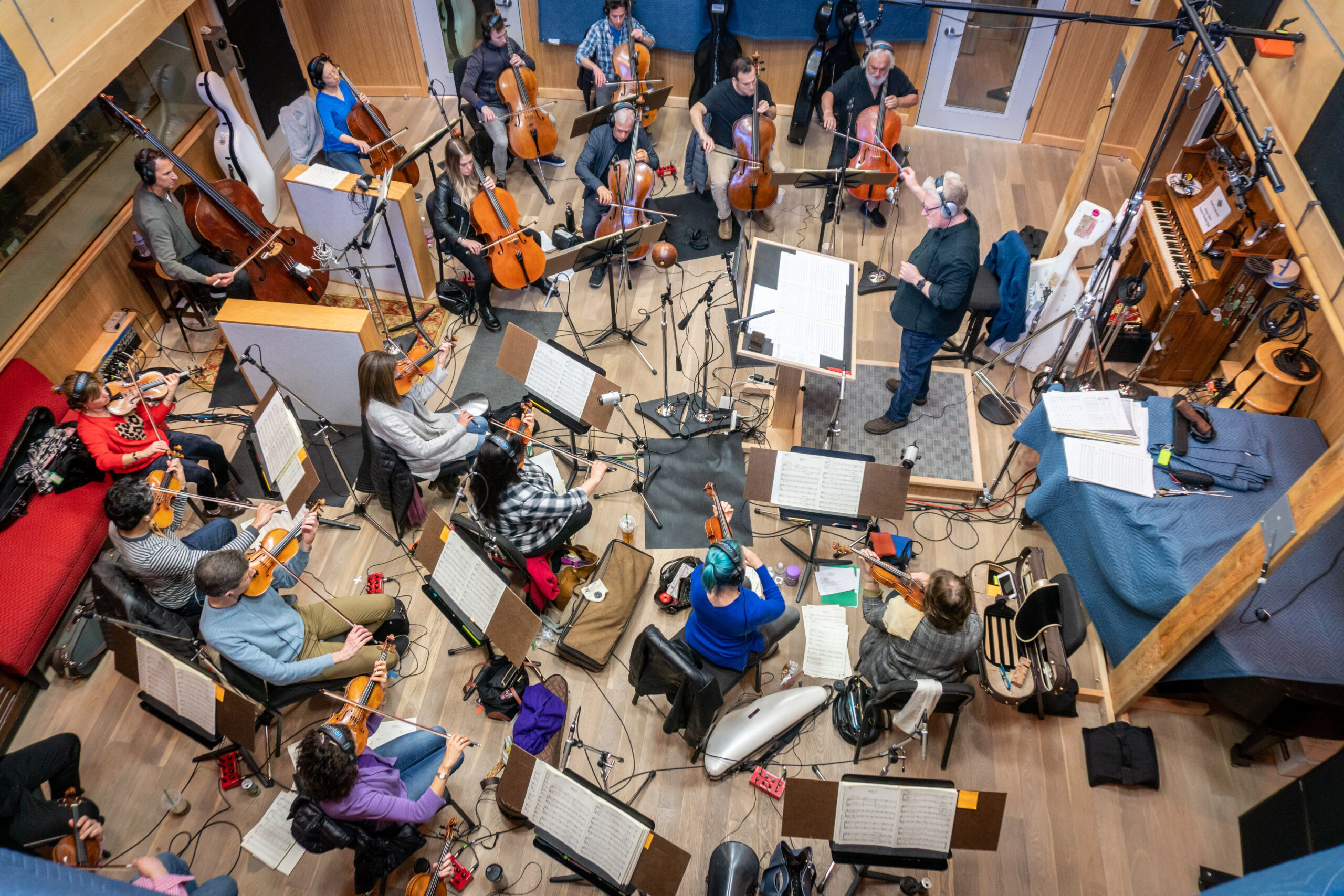
The same can be said for “The Shards’” musical teaming of Morgan Kibby and David Klotz (“The Watcher,” “Grotesquerie,” “All’s Fair”). Listening to their throbbing synth rhythms, sensual atmospheres scene-specific synergy of electronic and organic instrumentation, it’s scoring that drops you back in the glory days of Giorgio Moroder as much as it does the borning new wave moment, all with a keen sense of backbiting drama and surprising empathy. A long-time composing, throwback-friendly team, Kibby and Klotz’s music for “The Shards” is as perfectly tailored version as the apparel of Bret and his preppy class, a mainline for fans of this 80’s particular style that fits in perfectly with such streaming callback compatriots as “Stranger Things” (which Klotz was a music editor on). Tantalizingly visual in its surreal, soapily catty approach that conjures the omnivorous, throbbing and liquid tastes of Murphy and Elis as much as it does the way too old for their age young characters and coke-addled adults, Kibby and Klotz’s synergy has never been so hypnotic in a soundtrack’s that’s a pure, killer 80’s high.

Morgan Kibby
Where were you in 1981?
MORGAN KIBBBY: Waiting to embody in 1984.
DAVID KLOTZ: I was very young and living in Pittsburgh, PA. That was the year I saw “Raiders of the Lost Ark” in the cinema and it changed my life. I knew I wanted to work in the movie business in some capacity ever since I saw that movie. I didn’t realize it would be in music until much later.

David Klotz
Tell us about your respective musical and composing journeys, and what led you to collaborate?
MK: I started off in a band (M83) writing, producing, singing, touring, and eventually decided I didn’t want to be on a bus anymore as I entered my 30s. I had the tremendous honor of attending the Sundance lab in 2016 at Skywalker Ranch and it changed my life. I had found my community. David and I were fortunate enough to be brought together by Alexis Woodall who suggested we co-compose “The Watcher” and two shows later, here we are.
DK: After we had each scored an episode separately for “American Horror Stories,” it was Ryan’s producer Alexis Woodall in 2021 who suggested we collaborate on his Netflix show, “The Watcher.” I had never worked in this capacity before, and it was a real pleasure to work with Morgan. We were both surprised at how well we’d worked together. We had a shared love of synths and electronic music and we each brought in our own specific skillsets.

I take it you’ve both see “Less Than Zero” when it came out. What did you think of the film and its musical vibe, and could you imagine that you’d be scoring a Brett Easton Ellis TV series? And how did you become part of it?
DK: When “Less Than Zero” was released, it was the embodiment of its time. It captured that 80s MTV aesthetic as it was happening. And for “The Shards,” we’re sort of doing the opposite by musically re-interpreting that time, or rather an earlier period of the 80’s, incorporating the sounds of 80s’s pop music into a film score. I love the work of Brett Easton Ellis and it’s an honor to have been a part of this project. I was thrilled when they asked us to score this show last year. Morgan and I had successfully collaborated together on 2 other of Ryan’s shows, so that led us to this project.
MK: Getting a chance to score something written by Brett Easton Ellis is kind of a golden opportunity in the sense that it’s specific work that requires specific musical choices. David and I are fortunate enough to have worked together prior to this series on two other Ryan Murphy productions, so we have a method of collaboration that does exactly I think what was (hopefully!) needed here. Not only for the post team, but for the vision.

What brought your work to Ryan Murphy, and why do you think he liked it?
DK: I have been a part of Ryan’s team as a music editor since 2009 when I started working on the Fox TV series “Glee.” Being in this world for so long has enabled me to really understand Ryan’s brand and specifically what is needed musically to help tell his stories.
MK: I can only speak for myself but watching a RM show as a musician- it’s clear what’s wanted, what’s needed and what’s required to function at (what I know intimately) is a rapid-fire pace and a high level of creative execution in a short time frame. You have to be flexible and also, once again, creatively specific and dexterous. Understanding that has led to many years of fruitful collaboration with this production team and I’m very grateful. I’ve learned and grown so much working for them

How would you describe the Ryan Murphy brand and how “The Shards” fits into it?
MK: Ryan negotiates heightened reality with real precision. “The Shards” fits because Brett’s writing already lives in that heightened space, so the score just had to meet it there.
DK: Ryan’s body of work is very stylish, operatic, dark, glamorous and also has massive appeal to so many different audiences. “The Shards” fits in perfectly with his many worlds. He’s reframed Bret’s book to have a hyper-nostalgic, glamorous 80’s feel, but the horror and darkness from Bret’s story lends itself so well to the same kind of aesthetic we saw in “American Horror Story” and “Monster.”

What do you think made you both particularly suited for “The Shards”?
DK: Morgan and I both have scored a handful of other Ryan Murphy shows. We both worked on separate episodes of the anthology series “American Horror Stories.” Morgan scored “Grotesquerie” and I scored “American Sports Story “and we collaborated together on “The Watcher” and “All’s Fair.” Our scores were largely electronic and along with our excellent working relationship with Ryan and his team, it was natural fit for us to do “The Shards.”
MK: Probably my M83 years — my foundation is 70s and 80s synth world. And then there’s the David’s musical background which is also rooted on a personal level in a love for 80s music. I really feel his melodic instincts keep our cues legible, and that allows me to bring the slop and dither that keeps it from sounding too clean and hopefully surprises the listener. Together that’s basically the show’s whole sound.

How did your collaboration work on “The Shards”? What did Ryan want the score to accomplish, especially with Brett’s dark irony?
DK: When we got hired, we each read the book. Morgan was in London and I was in L.A. So we would get on the phone and talk about thematic ideas and instrumentation. And then when she was in L.A. in December of 2025, we got together at my studio for a couple of weeks and we jammed out on our synths. We had access to the dailies from the pilot. So we put them up on the screen, we’d get a drum pattern going on the Linndrum and we’d each get on a synth…I had all of the era-appropriate keyboards patched in—a Roland Jupiter 4, SH-2, Korg 770, MonoPoly, PolySix, a Moog Source and an Arp 2600. The music we created in those two weeks on those synths became the foundation for most of the show’s themes. Going forward from there, we often worked separately. We would each write cues separately and then send each other stems with notes about BPM or key and we would add or subtract and a new set of stems back to each other. We did all of the mixing ourselves.
MK: David finds the hook in almost anything. I bring the slop and dither — the stuff that’s slightly detuned or off the grid. We finish each other’s sentences musically at this point, which is a rare, rare gift with a collaborator. Ryan wanted a score that lies convincingly, and that split between David and me covered both ends without either of us having to fake it. We inherently I think embody (musically) the world we were stepping into. We get it.

Tell us about the themes that dance around “The Shards.”
MK: Nostalgia and dread. It’s interesting to me that two main themes really came from the both of us: one was a clear melodic through line, and the other was two notes full of detuned floating dread.
How did the “meta” character of Bret Easton Ellis being part of “The Shards” play into the score?
MK: It let us be a little unreliable perhaps? Cues that seem to score the “true” version of events and then undercut themselves later. Bret’s writing does the same thing.

Did you have any favorite characters to play, and why?
DK: Really Rhonda’s theme was something we came up with early in our initial recording session. It was a cool 80’s chorus guitar riff with a synth string that we played on a Jupiter 8. That was one of the demo tracks that we had sent to editorial while they were assembling the pilot. And then when we got a cut of episode three, we saw that they had used that under the introduction of Rhonda and it worked so well that we then continued to develop that more and I just love how that theme was perfected for her character.
MK: Anything with Evan Rachel Wood. My God she is a wonder to watch and score.
If you had any yearning to be part of the “cool kids” in high school, how did that play into your scoring?
MK: I loathed everything about my teenage years, so I never wanted to be cool. I suppose I wanted to be exceptions? Those two things don’t normally go hand in hand. After all I am a teenager of the 90s. It was a different time.
DK: I just remember that keyboards weren’t cool where I went to high school. You had to play guitar to be part of the “cool kids”. Maybe that’s why I still felt like I needed to sneak a little guitar into some of our cues.

“The Shards” soundtrack uses Ryan’s needle drops from other scores and iconic tunes. How did you want your score to have synergy with that?
MK: We wrote cues that could sit next to a needle drop without flinching — same sonic universe, so the transitions feel like one mixtape instead of score-song-score. That was honestly non-negotiable with a project like this.
DK: Most of the songs were scripted. In fact, many were mentioned in the book. This was great because when we’d get a scene from editorial, the songs were already cut into the sequence, so we were able to write in and out of them making sure our score was in the same key. We were also inspired by the instrumentation of the songs. For instance, we used the random arpeggiator sound from the Jupiter 4 synthesizer a lot in our score and that was something that Nick Rhodes had used in many Duran Duran songs from that time. We would take that idea and play an 80’s pop song arpeggio but slow it down and make it weird by modulating the LFO so it would be creepy and out of tune.
How did you want the score to play in song form as well as underscore, and bridge the two?
MK: I mean… I write everything like a song. Then work to picture. Hack, tune, refine… ultimately if the initial idea is whole and embodied, the edit will always find its way.

You have a pitch-perfect 80s synth vibe here. Did you research period scores, and did you assemble particular gear?
DK: I have always had such a love for 80’s synth scores particularly Maurice Jarre’s synth period when he scored “Witness” and “The Year of Living Dangerously.” I was well aware of Moroder’s work, Vangelis and Tangerine Dream, John Carpenter and also being a part of Stranger Things for 10 years, inspired me to go and find a lot of the gear used by those composers, so I have a roomful of synths from the 70’s and 80’s and that became our sound palette for “The Shards” score.
MK: Honestly this is our bread and butter. It’s our happy place. And getting to FINALLY explore an 80s score together, was an absolute joy. That fits week in David’s studio shaped the whole palette. You can’t fake that warmth digitally anyway; you need the actual imperfection of old analog gear. The wobble is the point.
What makes 80s scoring distinctive, technically and emotionally?
MK: Technically: limitation. Fewer options forced more personality per patch. Emotionally: those scores are unashamedly romantic even when the films weren’t.

A favorite you riff on is Moroder’s “American Gigolo.” How did that score’s way of playing gorgeous emptiness work for “The Shards”?
DK: That was Ryan’s idea from the start. It was the first score he’d referenced for us. He’d also mentioned “Blade Runner” at one point too. Tangerine Dream’s score to “Sorcerer” was another reference that our picture editor, Adam Penn said was “working well as temp music. So we listened to a lot of those scores. The “American Gigolo” score had all of the elements and sounds that we had already been discussing as a palette, so it was perfect to reference as we started writing.
MK: Moroder scored loneliness like it was expensive.
“The Shards” is also a slasher mystery in the “Prom Night” tradition. How did you want to recreate that sound, and any favorites from the era?
MK: We wanted the slasher stuff to feel earned, not referential — pulse over jump-scare. John Carpenter is the model for restraint; you don’t need much to make a room feel wrong.

“The Shards” recalls “Dangerous Liaisons,” with romantic entanglements and characters hoping others don’t come to good ends. Tell us about scoring that.
MK: Betrayal almost calls for a waltz. We kept those cues elegant even when the behavior wasn’t. Sometimes it was a technical choice, sometimes it was really just throwing the emotional spaghetti at the wall.
Given how harsh and ironic these kids (and adults) are, was it important for the score to give them emotional depth they might not otherwise show?
MK: Personally, I think it’s all there on screen. Out job was to highlight it.

A lot of recent scores lean into 80s synth. How does “The Shards” fit into that retro boom, and do you hope it pulls younger viewers deeper into that sound?
MK: That music was emotionally unguarded in a way we’ve circled back to wanting. If it sends anyone down a Moroder or Tangerine Dream rabbit hole, I support that wholeheartedly.
DK: This was a conversation Morgan and I had at the very beginning as we wanted this score to stand out from everything else that had been done recently, particularly because I had been a music editor on “Stranger Things” for 10 years. One the choice we made was that we included guitar in many of the cues. We liked the sound of an overly chorused 80’s guitar. We used a lot of piano too. It wasn’t just synthesizers.

How would you like “The Shards,” and its music, to continue?
MK: What a question. But to make more music in this vein would be a dream. It’s an endless, fertile place to create and I love it.
DK: If there is a season 2, it would be fantastic to keep developing these themes!
Watch the complete first season of “The Shards” on Hulu HERE
Special thanks to Jana Davidoff and Alix-Becq Weinstein at Rhapsody PR