
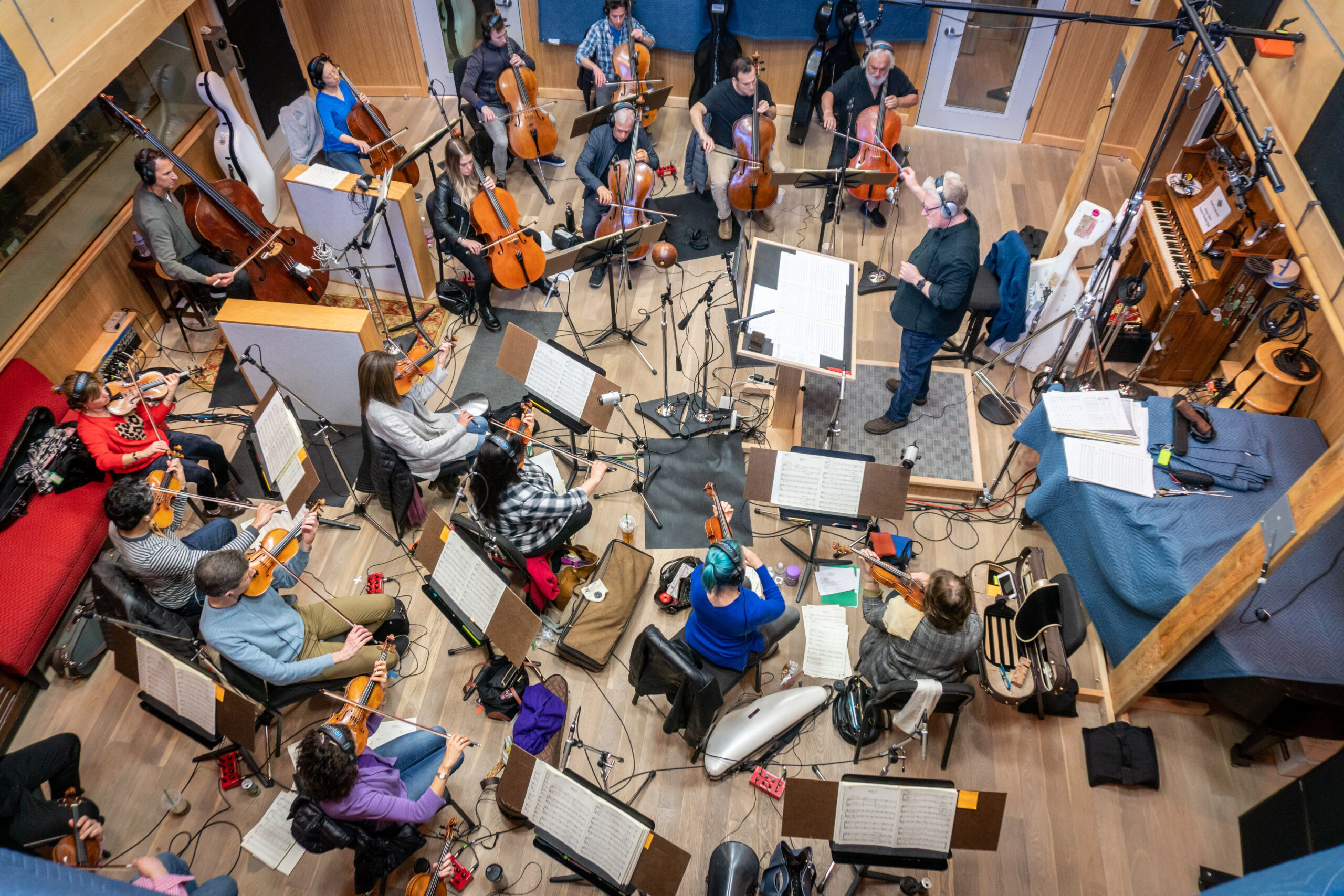


LILO and DAN ROMER
LA-based composer Dan Romer can certainly get down to earth with the out of control kids in his scores for “Beasts of the Southern Wild” and the child soldiers of “Beasts of No Nation,” let alone the cosmic killer horsies of “Death of a Unicorn.” He’s a composer who’s impressed with his indie-centric voice in such films as “The Little Hours,” “Skin” and “My Dead Friend Zoe” while making impressively unique small screen strides with “Let the Right One In,” “The Good Doctor” and “Superman & Lois.” Romer’s voice that often fuses disparate styles into an ear-catching whole is now off into the box office stratosphere with the little monster smash of the live action reboot of “Lilo and Stitch.” Starting off with the Mouse House cartoon for the Italian-spiced fish tale of “Luca,” Romer now smashes together Polynesian rhythms, enchanted voices, 50’s era alien invasion Theremins and an overall sense of sweetness for the unlikely relationship between a chaotic blue teddy bear Frankenstein and a family-deprived little Hawaiian girl.

This “Lilo” is an affectionate reboot of the 2002 toon that doesn’t try to go for the adventurously lush strains and mock-monster’isms of Alan Silvestri’s classic score. Instead, Romer captures that energy in his own idiosyncratic way that also continues Disney’s love affair with Islander heroines after “Moana 2.” And as with that defiant young heroine’s music, Romer delightfully uses culturally spot-on ethnic rhythms and voices together with western scoring symphonic energy and his own offbeat percussion. This is very much Romer’s own melodically loveable beast with a heart and soul, creating slapstick chaos with a plethora of antic percussion and distinctive themes that gives no amount of mischief and feeling to make this Stitch its own beast among Disney characters given flesh, blood and CG life.

I imagine you saw “Lilo & Stitch” when it first came out. What did you think of the film and Alan Silvestri’s score? And why do you think the movie has endured to the point of it being turned to live action? What’s the challenge of taking a new approach to popular work
I did see “Lilo & Stitch” when it first came out, and I watched it many times—I absolutely loved it. Alan Silvestri’s score is fantastic, and those were some big shoes to fill. My approach to the score was to lean more heavily on traditional Hawaiian instruments—guitar, ukulele, slide guitar, and percussion. I think the reason the film has endured, aside from how beautiful and a heartfelt it is, is how unique and punk rock both Lilo and Stitch are—they’re not what you typically expect to see, especially in a movie kids are going to be watching.

What do you think are the contrasts and similarities of scoring for live action and animation? And what kind of opportunities do you think they provide that the other might not?
One major difference is that animation’s sound design often leaves more room for music, since there’s less background noise or “walla.” This allows the score to play a more prominent role. Also, animation often expects the music to telegraph emotions more directly, making it feel more natural to be emotionally expressive compared to live action.”
Do you think you have an affinity for scoring young characters, whether they’re the vivacious girl of your breakthrough “Beasts of the Southern Wild” or the sullen child soldiers of “Beasts of No Nation”?
That’s a really good question. I think my background in producing pop and rock music gives my writing a youthful energy, which helps me connect with younger characters. I also enjoy that “heart on your sleeve” quality that young protagonists often allow me to explore.

Stitch starts off with some fun homages to old sci-fi “alien” scoring, particularly in the use of the Theremin. How did that approach come up, and how do you think it helps set the tone of the story’s alien element?
We decided to create a big musical shift between the alien space station and Hawaii. The spaceship features classic sci-fi elements like the theremin, strings, brass, woodwinds, and some more modern samples I created by blowing into a plastic bottle. Once the story moves to Hawaii, we incorporate traditional Hawaiian instruments to highlight the contrast and set the tone for the aliens and earthlings to collide.
Beyond his mischievousness, Stitch is an alien with major ADD. How did you rhythmically want to capture his constant scurrying and mischief?
Rhythmically, I highlighted Stitch’s mischievousness with the sound of Tahitian log drums (to’ere). For the more tonal elements, I used a small flute and played kinda random bursts of notes, which was fun since I have no idea how to play the flute!

Tell us about the bonding theme for Lilo & Stitch.
I ended up giving Lilo, Nani, and Stitch all one theme, to highlight the idea of “Ohana”, or family. I tried to make sure that that main theme could be played in many different contexts and scales so that it could remain fresh after lots of uses.
How did you want to capture the aliens Pleakley and Jumba bumbling about in human disguises?
Single repetitive guitar notes in a minor scale became the best sounds over those two, it felt both menacing and bumbling at the same time. They also got quite a bit of the toere treatment as well.

Tell us about your collaboration with director Dean Fleischer Camp, who made “Marcel the Shell with Shoes On” before this. What do you think that background brings to a live action movie with an animated character at its center?
Dean was a fantastic collaborator. He really pushed for sounds that would feel unique to the film. He wanted to stay away from obvious choices, and hitting scenes with more emotion than they needed. Since Marcel was a film with an FX driven protagonist with family as a central theme, it seems like a natural fit.
Though this is a comedy with some pretty wild swings, you’ve taken an authentic approach to Hawaiian music. Was that important to you?
I listened to as much Hawaiian music as I possibly could before starting the real writing of the score. I find the best way to make music within the sounds of a culture is to learn through osmosis as opposed to direct study only. The goal is to get your instincts to make choices that traditional musicians would. I believe this has to come through putting in hours with the music. However, even if I could put in hundreds of years of practice, the great Hawaiian musicians would still run circles around me.

Tell us about your work with the players and singers in creating it.
‘O’oe Carr and Kai Kalama were the singers on the score, they did a fantastic job, I really couldn’t have asked for more. Once their voices were in the music, it really took on a whole new level of emotion for me.
I enjoyed how you meshed all of the unlikely styles together here. What was the challenge to that?
Thank you so much! As you gather all the influences you want to reference, they can start to kind of mix in your head, and you find useful things about them that start to interplay with each other. I found the acoustic slide guitar useful for certain moments, and Tahitian percussion useful for others, and it was inevitable that they’d end up in some pieces of music together.

Orphaned characters are a hallmark of Disney. How did you want to capture the sister’s loss of their parents, and the presence they carry with them that spells out the movie’s theme of a family sticking together no matter what?
The singing in the score was meant to represent Lilo and Nani’s parents, the idea was to sort of have them watching over Lilo, and to drive home that even if they weren’t physically present, their love was still there.
In that respect, how important do you think that musically “quiet” moments are to movies with a lot of rambunctiousness?
Incredibly important! If all you have is one vibe, you have nothing to compare it to. A film that’s all action and no emotion will get tiring pretty quickly, and vice versa.
You’ve done quite a few unique “alt.” scores before a major studio film. Did you still want to bring that experimental quality to “Lilo” in addition to the kind of orchestra we’d expect – particularly in the big action climax?
I think that emotional and very active strings have been a pretty consistent part of my work, and when I use them, I try to pair the orchestral sounds with sounds from other genres and cultures to give the score a unique feel. I felt the drones and singing were coming from a pretty experimental place. We put the voices through tons of processing to give it the sound of an old record playing from the other room, and the main drone I use is an acoustic slide guitar through tons of effects and filtering.

Watch “Lilo and Stitch” in theaters, with Dan Romer’s score on Walt Disney Records HERE. Visit Dan Romer’s website HERE
Special thanks to Sarah Roche at White Bear PR