

THE BEST FILM SCORES OF 2025
CLICK on the soundtrack title purchase the album


(Bobby Krlic / Back Lot Music)
The family-splintering aftermath of “The Troubles” get a surreal telling from the father-son duo of writer-director star Ronan Day-Lewis and dad / writer / co-star Daniel Day Lewis, whose blazing performance for “In the Name of Father” hangs heavy over this film – except in his case it’s on the other side as a guilt-wracked ex British soldier turned hermit. His estranged son’s fate becomes the rescue mission of “Anemone,” which is as much a mystical one as real-world salvation undertaken by brother Sean Bean (who doesn’t die), given a trance-like alt. rock score by Englishman Bobbly Krlic (aka The Haxan Cloak). The forgotten forest where the tortured miscreant has made his home for years becomes a place of wonder for Krlic as strings, ghostly female voice, retro synths and piano dance among the rhythmic electric guitar chords, conjuring ancient spirits and ghosts of the past for the battling brothers. It’s an enveloping, thematic weird rock sound that you might expect to accompany rage zombies prowling the countryside, and really goes to cosmic town when a sea beast shows up in the aftermath of a biblical hailstorm. Krlic wears his sharp metal grooves and ancient, wooden sounds with pride, creating the sound of a transcendent cosmic exorcism of the ghosts of the Northern Ireland past.


(Bobby Johnston / Movie Score Media)
As they say, two things in life are certain, but how a documentarian’s dad gets there with bigger implications for everyone in America is a whole lot more welcoming and evocatively scored in “Death & Taxes.” As directed by Justin Schein (along with Robert Edwards) and scored by Bobby Johnston, this eclectic jazz-based soundtrack proves the key to family relationships often entirely determined by Justin’s father Harvey’s obsessiveness with avoiding the “death tax.” “Death & Taxes” grooves with Johnston’s scoring that ranges from Harvey’s old world Jewish origins to jazz that evolves from the birth of the cool to chart Harvey’s own hand in pop history and modern technology. Ironic, dreamlike and emotionally captivating, Johnston’s soundtrack shows off the eclectic, eccentric talents of the composer whose music for the unreleased documentary “Extra” became a darling of NPR’s “This American Life.” His use of offbeat instruments, rhythm and melody has led to an eclectic career that’s accompanied such controversial filmmakers as Stuart Gordon (“King of the Ants,” “Edmond”) to Larry Clark (“Marfa Girl”) as well as covering the culinary canvas of Los Angeles for its tastemaker in “City of Gold.” First partnering with Schein on the documentary “No Impact Man” about a couple determined to live off the wasteful grid while being an inevitable urban part of it, Johnston and Schein’s synergy has never been more universally profound, or musically enervating as in “Death & Taxes,” turning what we all face (or try to run from) as citizens into a deeply affecting picture about far bigger truths.


THE FANTASTIC FOUR: FIRST STEPS
(Michael Giacchino / Marvel Music)
Whether suiting up with The Incredibles, Spider-Man or Doctor Strange, Michael Giacchino knows that great superhero scores are spelled F for Family. It’s warm, adventurous and most of all fun orchestral music that captures a pure, unapologetic good guy comic book spirit that’s built on emotional bonds. So it’s only fitting that Giacchino would get the cosmic ray-irradiated O.G. FF family of Marvel that started the company’s craze in the first place back in 1961, made even better by being set in that souped-up timeline. Gifted with one of his best themes that literally sings the title, Giacchino’s melodic talent is on full blast from the word go here. Where his Incredibles music riffed on John Barry’s Bond scores at their mid-60’s height, this is more about a make-believe time period, conjuring Swingle Singers voices and Esquival jazz licks. But of course the real star is his warmly emotional writing, from the character’s interplay to the power cosmic mystery of the Silver Surf-ette and the Godzilla-sized lurching brass of a finally human Galactus. Capturing the bold fateful sound of a classic 50’s sense of wonder space operas a la “When Worlds Collide” in addition to his biggest alien language choruses outside of Dormamu’s dimension and the bountifully energetic fun at hand (with even a goofy Saturday morning cartoon theme to boot), this is the kind of big, epically marvelous thematic music that Giacchino has down like no comic book-centric composer’s business for a gem of a picture that puts its blue-suited family bonds first.


(Alexandre Desplat / Netflix Music)
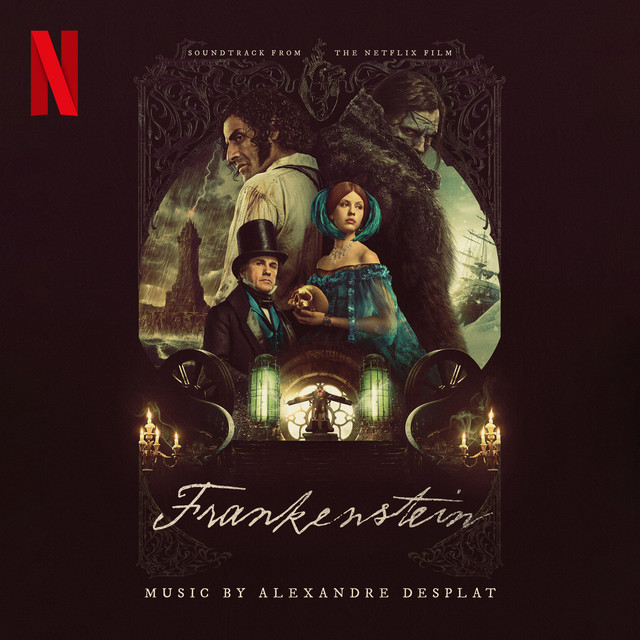
One is a master of melody. The other the visually striking alchemist of horror. Both love to hear the innocence of The Monster. Combine these Oscar winning artists with the soulful creation made out of corpses that launched horror itself, and you’ll get the ultimate synergy of the collaboration between Alexandre Desplat and Guillermo del Toro that has electrified “Frankenstein.” First striking gold together for a heartwarming fairy tell spin on The Creature from the Black Lagoon with “The Shape of Water, “Desplat and Del Torro next cobbled together a legendary fairy tale work of art for the Frankenstein-adjacent story of a little wooden boy for the Animated Best Picture winner “Pinocchio.” But now wood come to life reaches back even further into re-activated flesh and blood for their goal of sticking to the 1816 book of “Frankenstein” by Mary Shelley. The result is the best cinematic version yet of a tale told hundreds of times on the big screen, yet never before with such soulful empathy, gorgeous production design, haunting make up and fiery performances – all the trademarks of a Del Toro film rapturously stitched together by Desplat’s themes for a beautifully beating heart. It’s an epic soundtrack that feels for the alleged beast and scorns the vain doctor who can only think of the experiment instead of the human he creates. Employing a period tapestry of violin, harpsichord and sumptuous strings, Desplat not only brings his fierce dedication to melody but also an energetically unhinged joy in musical creation that recalls the great Frankenstein scores of yore from Universal to Hammer, all while bringing new scoring subtext to the nature of destruction and the ultimate, tearfully touching power of forgiveness. It’s a Frankenstein movie and score for the ages for Desplat and Del Toro that continues to show the rarest of composer-director alchemies – here brought together like never before to rejuvenate literature and cinema’s most famous member of the walking dead with tremendously moving body and soul.


(John Powell / Back Lot Music)
It’s been a true fairy tale year for John Powell. But even cooler, and arguably more challenging than taking a metaphorically rebooted dance down the yellow brick road to Oz is revisiting the Isle of Berk in live action (not to mention scoring its relocation to Florida’s Epic Universe theme park). The whole phenomenon of turning animated classics to flesh and blood has certainly been going on for a long while, with their original composers similarly rebooting their scores – but with iconic themes intact. Where some have questioned the trend with good reason, this year’s “How to Train Your Dragon,” in company of its original screenwriter-director Dean DeBlois and star Gerard Butler, soars high to validate its existence, especially with Powell back at in the reptilian saddle. A composer who took flight for his energetic, and often eccentric spins on traditional scoring (particularly with animation), Powell’s Oscar-nominated score for the first “Dragon” picture in 2010 was a true breakout, with an audacious Scottish bagpipe sound that’s the last instrument anyone might expect for a beast-riding Viking nerd. It’s full-throttle, adventurous whimsy that now takes off to the big screen on the power of an instantly classic theme, but spins it off into a whole new beast. Few composers capture the symphonic-choral thrill of flight like Powell has for this marvelously performed score that shows there’s plenty of Celtic gas left in Toothless’ engine, rousing music that makes everything old new again with what was a rousingly fresh score to begin with. Now I’m salivating to see Powell’s new spins for the next two reboots after this magically gorgeous thrill ride that shows everything old is new again


Max Aruj (L) and Alfie Godfrey (R)
MISSION IMPOSSIBLE THE FINAL RECKONING
(Max Aruj and Alfie Godfrey / La La Land Records)
For the Impossible Mission Force’s eight adventures on the big screen, composers accepting the sixty second challenge have included Danny Elfman, Hans Zimmer, Joe Kraemer, Michael Giacchino and Lorne Balfe – all bonded together by Lalo Schifrin’s iconic TV themes While Balfe began “Dead Reckoning’s” fight against an evil A.I. entity and its human pawns, the battle that now encompasses the entire film series, and its seeming conclusion now recruits the talented fresh faces of Max Aruj and Alfie Godfrey. Having worked as part of Hans Zimmer and Lorne Balfe’s team on the likes of “Top Gun Maverick” “Black Widow” and “Mission Impossible Fallout,” Aruj’s own impressive scores include the O.G. gangster “Lansky” and the action of “Ice Road.” Godfrey also counts himself as member of Maverick, as well as his own scores for “A Town Called Malice” and “Marching Powder.” Together, Aruj and Godfrey are dynamite in providing the suspenseful fuel of “Final Reckoning.” Impressively bringing new inventiveness in varying the essential partner of Lalo Schifrin’s music, Aruj and Godfrey provide their own time bomb ticking intensity to epic submarine and biplane set pieces with a score that’s equally about a relentlessness countdown and Ethan Hunt’s emotion for the unbreakable bond of a spy family in Mission Impossible’s most daunting race to save the world from A.I and its human cultists. It’s music that fills the Imax frame to show that Aruj and Godfrey’s suspenseful skills are more than capable to save a world on the brink.


Jónsi (L) and Alex Sommers (R)
(Jónsi and Alex Somers / Hollywood Records)
It says something about the captivating, cultural poignancy of “Rental Family” that the story takes on a Zen resonance – especially in the hauntingly poetic score by Jónsi and Alex Somers. The latter is an alternative musician from Iceland best known for his work with the band Sigur Rós, while Somers hails from Baltimore. Finding themselves kindred musical spirits in the island’s capital of Reykjavik, their score collaborations contrastingly range from the lullaby-like “We Bought a Zoo” to the ticking dread of the atom bomb in the TV series “Manhattan.” On his own, Somers has provided the uniquely atmospheric and rhythmic scores to “Captain Fantastic,” “Honey Boy,” “Charm City Kings” “Nickel Boys” and even the delirious noir of “Holland.” Now cast beautifully adrift into a human-packed nation that can be impersonal and emotionally needy enough to necessitate the business of “Rental Family,” Jónsi and Somers expound upon the ethereal and enchanted sound of “We Bought a Zoo” (another film about an unlikely clan) to hear “Rental Family” as a state of tone poem mind. Gossamer fusions of orchestra, electronics and reverberating angelic voices become walls of transfixing sound that don’t really play onscreen action, let alone Japan. Yet it’s thematically ephemeral music that has everything to do with people trying to overcome a disconnect. Echoing tinkertoy piano, rhythm that goes from joyous to deliberate and walls of Haiku sound become the longing of child too old for her years, the sadness of man being consumed by them and the need for an outsider without bonds to discover his own worth. It’s a religious score as such without being religious. Think the equivalent of cherry blossoms falling on an ancient, now beyond modernized society and that’s the spiritual, environmental beauty of that rarest of movies that’s about the good that humanity can find within each other. “Rental Family’s” score makes a final sale with beauty and innovation to spare.
THE TESTAMENT OF ANN LEE
(Soundtrack available soon on Milan Records)


(Photo by Alana Blumberg)
“The Testament of Ann Lee” is this year’s other utterly unexpected musical next to “Sinners,” if ironically more religiously soulful in spite of its seemingly devilish groans and screams. Imagine “The Witch” as a Busby Berkeley showstopper where the eerie Wiccan cries were actually the devoutly orgiastic vocalese of anti-sex Jesus cult, and you’ll end up with a soundtrack that’s equally rapturous and unnerving. “The Brutalist’s” Oscar-winning composer Daniel Blumberg is back in the service of Brady Corbet (producing and co-writing here for the striking direction of his artistic partner Mona Fastvold). Where that bent architect epic had an unabashed sound to express a titanic, unwavering ego, Blumberg’s approach for a similarly unwavering, young Shaker “mother” who goes through the trials of Job is conversely muted, yet to equally powerful effect. Glistening bells, a fiddle that isn’t Old Scratch’s and eerie atmospheres convincingly transport us to pre-revolutionary America. Seemingly every melodic and dissonant range of the human voice is explored there to create a naturalistic bed from which the Shaker-based songs are built. Where many religious tunes can border on the monotone, the ones here are the most wonderfully catchy this side of “Wicked’s, from the tender “Beautiful Treasure” to the pirate ship-like rhythm of “All is Summer” and “John’s Song,” which sounds like the Who in Puritan clothing. Most strikingly “Bow Down O Zion” evokes alt. 1700’s emo rock with a piercing electric guitar. Constructed from themes as finely crafted as the Shaker’s furniture, Blumberg conveys in score and song what it’s like to be caught in orgiastic rapture with all the world against you. But where the score revels in the joy of true believers who’ve transported themselves in song to a place beyond earth, the triumph of “The Testament of Ann Lee” is ultimately how sympathetically moving this unplugged score makes it, resounding with a sense of loss for a sect whose thousands now only number three. It’s faith-based music that speaks in often beautiful tongues, with a strikingly unique approach for Fastvold’s visions that makes even us heretics into believers.


As a founding member of the alt. group the National and with collaborations including such modernist icons as Philip Glass and Steve Reich, Bryce Dessner is at the top of the wave of exceptional, rising alt. music composers. His scores like “We Live in Time,” “Sing Sing” and “She Came to Me” are impressively thought out works of art (I’d most certainly put dysfunctional assassin bro heart he put into “The Accountant 2” in their league), which means he couldn’t be more at home then in The Great Wilderness of this year’s best film “Train Dreams.” Imagine if “Days of Heaven’s” Terrence Mallick had grown a heart as well as making amazing naturalistic portraits, and you’ll get the gorgeous melancholy expanse of filmmaker Clint Bentley’s look a a simple man and his simply lived life spanning the late 1800’s to the late 1960’s. Yet it’s as emotionally rich a movie portrait as we’ve gotten in decades at conveying the wonder and fickle hand of fate, especially in Dessner’s lyrical hands. Evoking the melodic impressionism of Claude Debussy and Arvo Part as well as the rustic music of the post old west, it’s a score of astonishing poetry that conjures images of lilting trees, verdant landscapes, falling snow and the overwhelming terror of fire as much as it does the pure love of family and the gut punch of having it ripped away, and then trying to somehow live life again. At first energetically chugging away with the locomotive rhythm and chirping percussion of America’s expansion and nature’s response to it, “Train Dreams’” optimism gradually gives way to spare violin and rubbed glass feelings of impossible loneliness. It’s chamber music as intimate as it emotionally overwhelming, conveying the feeling of a man alone in the universe, his life horribly affected by it even as he doesn’t lose his admiration for God’s Country. The music’s spareness, and ultimate transcendence is also perfect for Will Patton’s rhapsodic narration as all tracks lead to a beautiful, character-affirming Nick Cave song about how it was all perhaps worth it for this everyman. Dessner’s “Train Dreams” is a pure, beautifully affecting tone poem for Bentley’s resplendent visual lyricism for a film that seemingly doesn’t try hard, yet hits you like a hammer nailing a track into place on its zig-zagging trek through life’s journey.


Left to Right: Ryan and Hays Holladay, Zach Cregger (Photo by Alfonso Bravo)
(Hays Holladay, Ryan Holladay and Zach Cregger / WaterTower Music)
I didn’t know what to expect running and screaming arms outstretched into the brilliant “Weapons,” but a white witch voodoo priestess (or alien, or whatever) wasn’t on my bingo card, which makes the unimind score by filmmaker Zach Cregger and brothers Hays and Ryan Holladay. Childhood friends who played in the band Sirhan Sirhan before Creggar’s breakthrough movie “Barbarian,” with the Holladays then scoring podcasts, art installations and the documentary “Class Action Park. Together as major composers for the first time, “Weapons” marks the trio’s wicked sense of humor. “Weapons’” uses playful percussion that ranges from lurching rhythm to pounding inevitability and berserker speed, along with nerve-shredding string effects for mind invading cause and effect, particularly when applied to children. More conventional suburban spookhouse investigation tonalities blend with percolating synths, with eerie voices and harpist Mary Lattimore’s heavenly percussion for truly unsettling and innovative effect. At once droll and real deal scary, “Weapons’” score is the shock and awe of turning the calming sound of fairy tale innocence into a rhythmic horde, a cruel and post-hip alt. ironic musical approach to horror scoring that couldn’t be cruelly fresher.
THE RUNNERS-UP


(Hrishikesh Hirway / WaterTower Music)
Podcaster, ice cream inventor and musician with the scores for “Save the Date,” “Our Nixon” and “Everything Sucks!” to his talents, Hrishikesh Hirway seems like the perfect guest for a bros getaway in the woods – and certainly proves it by putting the righteous anger into an artificial sex worker who gets a hand-clapping comeuppance on Mr. Nice Guy for the femme bot revenge picture “Companion.” Starting off sweetly enough with guitar and the sweetest humming voice outside of “Rosemary’s Baby,” Hrishikesh cleverly uses a smoothly melodic acoustical approach before the flashbacks hit the fan and harsher electronic tonalities begin to strip away the facades. Ghostly voices and aggressive strings then mix with those perky voices to unleash the righteous rage in the machine, with Hrishikesh adding rhythmic comic suspense for good measure as the plot’s machinations include a rich kid heist. Like “Weapons,” it’s a great example of black humored horror scoring that also needs to hit the more serious beats, The power of this metaphoric sci-fi picture is empowerment as Hrishikesh’s strikingly inventive and particularly well thought-out score in the empathetic end is all about freeing a femme bot’s chains with no small amount of humorous, hybrid musical carnage left in her wake.


(Michael Yezerski / Range Music)
Aussie composer Michael Yezerski has done no small amount of effective scores for the dangers of surf (“Storm Chasers,” “Drift”) and turf (“Corporate Animals,” TV’s “Wolf Creek”), as well as played super satanic black metal in Texas for fellow down under filmmaker Sean Byrne’s “The Devil’s Candy.” So what’s better than to combine two popular taste treats to chum it up and rip off several chunks of flesh for Bryne and Yezerski as an Aussie serial killer use sharks as his not-so blunt instruments in “Dangerous Animals.” All the better for Yezerski to employ what sounds like a chainsaw for his unbearably tense, stomach churning in all the right ways, horror score that works both viscerally and psychologically. Orchestra, warped piano, chopped synths and relentless ramp-ups to the ocean dunking make this unbearably suspenseful stuff the swims like lightning between ruthless dissonance and, in the score’s most brilliantly unexpected attack, makes the final girl’s apex predator underwater close encounter into a thing of majestic beauty. It’s a ferociously clever score for an equally intense film that really knows how to twist the knife-teeth.


(Tim Wynn / Lakeshore Records)
Giving an invisible face to Death as he outsmarts his victims in ghastly Rube-Goldberg cause-and-effect manner is what’s distinguished the “Final Destination” series. When your inevitable foe is more of a metaphoric idea, an all-important element in materializing an unstoppable force is music. First materialized by Shirley Walker with the torch passed to Brian Tyler, the “Final Destination” franchisescoring has been characterized by its relentless suspense and operatic sense of black-humored fate. Bringing a new emotional level along with the dark musical irony and outrageous symphonic gore that you’d want from a “Final Destination” is Tim Wynn. Teaming again with directors Zach Lipovsky and Adam B. Stein after the giant robo kids’ series “Mech-X4” and their darker future mutant movie “Freaks” (soon to have a sequel), Wynn is sure to tip that hat to Shirley Walker’s O.G. “Final Destination” theme as a driving force in this score, And no doubt she’d be impressed with Wynn’s furious combination of symphony and rhythm, as well moving emotion – no more so than in the final, self-aware appearance of Tony Todd’s Karloffian coroner. It’s a tragic overtone that makes Wynn’s score more of the straight man as such without losing the excitement of the ghoulishly energetic suspense that gives a “Final Destination” score its pulse. Death is indeed good musical company with Tim Wynn, whose scoring rips the life out its clan with surprising heart to spare – along with other flying instruments and organs.


(Hildur Guðnadóttir / Milan Records)
When one hears Hildur Guðnadóttir, a dramatic chill of the Icelandic composer fills the soul, whether it’s the spine-shredding strings of her Oscar winning “Joker,” the found metal that becomes the horrific nuclear non-containment of her Emmy-winning “Chernobyl” or the nightmarish Agatha Christie mystery that plagues “A Haunting in Venice.” But for a composer who dealt with a villain who previously asked “Why so serious?” one might not expect Hildur to deliver a malefically playful score with “Hedda.” For a 1950’s English countryside set-spin on Norwegian Henrik Ibsen’s 1890 play about the lethal machinations of a literai society grand dame, “Candyman’s” reboot director Nia DaCosta cleverly flips her script to position Hedda as party girl with poison up her sleeve, cunningly playing off her past and present love affairs to catastrophically ensure her weak-kneed hubby gets his big promotion. Set amidst jazz age debauchery of heated couplings and multiple gunshots, Hildur is the bandleader of this wild party. Uses breaths like the hiss of a cobra woman amidst an eerie chorus, Hildur springs Hedda’s pathetically depraved personality with dark, seething menace. An innovative jazz-tinged score with a memorable noir theme and energetic songs the composer also produced, “Hedda” levels up Hildur’s talent for conveying a malignant, yet captivating Queen Bee who makes Tar look like a piker. It’s a score very much in twisted tune for the composer, but in a whole new transfixingly creative key.


(David Longstreth / A24 Music)
Among the indie artists turning composers this year, Dirty Projectors’ frontman David Longstreth arguably gets the biggest, and enchantingly strange shot of them all for fractured fairy tale impresarios A24 and their clash of modernized neo-Icelandic island culture’s kid soldiers trying to stamp out unhappy woodland creatures in “The Legend of Ochi.” Credit animator-turned-writer/director Isaiah Saxon, who’d directed videos for The Dirty Projectors (and tellingly Björk and Grizzly Bear as well) for bringing Longstreth on to score his impressive debut. With giant, impressionistic brass conjuring ram horn calls in the stone valleys of a time-lost pagan hinterland, thoughts of Wagner and Straus fill the mind, with Debussy heard in the gentle flute and harps for the E.T.-ish bond between misfit girl and pursued ugly-cute beastie. It’s not so much a score as it is a fantastical tone poem painting, never quite settling into enchantment given the story’s very dark and potentially violent overtones that’s overall the stuff of A24. But then what worthy fairy tale didn’t have a foreboding edge to it? Longstreth’s instrumentation gets even more tantalizingly weird as Asian winds and avant garde concert writing add peril to the quest of girl and critter. The score finally settles on soaringly melodic symphonic spectacle a la Maurice Jarre and bird-chirp song whistling for Longstreth’s truly bold approach for the year’s most foreboding fairy tale. It’s a small miracle there’s a musically sumptuous happy choral ending to “Ochi’s” score whose striking instrumental oddness and sheer, uncomfortable beauty plays way beyond musical kid’s stuff.

 Andy Grush (L) and Taylor Newton Stewart (R)
(The Newton Brothers / Lakeshore Records)
The Newton Brothers (aka Andy Grush and Tayor Newton Stewart) might not be related by blood to themselves or filmmaker Mike Flanagan, but they’ve certainly poured on the sonically sanguine terror for the horror auteur on such productions as “The Haunting of Hill House,” “Midnight Mass” and Stephen King’s “Shining” sequel “Doctor Sleep.” This year they teamed with Flanagan for another King project, but “The Life of Chuck” is exactly what you wouldn’t expect from them – even though we’re accustomed now to King’s non-genre adaptations resulting in some of his best work with the likes of “Stand by Me” and “The Shawshank Redemption.” Though there’s just a little bit of the fantastical in “The Life of Chuck” (and seemingly way, way more than that at the start), this is collaboration from the trio is so powerful by its non-flashy telling as we go backwards in time for the end to the beginning to show the Bedford Falls-ish worth of an everyman with unused musical talents. Wistful synth cosmic majesty leads to a tender, yet very strong and spare piano theme as the score is accompanied by marimbas, ghostly electronics and a meaningful hesitancy that leads to its profound musing on existence. It’s by far the most subtle (and shortest) work for the Newtons and the most naturalistic for Flanagan, and arguably their most emotionally impactful one altogether when it comes to making sense of the world and its fateful curveballs.


(Jeremiah Fraites / Milan Records)
No small number of alternative rock artists are making the transition to film scoring. And while some traditionalists might want to stop that march, it’s a do-or-die race that brings a breath of fresh air to composing, especially when it comes to unconventional ways of conveying emotion under stress. This element impressively facts into Lumineers’ member Jeremiah Fraites’ one-two punch with “The Long Walk” and the Bruce Springsteen bio “Deliver Me from Nowhere.” Both are united in fiction and truth at conveying young characters’ absolute conviction to reach the end goal – in this case teen contestants dropping like ants before a dystopian governments’ anti-race to reach a monetary prize. In his score for Francis Lawrence’s spin by Stephen King on The Hunger Games long before that was a youth-slicing thing, Fraites creates a rural-tinged score for young brotherhood under stop-and-you-die fire, weaving musical camaraderie with poignancy in spite of fear. His way of playing both panic and brotherhood, often at the same time, succeeds in gripping viewers with the plight of these teenagers in an unplugged way that befits an economically blighted heartland they have to keep pace through at four miles per hour. Yet this is a somehow heartening musical struggle, as crafted by an artist bringing his distinctive, offbeat craft to a whole new cinematic stage in a way that guarantees he’ll be standing there for a long while.


(Brian Tyler / Sony Classical)
Brian Tyler is the rage when it comes to supremely entertaining scores for fast cars, flying superheroes and the battle for cowboy land. But amid his dazzling blockbuster work, there’s an equally impressive serious side that goes for the art, deeply moving scores that have dealt with the “Partition” of India, F. Scott Fitzgerald’s “Last Call” and the nature of journalistic “Truth.” But perhaps none of Tyler’s scores to deal with real world history is as important as the past is present lessons offered in his moving score for “Nuremberg.” With filmmaking James Vanderbilt taking a very different tact to the trail of Nazi War criminals than in Stanley Kramers “Judgement at Nuremberg,” this is far more of a suspense tale than courtroom testimony that centers on the relationship between psychologist Douglas Kelley and Hitler’s surrendered second in command Hermann Göring. Faced with the do or die responsibility of holding the Reich’s worst accountable, Tyler uses his pulse-pounding talents in service of militaristic suspense, immersive, Hebraic tinged emotion and a soulful chorus for the ultimate explosive countdown in demanding justice. It’s an impactfully moving film and score that’s driven by a sense of holding fascism to rights, a theme that’s more important than ever.


Photo (c) Classic FM Youtube
(Ludwig Göransson / Sony Classica)
Too often scores win because Oscar voters can’t separate them from the songs, but I have feeling that if Ludwig Göransson takes home the Oscar again with “Sinners,” it will be because the Academy realizes just how well this horror barnburner meshes with filmmaker Ryan Coogler’s Dracula-worthy taste when it comes to the tunes of this ersatz musical. It’s all about the music here as the Swedish composer takes his talent for urban ethnography that he displayed for Coogler on “Fruitvale Station” and his Oscar winning “Black Panther” score to the next jazz shack from hell level. It’s not specifically a musical region as it is a fluid merging of the Delta Blues, Africa and all points black as guitar, harmonica and voice create a rich, heat-and-sensuality soaked culture to grind and bite by in the most atmospheric southern grooves this side of a classic Ry Cooder soundtrack. But make no mistake that this isn’t a horror score as strings and electronics slowly enter the acoustic stage, with a violin and organ as well to suggest Transylvania as the root of all evil. Harmonica and voice turn sinister as the score becomes more modernistic, with an unholy chorus rocking out to stake-happy metal and strings. It’s a truly audacious all-things at all-places mash up for a movie of staggering invention across black musical time that rocks the joint from dusk ‘til dawn.


Trent Reznor (L) and Atticus Ross (R)
(Nine Inch Nails / Interscope)
For a franchise graced with revolutionary visuals, the Tron-verse has beckoned Walter Carlos, Daft Punk and now Nine Inch Nails to solidify its game grid with electronic wavelengths. Carlos combined her switched-on synths with a traditional orchestra, an approach similar to how Punk brought in a symphony over its house music beats. Now NiN (including its most famous “Social Network” Oscar score proponents Atticus Ross and Trent Reznor) dispense with most organic instrumental pleasantries for their hard-hitting house brand of industrial grooves, though are sure to reduce their sound as well to a pensive piano. With the score never seeming to stop here for more than a few seconds, it’s tremendously effective at crossing the streams between its neon glow computer world and the real one it traverses into. It’s state of the art grooves that are beyond essential to this underrated film’s awe-inspiring visuals and cyberpunk energy, no more so than when the industrial rave arrives with the recognizers. There’s a retro energy as well here, though far more to the 80’s synth era than Carlos’ sound specifically (though there’s a quite wonderful OG score snippet and scene in the film). Finding grooves and moods and latching onto it with their distinctly souped-up music computers, “Tron Ares” is overwhelming and enervating in all the cool ways a NiN concert is with a pulsing, rocking sound and songs that are state of the game grid music art.
THE COMPOSERS TO WATCH


ATTICUS DERRICKSON levels up from scoring his dad Scott’s segment of “V/H/S/85” to grabbing a new call from the bloodline for BLACK PHONE 2 (Back Lot Music) and answering it quite impressively. Like the previous composer Mark Korven, a bunch of Derrickson’s line is analogue, constructed from eerily gnarled sampling of tones and voices. But the difference here is that the call is coming from icy hell itself, allowing Atticus to take on an even more clammy, surreal resonance that grants the once earthbound, Freddy-worthy child killer a sound of seemingly invincible dream dark magic. And no newfangled cell phones here either, as the score channels a cool rhythmically pounding retro ice wall of sound that evokes John Carpenter at the dark bloom of his rock-terror musical career. It’s certainly one thing to play the horror, but what gives “Black Phone 2” extra resonance is how Derrickson hits on the theme of survivor’s guilt, with surprising emotional release. Derrickson gets a solid 8 from the judges when it comes to the winter retro horror scoring Olympics for killer synth ice skating that I suspect the grabber will keep pirouetting to, even as his victims spin in growling, trashing mid-air.


Though he made his acting breakthrough as a punk voeyeur killer in “The River’s Edge,” you’d never guess that Pennsylvanian Daniel Roebuck has turned into a prolific faith based filmmaker-actor whose familial projects resound with the milk of human kindness overcoming dire (though far less deranged) challenges. And there every step of poignant and humorous way is fellow Lehigh Valley native ALEX KOVACS, who’s melodic talents have accompanied Roebuck since his moving undertaker dramedy “Getting Grace.” Their latest gift is SAINT NICK OF BETHLEHEM (Buysoundtrax Records), for which Kovacs once again nails Roebuck’s Capra-esque brand of hometown characters warmly finding their way through lump of coal challenges. Nicely reminiscent of emotionally effusive composers like Alan Silvestri, Bruce Broughton and Marc Shaiman, Kovacs comes up with memorable main theme and drives the score with it, here with the expertise of an ersatz Santa’s sleigh as a grief-stricken and good-hearted man finds his Christmas spirit. Nicely interplaying with any number of Xmas standards, Kovacs underlines the good-spirited jokes with musical punchlines to spare, but most importantly isn’t afraid to pull at the heartstrings, just like unabashed family film scoring used to do. Here it’s wearing sentiment on a big, lush red sleeve woven from humor and heart with all of the jinglebell fixings you’d expect for Roebuck’s productions that more than have faith in Kovacs’ warmly lyrical talents.


In this rousingly silly salute to the iconic Looney Tunes brand, there’s no more resounding valentine to Carl Stalling than in the lushly operatic score by JOSHUA MOSIER for THE DAY THE EARTH BLEW UP . (WaterTower Music). Having composed no end of live action hilarity with “Shrink,” “Baskets” and “Special,” Moshier also has no end of notes when it comes to writing the merry melodic ‘toon chases of Tom and Jerry, “Dragons: Rescue Riders” and numerous Emmy-nominated hours of Looney Tune shorts. Now that TV-centric toon talent goes to the big, wide screen with “Day’s” epically feature-length Looney Tunes score. But whereas the characters in that franchise tended to have dysfunctional relationships to say the least, here Porky and Daffy as true bosom buddies as they take on an alien overlord and his seemingly heinous body snatching scheme. It’s a BBF vs. outer space menace tone where chummy emotion is as important as the Ren and Stimpy-worthy facial freak outs and theremin-topped salutes to classic alien invasion scores. Joshua Moshier’s score rises to the emotionally multi-leveled 2-D animation challenge, hitting, poking, and blasting all of the iconic Looney musical signatures with feeling and fun for this vibrant, retro delight. It’s a soundtrack that works just as well for old school Tunes fans and new children alike with note-perfect merry-scary melodies that also manage to drop multiple anvils on the heartstrings.


Howard Drossnin

Fergus McCreadie
HOWARD DROSSIN has long worked on such urban-centric scores as the anime “Afro Samurai,” RZA’s Hong Kong Kung Fu salute “Man with the Iron Fists” and arranging and orchestrating on the soundtracks for “Cadillac Records” and “Akeelah and the Bee,” and in particular such Terence Blanchard Spike Lee scores as “The 25th Hour” and “Miracle at St. Anna.” Now Drossin impressively steps up to the Spike plate with one of the filmmaker’s best films for “HIGHEST 2 LOWEST.” (A24 Music). A NYC-set reboot of Kurosawa’s “High and Low” that starts off as a kidnap thriller and then impressively segues into a gangsta rap takedown, Drossin knows the director’s penchant for a lyrical, Aaron Copeland-esque orchestral sound that gets inside the head of a seemingly callous music exec with unusual power that serves as a contrast to the hip-hop soundtrack. There’s a feeling of skewed, poignant nobility to his approach for a character who ultimately does the right thing when confronted with his doppelganger on the vicious way up. But the score is no more inventively thrilling than when Drossin unites with Scottish jazz pianist FERGUS MCCREADIE to use jig rhythm for a climactic subway-hopping chase. I never had a Scottish approach for an inner city vs. uptown clash, but it’s a delightfully unique and thrilling approach that’s the coolest thematic piano action to be heard since Dave Grusin’s “The Firm” in giving Spike a new musical shot for the film’s moving moral takedown.


Winning an Emmy for “Cat People,” a nomination for “Navajo Police: Class 57” and having a prolific documentary-centric scoring career whose movie star subjects have included Sylvester Stallone, Selena and Faye Dunaway, TYLER STRICKLAND knows how to musically get into the headspace of his subjects. And while many have a lot of baggage to say the least, few are as universally beloved as Canada’s great import John Candy. For Amazon Prime’s JOHN CANDY: I LIKE ME (Lakeshore Records), Colin Hanks directs and Ryan Reynolds’ produced documentary, Strickland makes no bones about take a warm, empathic approach to a legit nice guy whose legacy keeps giving with an iconic pantheon of characters. His compulsive work ethic and cheer from a father-robbed childhood is poignantly told with a lush orchestral approach that’s more heartland than Hollywood. Even when Candy’s success starts rocketing, Strickland mostly takes a melancholy, affecting approach that nicely combines orchestral and electronic rhythm in the documentary way of driving a story forward. That it inevitably leads to Candy’s tragic passing from an exhaustive, aim-to-please schedule makes for honestly tearful scoring that not only captures the comedian’s incredible contribution, but also loss of him, yet with a soaring finale that cements Candy’s legacy and laughter for a score that powerfully sums up what makes a mythic entertainment figure.
(Jason Hill / Department of Recording and Power)


Photo by Moog Music, Inc.
SARAH SCHACHNER has certainly been dealing explosive action for quite a while, given boot camp by Brian Tyler with additional composing on his scores for “John Dies at the End” and “Modern Warfare 3” before making a musically aggressive name for herself on such videogame franchises as “Call of Duty” and “Assassin’s Creed.” But in terms of movie scoring, it’s really been the alien killer of killers for Predator interpreter Dan Trachtenberg that’s let Schachner’s percussive and atmospheric style shine, first when the creature unwisely went after a Native American woman on Hulu’s hit “Prey.” There she brought to life a culture’s spirit taking on a super aggressive villain who’s M.O. is a combination of old school savagery and high-tech lethal tools. Now Schachner really gets a shot and a laser slice and dice in the company of “Alien Romulus” composer Benjamin Wallfisch to play the first “good guy” Yautja (as the predators are now called these days) for “PREDATOR: BADLANDS“(20th Century Studios). For a story that’s essentially another AvP film (though androids instead of aliens in that same universe) Schachner and Wallfisch convey an astonishingly textured and varied score that truly sounds like a predator, but in an emotional way we’ve never heard them before. With their guttural language on autotune, Schachner unleashes deep bass with music that might fit a Medieval battle film along with a tribal drum beating away for a sense of berserker honor. It’s even more of a cultural throwback score than “Prey,” with synths, rock grooves and even dare I say humanity that makes these hunters, and this younger one in particular, the heroes I always knew they were for a soundtrack that plunges you into a raging, pounding death planet and then proceeds to kick energetic ass for victory.


There’s an omniscient symphonic entity haunting “Presence” that powers filmmaker Steven Soderbergh’s Steadicam spook, and it’s not what you’d expect – especially given a lower budget that has to rely on acting and atmosphere as opposed to “Haunted Mansion”-level effects. Yet within walls where an intimate approach would be just fine, there’s one giant musical upgrade worthy of a symphonic castle. It’s courtesy of composer ZACK RYAN whose lush score sells the property of “PRESENCE“ (Milan Records) like no specter’s business. Keying off Soderbergh’s desire to fill out the invisible titular character with emotion to spare (yet to keep it dramatically sparse), Ryan creates what’s essentially one big, powerfully subtle scream from its entity. When you hear his quite beautiful piano and string theme, you start looking for the person who’s possessed with the great, lushly melodic ghost scores by Alan Silvestri (“What Lies Beneath”), Michael Small (“Audrey Rose”) and James Newton Howard (“A Stir of Echoes”) in the best way. While a lot of horror scoring has descended into dissonance, Zack Ryan shows that it’s the power of melody that can truly command us with the emotionally haunted presence overseeing a family becoming undone. Yet it’s not an even an old school ghost score at that as it starts and stops in some truly unusual places, not even screaming “Boo!” once. Floating about with eerie poignance, creepy vibes and yearning suspense, it’s music as character that makes a strong, eerily soothing impression that definitely makes you take notice of its composer.


There’s been a long history of the sad sack in scoring, and it’s hard to think of a more wonderfully pathetically portrayed one than Jeffrey Manchester, a real-life habitual robber who views himself as a “nice guy.” Cue the slow winds, piano and brass that embody this loveable loser (at least until he finally clocks someone with a gun) that make for CHRISTOPHER BEAR’s whimsically endearing score for “ROOFMAN” (Varese Sarabande Records) that could just as well be placed on a doe-eyed teddy bear come to life. A founder of the indie band Grizzly Bear, Christopher has steadily been clawing his way up the alt. score tree with the ethereal “Past Lives,” the loopy Andy Kaufman documentary “Thank You Very Much” and the road trip of “Omaha.” The sleeper hit “Roofman” is his most mainstream picture yet, with Bear’s eccentric voice very much intact in the playfully loping spirit of such ironic dramedy composers as Jon Brion. Given what’s also heavy duty “Blue Valentine” director Derek Cianfrance’s lightest film so far, Bear captures the playful percussion of what it’s like to hide out at Toys R Us, the sweet charm of redemptive love and the tenderness of a guy who just can’t go straight for the life of him. Melodic in a waltzing, subtly jazzy way that’s almost European in spirit, Bear’s score is tied together with a feeling of resignation, the knowledge that it’s all inevitably going to shit with a wink and an exasperated promise to do better next time. It’s a sweet, captivatingly thematic and droll score with an unplugged feel for the kind of stranger than fiction true crime tales this sort of music is made for.


Photo by Kris Tofjan
Nala Sinephro is the kind of formidable shock of the new composer you get when a completely unexpected musical style enters the ring. As opposed to opera or orchestral music that alternately take apart and celebrate the underdog (or overdog if you will here), leave it to the determinedly untraditional tastes of A24 and director Benny Safdie to go for a truly striking alternate jazz score by giving NALA SINEPHRO, the artist of “Space 1.8” and “Endlessness” a title shot for “THE SMASHING MACHINE” (A24 Music), an art movie masquerading as a sports one. Giving the utter brutality of MMA fighting a dream-like quality with lush string and electronic grooves, Sinephro’s music is grace contrasting with a fist in the face by a well-meaning guy. At one point it’s about his dream of victory, and at the other it’s a drug trip for the addiction spiral he finds himself in to survive the “sport.” The meditative, retro approach is jarring to say the least in a WTF way that catches the ear. Other cues are angry jazz-dissonance ramps a la “Whiplash” that are more about abstract punishment. Then there’s are wildly improvistatory licks in the spirit of Miles and Sun Ra. The end result is a tone poem score that truly keeps you standing amid the rain of punishment to see just how far what’s arguably the most unique score to grace a beatdown movie will go. It’s pretty far for an unexpected performer whom I think will continue to go the experimental distance in unlikely rings.


Adolescent angst fills another impressive director father / composer son collaboration between Kutsy and ACE VAPTSAROV in GOOD PARENTS, except here the hell on earth that a perpetually sunny Bulgarian expatriate mom is put through by her Norwegian husband is arguably worse than what any supernatural serial killer might inflict. As Sophia (an extraordinary Lina Zlateva) is thrown into a Kafka-esque whirpool of oh-so caring public servants determined to take her two children, Vaptsarov judiciously applies a striking mournful theme with subtle, yet menacing psychological suspense as a woman already dealing with abandonment issues finds history horrifically repeating itself through no actionable fault of her own. Given an artfully written and directed film by Kutsy, Vaptsarov digs a gripping well of noose-tightening thematic despair from strings, piano, violin, voice and rhythmic sampling with a distinctive, strong musical construction no doubt gained by his time at Remote Control and orchestrating and arranging work on such scores as “His Dark Materials,” “Wheel of Time,” as well as composing “The Lost Weekend: A Love Story” about John Lennon’s unrequited relationship. Ace certainly knows something about dysfunction in this score about every mother’s worst nightmare that makes for an unnerving, yet hauntingly compassionate score.
Special thanks to Chris Mangione