


Earth has been assaulted more times than the movies can count by killer robots and human-hunting aliens, yet few pictures in recent memory have brought truly frightening blood and thunder, as driven by heroic military know-how across the finish line with death ray and body blasting excitement of Netflix’s “War Machine.” Credit the down under directing-composing collaboration of Patrick Hughes and Dmitri Golovkov for a massively entertaining assault on the senses as swiftly rising “Jack Reacher” action hero Alan Ritchson plays ranger hopeful “81,” a soldier driven by his attempted rescue of his brother in Afghanistan. Now in a beyond punishing program to sort out the best of the best, the grueling rangers’ course becomes a whole other contest of survival when their final test ends up bombing the wrong “missing plane,” only to awaken the scout of an alien invasion with enough lethal weaponry up its arms and body to make a Yautja hunter look positively weapons starved. “81” instantly finds that everyone’s number is up as ED-209’s way angrier alien cousin launches a relentless pursuit where coming out alive is the ultimate finish line.

Driving the film’s powerhouse combo of unexpected emotion and stark terror is the massive orchestral score by Russia-to-Australia composer Dmitri Golovkov, who’s come a long way in his commercial born collaboration with Hughes to his most epic score yet. A brawny, heroic theme that won’t quit is the human element in the relentless, percussively melodic and ultimately operatic score that’s the stuff that ultimately mano-a-mano (or alien killer) scores are all about, both embodying the militaristic right stuff and the impervious menace on their trail. It’s a musical arena as big as the great, rapid-filled outdoors where organic strings race from fearsome, non-stop rhythm, where metallic sounds and brass construct the seemingly unstoppable foe. In that thrilling sci-fi action scoring thunderdome, Golovkov earns his exciting and very human musical stripes in declaring mankind as the winner.
Tell me about your family background, and how you ended up in Australia?
I was born in Moscow, Russia, to Ukrainian parents, just as the Soviet Union was collapsing. I think it was a hard time for people, so when I was still young my parents decided to migrate to Australia, hoping for better opportunities and prospects. We moved to Australia as a family when I was around 7 years old, and most of my life I’ve lived in Melbourne, Australia. But I still have family in Ukraine right now and with the war raging on it’s been tough for them there.
What led you to composing?
I learned to play music, as most musicians do, from a very early age. First it was piano, and then I moved into percussion. My father is a percussionist so in a way I was following in his footsteps. I learned to play Jazz, specializing in vibraphone and piano, and then when I graduated high-school I had an infatuation with storytelling in films, games and so on. So I tried to study filmmaking at the Victorian College of the Arts. While doing a short one-year course there I wound up scoring a lot of my friends’ short films. This really crystallized that maybe this is what I should be doing professionally. So I have been pursuing screen music non-stop since.
 ”
”
“War Machine” director and co-writer Patrick Hughes
How did you first meet Patrick Hughes?
I met Patrick early on in my career. We kind of came up together doing commercials. I couldn’t tell you the number of commercials we had done together over the years but let’s just go with “a lot”. Later I scored what was his and my first film, a modern Western called “Red Hill”. I don’t think either of us knew what the hell we were doing… those were fun times.

“Red Hill” was an acclaimed modern western-aboriginal injustice thriller that was a breakthrough for both of you. Tell us about that collaboration.
“Red Hill” was basically us cutting our teeth and really figuring out this whole “long form” thing. We were really focused on just making the best possible movie we could with the very, very limited budget that we had. Looking back there were all these stresses and dramas (typical indie filmmaking), but actually we had an awesome time working together. I remember we would spend some nights in the edit suite just watching Tommy Wiseau’s “The Room” and laughing like hyenas between review sessions, serious professionals that we are.

Your next film with Patrick was the way lighter action film “The Hitman’s Bodyguard.” How was it to write for a constantly four-letter, wisecrack action comedy?
That was another one of those cool things to be a part of. I’m always super grateful to have any opportunity to make music, let alone for an action-comedy set piece featuring two mega stars like Samuel L Jackson and Ryan Reynolds. I still find it crazy how much of a life outside the film “The Amsterdam Chase” has had since then.

What did Patrick want your score to accomplish for “War Machine?”
So I originally heard about “War Machine” all the way back in 2018 when Pat sent me a treatment and then a rough first draft of a screenplay. I wound up creating several demos over the years for it. So this story has been living in my head for a while, and even longer in Patrick’s. Early on we mostly spoke about 81 and his internal struggle, as well as the machine itself and what it represented. As much as it is a big bombastic popcorn flick, it has a few layers that some folks may miss. But they’re there if you pay attention. Ultimately it’s a story about overcoming “shame”, a feeling I think not everyone is familiar with. It’s not “guilt” which is about the feeling of having done something wrong… shame goes deeper and makes you question yourself; like “I am wrong”. 81’s struggle is universal, so that feeling, outside of all the big set pieces, was the main crux of the music and what we discussed.
Tell us about your main themes and motifs.
There are three main pillars to the score, First is 81 and his internal and external struggle. You can hear it in the soundtrack album in the “Death March”, “The Pool”, and “Aftermath” tracks. I tried to use falling intervals to get this across. The main melody is constantly falling, which I thought could represent that feeling of constantly moving forward but falling down – 81 is always feeling this internal pressure to try to get to that internal “finish line”. But he never quite can get there because to get there he has to accept himself for who he is. So instead he falls. He gets back up but falls again. Same as in the melody.
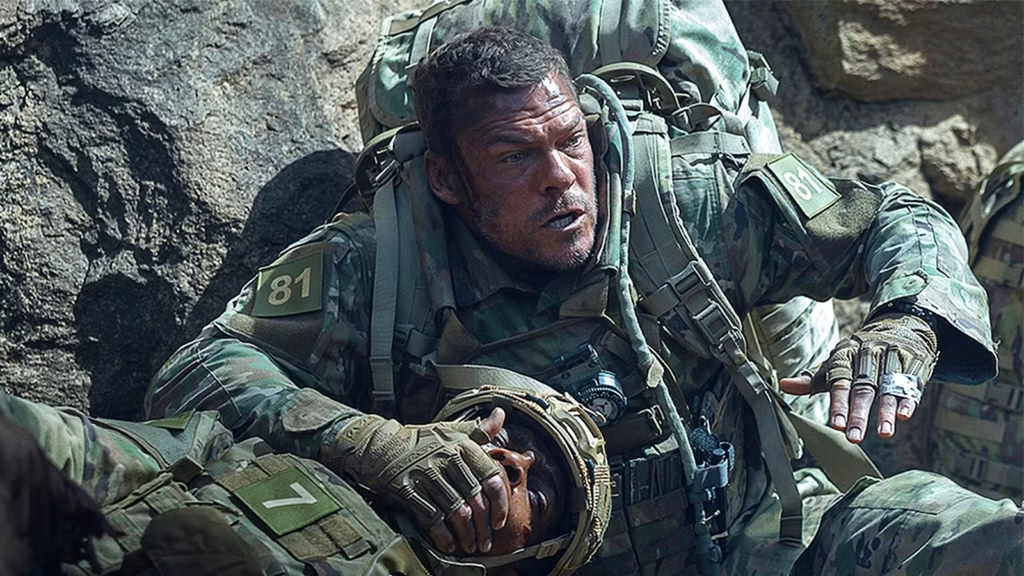
The second pillar is the rangers and their theme. This actually became 81’s theme in the end as well, since he becomes a ranger himself by the end. Ultimate it’s as 7 tells him when they’re lying in the mud in the rain. 81 believes he has failed everyone and 7 replies; “But you never gave up. That’s not failure, that’s a ranger”. The rangers’ theme can be heard most clearly on the album in the tracks “81”, “I Never Made It Back to Base” and “War Machine”. This main theme also uses intervals but instead of always falling, the main melody first falls, but then rises above where it started. It continuously keeps rising. Even as it falls, it rises higher, pushing forward; just like the rangers themselves. And just like 81.
And the third pillar of the score is the machine itself. I wanted to make the sound of the machine feel overwhelming and “awesome”. Like that feeling when you’re standing at the bottom of a large waterfall and you look up. The feeling of insignificance. There’s a bunch of textures I used to try and do that. These included choir, various synths, and a big one is an instrument called a Carnyx. This is an old 2000+ year old brass War Horn, which was played by Celtic warriors in both the battlefield to intimidate their enemies, and also in rituals and more intimate settings. It’s a very unique instrument as it can sound very menacing, deep and big. But also can be very soft and rounded. I found a guy in France who specializes in making and playing these instruments, Samuel Meric, who is incredibly talented. He recorded a ton of samples and performances for us and I used those to build virtual instruments as well as manipulate the recordings and in the end that was one of the main textures of the machine.

One thing that sets “War Machine” apart is that it’s driven by its hero thinking he’s a failure, and that sense pushing him forward. How did you want to get that emotion across?
The falling and rising intervals as mentioned before was the main way I tried to tackle this. There are also several textures that are unique to 81. It’s not a unique approach maybe, but I’m always a sucker for a strong melody and a simple hook that can then be used in various ways across a score to consciously or subconsciously remind the audience of a particular feeling, theme or idea.
Where “Predator” throws you straight into the action with seasoned soldiers, “War Machine” has an interesting structure of soldiers trying to prove themselves as rangers – in a way where that could be the whole movie without a terminating robot even coming into the story. In that way, did you view this whole first half hour as a mini-movie?
Oh, for sure! That whole training montage especially was a pivotal sequence. I mean if you just see the amount of locations in those 8-9 minutes alone, it could be a whole movie itself. Musically there’s definitely a conscious effort to make the “world of the rangers” feel and sound different to the “world of the machine”. But as soon as we get to the drop off, that’s where we start to change gears and get the audience primed for the big turn.
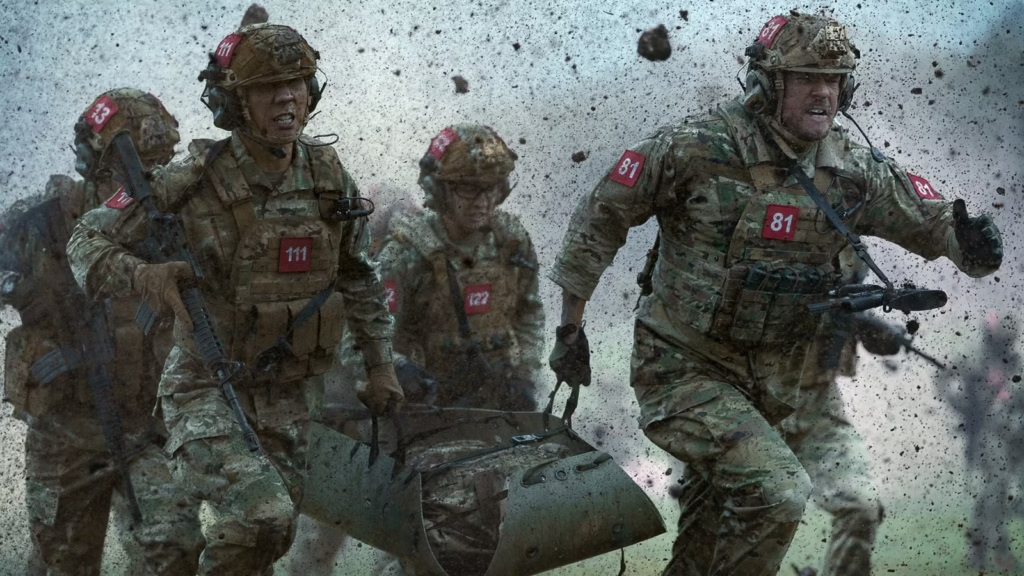
What do you think sets writing for American patriotism and soldiery apart, or do you think it’s a universal composing approach?
I actually don’t think this film tries to aim for that at all. I can completely understand how it may seem like that because they’re US soldiers in training. But if you changed the story and made them all British SAS trainees, it would literally change nothing about the plot or the characters (maybe their accents). The locations might change but that’s about it. Patriotism doesn’t really ever enter the picture for me. For me this was a simple survival story with that underlying theme of what it means to cross that “finish line”, and in 81’s case, overcome his inner demons (and then insert a giant killer robot). So I guess to answer your question, I just simply followed the story, keeping all of those fundamental ideas I discussed with Patrick in the back of my mind as I went along.
As this movie is the potential set-up to hopeful sequels, this picture doesn’t really tell us about the war machine’s background as such. Did you imagine one while composing for it?
Oh I actually know all about its background, where it’s from and why it was there. Well, the broad strokes anyway. Pat and his writing partner James Beaufort have mapped out a whole plan if this ever was to branch out into a franchise. And we discussed at length some of the background of these things and what they want. Some of that definitely influenced the sonic palette I was using. With this movie, we’re experiencing the first 24 hours of an alien invasion from the rangers’ perspective. They wouldn’t have any idea yet why they’re here. There will be a lot of that world building if there are sequels of course so I’m the wrong person to talk about it, but it definitely makes me excited to see where this story will go.

What went into the orchestral and sampled construction of the War Machine – particularly when it comes to brass and mysterious electronic sounds?
I had already mentioned the Carnyx which was a big part. That sound was put through various effect chains including heavy filtered distortion and big reverbs. It also naturally can play an interval that became a motif for the machine (again trying to use intervals to juxtapose and relate to the other two main themes). But other important elements were of course the synths and heavy percussion. I got to record a ton of synths for the score which was a lot of fun. There’s an incredible space in Melbourne called “Synth Temple”. It was a lot of fun using some of their old and new synths and seeing all the various cool sounds we could get out of them.
A lot of today’s action scores are driven by percussion. How did you want to make your rhythm interesting here, especially given the war machine’s pure, seemingly unstoppable relentlessness?
Being a percussionist myself, I used some of my own drum recordings and virtual instruments I created over the years, as well as the typical libraries and instruments. But rhythm is definitely a big part of the score. I did think about a rhythmic hook that could relate across the score; the rhythm in the rangers’ theme is ultimately similar to what you hear in the final big battle against the machine. This was on purpose to be able to, hopefully, reflect both the machine’s relentlessness and 81’s relentlessness also.
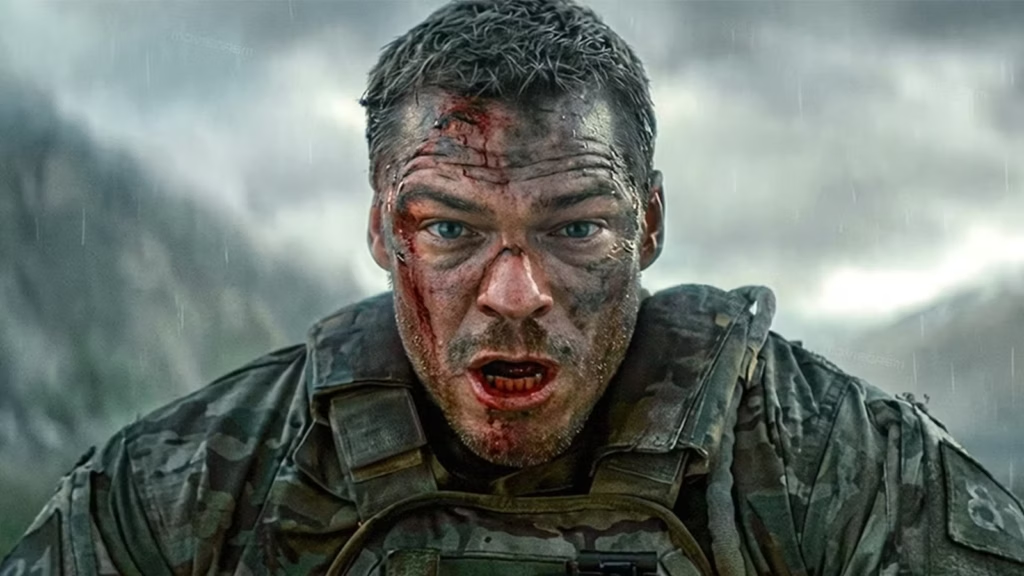
The War Machine is actually scary, which is no mean feat. Do you remember what monsters, or robots had that effect on you as a moviegoer, and how did you want to bring that kind of “Holy Shit!” fright to this score?
Totally! Pat and I actually often said that, as big and bombastic as this movie is, we thought of it as a horror film at its core. And so the score should be partly a horror score as well. I’m also a massive horror fan. So I could name a million movies that have had an influence on me, but as far as monsters go… I think some subconscious influences were probably “Jaws,” “The Terminator” of course, “War of the Worlds,” and even Kubrick’s “The Shining.” And maybe a big one (pun intended) would be the T-Rex from Jurassic Park.
Do you think it helps the film that it plays it straight and very seriously, as opposed to other “Predator” spins that often have a humorous self-awareness about what they’re riffing on?
I honestly (and this is going to be personal opinion here) don’t think every movie has to be funny and quippy. Even for it to be self-aware. And trust me the filmmakers are fully aware of what they’re doing with “War Machine!” We are absolutely inspired by the kind of films we grew up watching and this film, including the score, is harkening back to that era with a nod and a wink. There’s been this trend for a while now (maybe because of the superhero genre dominating for so long, I’m not actually sure) with peppering our action movies with jokes and quips. And there’s absolutely nothing wrong with that. But I actually remember watching a lot of those 80’s and 90’s action films and actually… many of them were not as self-aware as we’d like to think. I mean this is a movie about a giant alien robot and a team of trainees with no guns, and no names. It’s ridiculous already. But if we’re going to ratchet up the tension, and really bring out the horror of what’s happening, as well as the more intimate aspects of 81, then why not take it as seriously as the characters do?
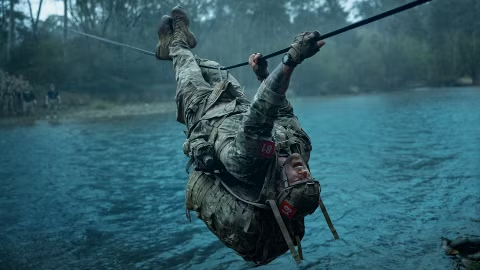
The other big obstacle the dwindling rangers face here is nature itself. Tell us about that scoring element, particularly when it comes to the vastly suspenseful rapid-crossing sequence?
That river crossing, like many of the action set pieces in the film, was very fun to score. My approach is always to look at a scene or a story moment and just ask “what’s the most important element right now”. That could be an emotional beat, an action, a story moment or something else. With the river sequence the most important thing we wanted to get across was the idea that the machine could be just over the hill. You gotta keep in mind that when you’re standing next to those rapids, they’re so loud you can barely hear anyone speak, let alone the lumbering footsteps of the machine. So highlighting the tension with the compass, and an almost ticking-clock-like element was very important. Once the machine arrives that’s when the music gets big and heavy. Usually that’s also when the choir singers come out and all the horror action elements start building.
Did you consciously want to avoid a “Predator”-esque sound for “War Machine” while still getting across the idea of an unstoppable alien killer versus a lone soldier hero? And on the other hand, did you want to capture that Alan Silvestri spirit animal as such?
I was definitely channeling the scores that I love from that era, but with a modern twist. And we wanted the film to really have its own style that although inspired by that era would feel more current. “Predator” was definitely an inspiration, but also Jerry Goldsmith’s “Total Recall” was a big one, Basil Poledouris’ “Starship Troopers” and “Robocop”, as well as Brad Fiedel’s “The Terminator”.
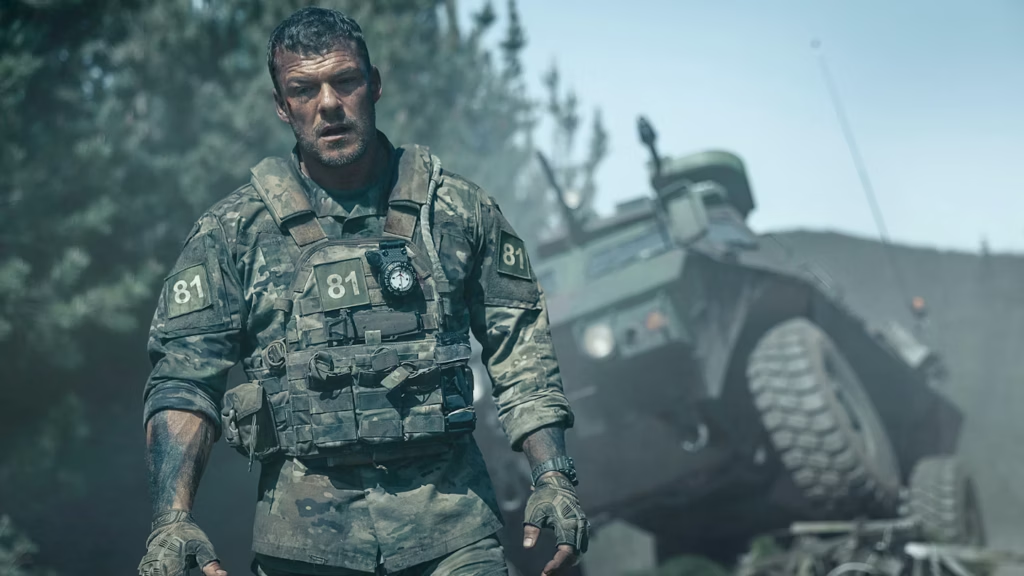
Did you want the score to change when it’s essentially 81 versus the War Machine?
There’s definitely a shift. Mainly things just begin to mesh, and all the elements really come together to become one. So you have the clash of the rangers/81 rhythms with the big real and synthetic percussion, and the big brassy theme (when 81 gets the upper hand), the choir elements of the machine, and the heavily distorted synths leading the whole thing. And tying it all together are these moments of horror and tension in the strings.
What do you think the chorus, and voice adds to the score?
My personal feeling is that having a large number of singers in a room can make one feel somewhat small when they really go for it. And ultimately that was the goal with introducing the choir/vocal element. That sound we hear in “2001 A Space Odyssey” when staring down at the monolith; the feeling of being a speck of dust in a world that’s bigger than us… or like looking up and seeing a giant murdering machine towering over you… I think the choir helps a bit with that.

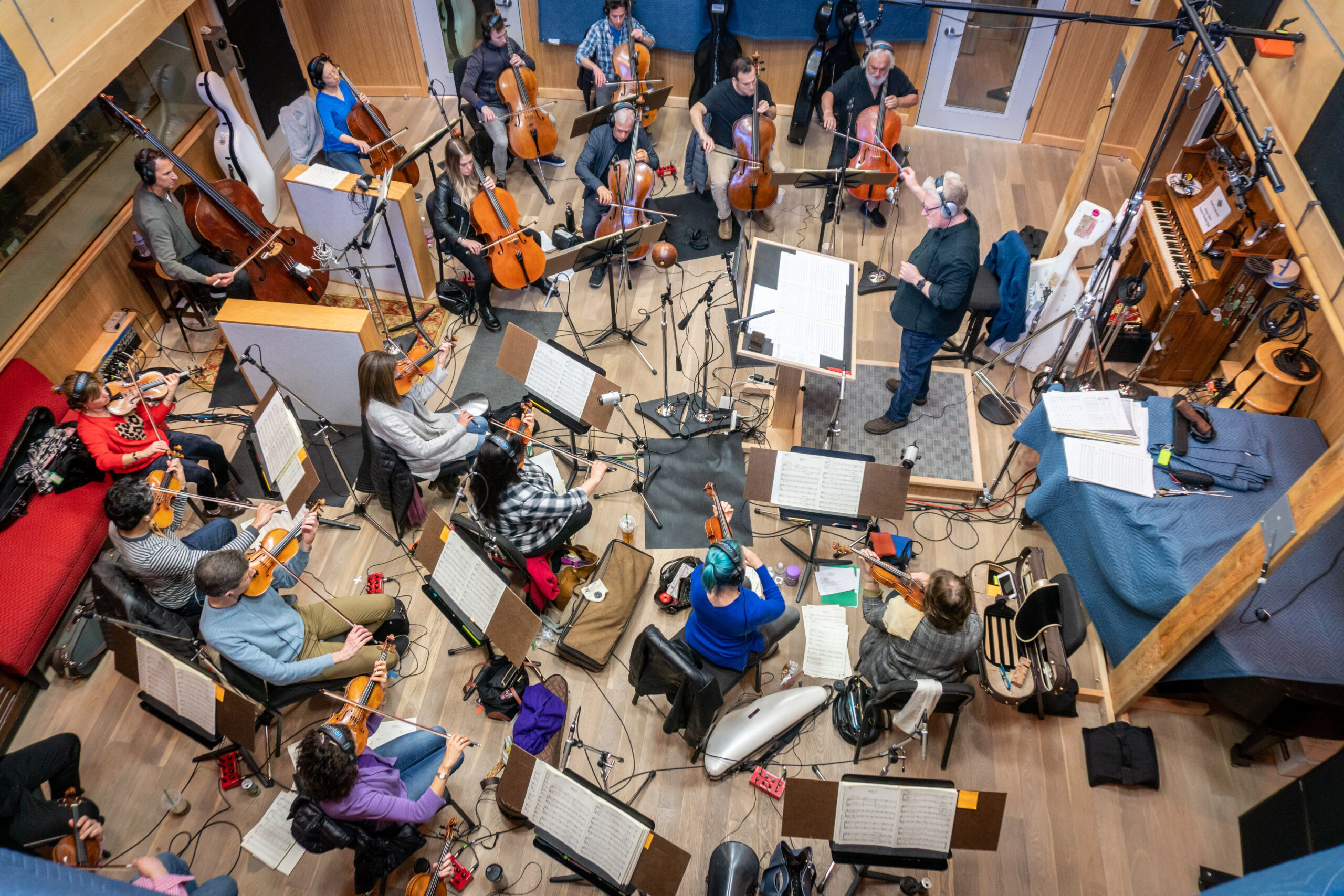
Dmitri and the “War Machine’ scoring crew
Tell us about the “War Machine” recording session.
We recorded the score at Trackdown Studios in Sydney over the course of about a week. And honestly it was a heap of fun. We had an amazing crew with us which made it a breeze, and the musicians were all wonderful. And I just tried to inject as much fun as I could into the whole process so everyone felt comfortable. We’re making music after all, and for a movie with a giant alien robot no less! How can we not have fun with that?
You began studying filmmaking. How do you think that helps you as a composer, particularly when collaborating with a strong director like Patrick?
I’m not sure if it does consciously, but I always keep the story and the characters first and foremost at the front of my mind. It’s not always a clear path, but being somewhat aware of how some of that sausage gets made and why some decisions get prioritized over others, certainly helps. And working with Pat has always been one of the easiest and rewarding collaborations for me. I feel like we know each other well enough now that when he tells me something or even doesn’t tell me something, I know exactly what he means. We have definitely developed a kind of shorthand over the years.

On the same wavelength, how does your background in sound design pay off, particularly here in making your music cut through the effects?
It definitely helps with some of my work. I often try designing interesting new sounds (when time allows for it of course) for every project I work on. And it does help me think about what the sound designer and the sound mixer might be aiming for in any particular scene so I don’t get in their way. With that in mind I just want to give a shoutout to our amazing sound designer on this film, Rob MacKenzie, who with his team did such a superb job on the sound and mix of the film. They really married the music and the elements of the machine together so well.
“War Machine” has been getting justifiable, if surprising raves given just how many times this kind of story has been around the block. What do you think about that reaction, and what sets this movie apart from the “Predator” pack?
Honestly I can’t say for sure, but I do think there’s a thirst out there for this kind of film. When was the last time we had an original IP, with a budget of this size, that had so much world building potential? Let alone one that was Rated R. They don’t come around as often as they used to I think. I also think that 81 as a character is a perfect vehicle for it, and Alan Ritchson is an absolute badass and a movie star in the making.

Patrick, Dmitri and friends at the “War Machine” Australian premiere
Should there hopefully be more adventures for 81 taking on the legions of war machines that are about to hit earth, where do you hope the story and your score go for it?’
Oh man… I honestly feel so lucky to have been a part of this film. It would be amazing to continue to be a part of any future installments. Regarding where the story could go… well I already have some idea of what the sequel is from what I’ve been told. And let’s just say, it goes to some big places. I don’t think it would be fair of me to reveal anything here but let’s just say it’s definitely an even more ambitious ‘adventure’.
What’s ahead for you?
Currently I’m scoring a horror comedy TV series called “Gnomes”, about murderous garden gnomes that come to life in a small town. It’s been a lot of fun to work on that show… very different to “War Machine” that’s for sure! And another really awesome project I’m currently working on that will be coming out later this year, is a video game called “The Dungeon Experience”. It’s a comedy adventure game that’s a bit hard to describe, but we have a bunch of trailers out, and right now people can go and play our demo on Steam and experience a part of it for themselves! There’s a saxophone playing crab… what more reason do you need?
Watch “War Machine” on Netflix HERE, and buy Dmitri Golovko’s score on Netflix Music HERE. Visit Dmitri’s website HERE
Leave a Reply