

Ironically snarky robots go back to the days of Robby in “Forbidden Planet” and C3P0 in “Star Wars.” But it’s doubtful that these wiseacre droids would have had any problem with the Krell monster or The Empire had they been suited up with the arsenal of the organically enhanced Murderbot. Yet for all of his head-blowing abilities, by far the sharpest part of Murderbot’s arsenal is his hilarious dry wit and ruminations that the dirty hippy settlers he’s been saddled are better off not hearing out loud – especially given that he’s a free agent from human control.

The antihero of author Martha Wells’ “The Murderbot Diaries” gets a wonderful flesh and blood printing as the star of Apple TV+’s series in the personage of Alexander Skarsgård. Introduced in an ominous yin-yang helmet before revealing a visage designed to install confidence, “Murderbot’s” endlessly funny stream of consciousness and overt action is exceptionally programmed by Paul and Chris Weitz, who’ve brought on composer Amanda Jones to give him musical voice that’s at points hilarious, threatening and finally endearing in a Bicentennial Man fashion. It’s an adaptation whose parts also bring in “Galaxy Quest”-worthy snippets of Murderbot’s favorite show “The Rise and Fall of Sanctuary Moon,” allowing Jones to not only play the sci-fi reality of Murderbot trying to save the settlers’ skins, but also the fourth wall of cosmic streaming cheese.
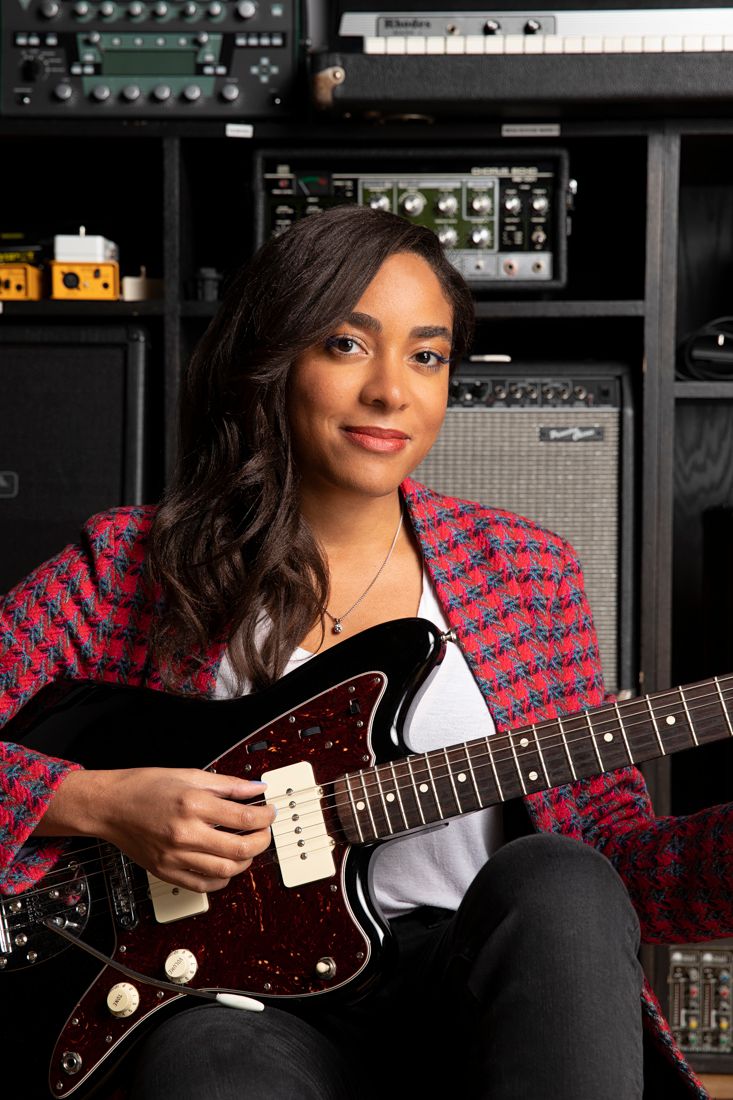
A music graduate from Vassar College and singer and guitarist of her band The Ant Job, Amanda Jones’ scores have encapsulated comedy (“Shitty Boyfriends,” “A Black Lady Sketch Show”) terror (“An American Horror Story”), superheroes (“Naomi”) and drama (“Emperor of Ocean Park”), all emotional programming that combines into “Murderbot” while exploring new avenues of electro-orchestral sci-fi music. She’s also received an Emmy nomination for the “Maine” episode of the dream house documentary series “Home” before having dramedy murder on her mind for Paul Weitz’s widower revenge film “Moving On.” Now she’s impressively exploring strange new sarcastic musical worlds for the bros with an unexpectedly moving bite to give a killing machine heart and soul in between Trek satire station breaks for the winningly evolving “Murderbot.”

What led you to music, and composing in particular?
I’ve always loved listening and playing music and knew from an early age that it would be a big part of my life. It wasn’t until I was much older and had graduated and moved to L.A. did I find composing for film and television specifically, a viable career choice. In Los Angeles everyone is always working on something (films, tv series, short form content) and needing music for those productions.
Your resume has a lot variety, but with no big genre series as such before “Murderbot.” Do you think they were looking for someone with a fresh approach in that respect?
In some ways yes – but also I’ve wanted to do a sci-fi thriller score a long time. The score definitely tows the line offering fresh / quirky ideas mixed with the traditional big orchestral space sci-fi sound. I had a great experience on Paul Weitz’s previous film so it was great to continue our collaboration and share our love of sci-fi on “Murderbot.”

Were you fan of sci-fi, and genre movies involving “emo” robots before doing “Murderbot?” And once you got the gig, did you dig into them?
I was always a fan of sci-fi and genre movies — involving “emo” robots? Does “Ex Machina” count? “Westworld?” If so, then yes 🙂 I was also a fan of the “Murderbot Diaries” book series before working on the show.
What’s it like to work with the show’s prime movers the Weitz brothers? What would you say are the biggest similarities, and differences in their musical tastes?
It was absolutely incredible working with them! We, and they, share a lot of similarities in our musical tastes, a love for the eclectic, modern classical, jazz, 60s-70’s rock, indie rock, the list goes on. Differences were few and far between but when they did come up it was very subtle and really taking into consideration the tone of a scene and what makes sense for the larger work.

How did you see, and hear the Murderbot? And how do you think your approach may have differed if he didn’t have Alexander Skarsgård’s face?
Well, it was interesting reading the books first, then experiencing Alexander’s face and voice over in the television series. The Weitz Brothers really honored the source material, and it really was almost identical to how I had imagined Murderbot from reading the books.
What do you think that Alexander’s deadpan delivery brings to the show, and your music? Do you think we can’t help but identify with him in some ways, especially as he’s the hero of the show?
I absolutely love Alex’s deadpan delivery in the show. He’s perfect and really speaks to a lot of our collective inner dialogue when interfacing with people making rash and BIG mistakes.
Given that Murderbot thinks of his “clients” as “ungrateful hippies,” how did you want to play them?
We have a lovely client / crew theme, track 02 on the soundtrack “Crew Montage” this is heard throughout the series and various ways. It’s fun, bubbly and quirky, like the crew.

Tell us about composing “Murderbot’s” main title that sets the series’ tone. There’s a fun, rhythmic machine-like quality to it.
Yes! I wanted to get the audience AMPED and ready to watch the show. It’s a fun juxtaposition to the more moody and deadpan aspects of the show. I wanted to elicit a powerful robotic and chaotic feeling mixed with some soaring emotional elements.
Much of Murderbot’s dialogue is his hilariously snarky interior monologuing and quips. How did that effect the score, especially in terms of having to play under dialogue that no one else is hearing, or otherwise not go straight through scenes?
I definitely complemented Murderbot‘s snarky tone with either silence – no score or very minimal score. Skarsgård’s performance is so fantastic. I didn’t want to overly highlight or underscore it. I wanted to let it sit most of the time.
What to you is futuristic “sci-fi” music? And how did you want to balance that synthy sci-fi sound with the show’s more humanistic and orchestral elements?
I don’t really consider the score to be futuristic sci-fi so to speak it’s kind of in its own lane really paralleling, emotion and anxiety. I’m making creative choices based on how I perceive Murderbot, something that is both robotic and organic, and the score reflects that with a lot of synthesizers I’m utilizing an analog Roland Juno 60 synth along with variety of other production elements blended with a full orchestral score

Even with that context, there are a lot of different styles to the electronic music in “Murderbot.” Tell us about some of them.
I would say the crew theme feels very much like 90s rave music, while some of the blended synths that you hear with the orchestra feel a bit more grandiose, blockbuster-esque and action packed.

Tell us about scoring the clips, and theme song of “The Rise and Fall of Sanctuary Moon.” They definitely help bring a “Galaxy Quest” feel to the show.
It was absolute pure bliss scoring the “Sanctuary Moon” segments. They stand apart from the rest of the score because they are 100% orchestral there are no synths or in the box sounds. I was definitely excited to flex my orchestral chops for those segments.
On that note, what’s the trick to playing a score where irony is a big counterpoint? Yet at the same time the score is humorous without being overt comedy.
For the irony to work, the score needs to be dead serious with its intention of being highly dramatic, orchestral and traditional. It makes the comedy that much more hilarious when the music is so self-serious.

What’s the trick to scoring a monster two-headed centipede?
Go big or go home! The worm fight in episode 1 had to sound massive and thrilling. This is the first time the audience sees Murderbot as a hero, so we really wanted it to feel scary, thrilling and exciting.
There are some pretty yucky operations in the series. Tell us about playing that queasy factor where the humans are particularly aghast at Murderbot’s wounds, let alone their own.
Throughout the series, I played a lot with sliding pitch, and Tri-tones to elicit a feeling of uneasiness and anxiety. I double these sounds with the orchestra to really press into the feeling of uneasiness.
There is the suspense that an “unchained” Murderbot is going to turn on his clients. Tell us about capturing the inherent killing machine nature of him.
Again, I wanted to play a lot with tempo and sliding pitch to give us this feeling of an uneasiness and anxiety, and that really plays a role in the beginning of the series where we hear a lot of high-pitched frequencies coupled with twirling strange synth sounds. I’m utilizing a Korean instrument called the Saenghwang and vintage synth Roland Juno 60 to help capture some of that sound.

For as funny as “Murderbot” is, there’s also a lot of drama to it, and ultimately quite moving emotion. Were you ever concerned about capturing all the tones in the score?
Absolutely those were some of the most important creative conversations I had with Paul and Chris Weitz. It was important to capture the comedy, the anxiety, the action and the emotion and make it all feel cohesive and unobtrusive. Those were some of the very first conversations we had, balancing the emotion and the humor.
A big theme of the show is how Murderbot and his “clients” come to care for each other – albeit very reluctantly at first. How did you want to capture that hesitant bonding?
I played a lot with timing and silence, and eased in emotion with more organic instrumentation, the orchestra, cellos, woodwinds, etc as the series progresses. Silence was very important to capture the awkward feeling. The use of high frequencies and pitch bending via synths (and played in parallel with orchestra) was also an important part of the sound.
How do you think Murderbot has helped you grow as a composer?
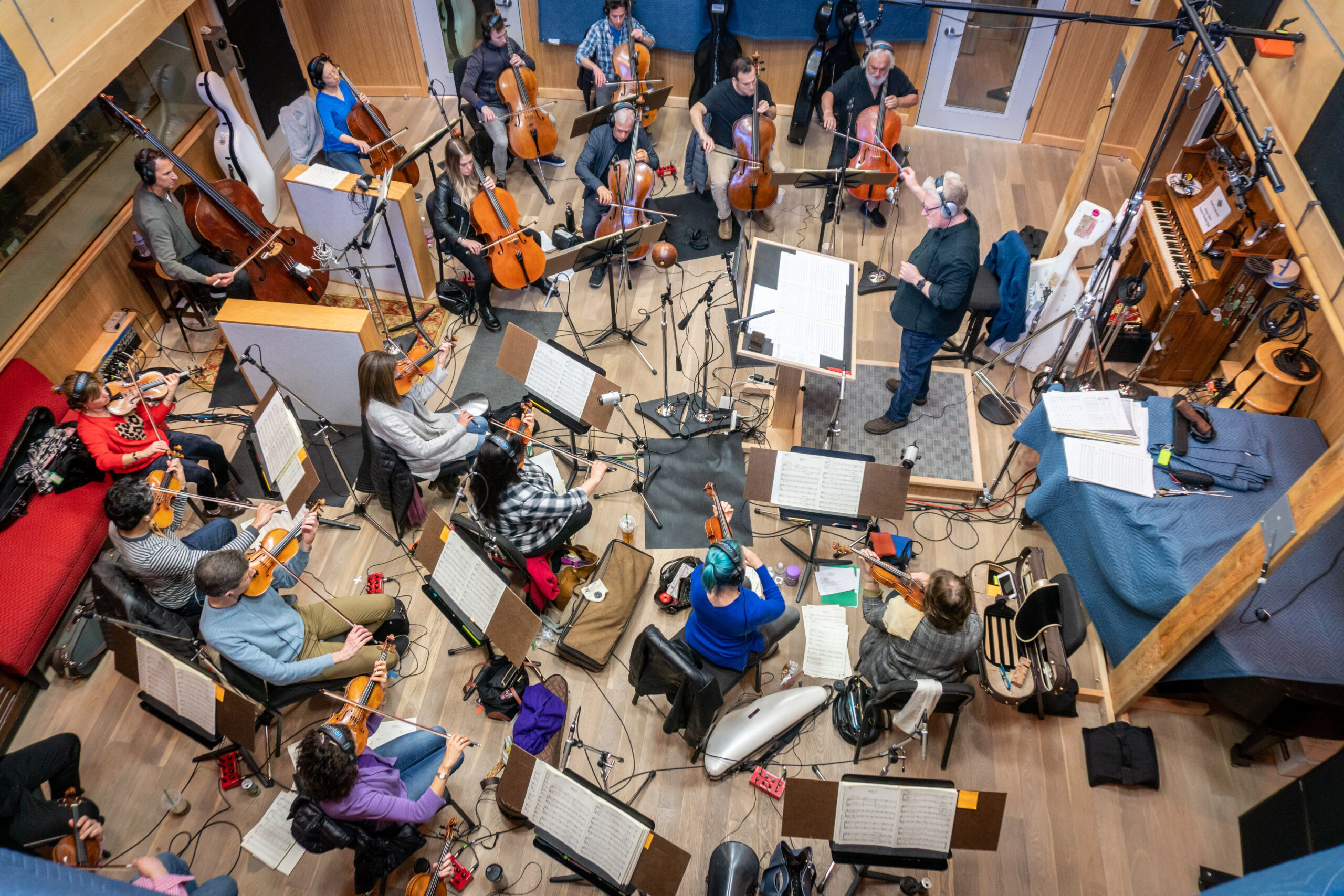
While all the music was created organically and effortlessly and was a lot of fun to create the biggest milestone was then wielding a 40-piece orchestra to both complement the synth-y elements and really make the standalone orchestral pieces shine.

When you look at the number of female composers doing genre films and television, do you think there’s a renaissance going on in that regard?
I do think there is a growing number of female composers composing for a variety of genres of films and television, and I’m happy to see the numbers increasing albeit slow but moving in a positive direction.
What’s ahead for you?
I’m currently working on a lovely beloved, animated series and a few documentary features.
There are seven Murderbot books and short stories with the character. If this series hopefully catches on, where would you like to see the character and your music for him go?
Murderbot is on a glorious journey of self-discovery, so I’m excited to see the music continue expanding thematically and instrumentation wise. With many more interactions to be had, planets to discover and hidden truths – there’s much to explore.

Watch “Murderbot” on Apple TV + HERE, with its score available on Lakeshore Records HERE. Visit Amanda Jones’ website HERE
Special thanks to Jana Davidoff and Alix Becq-Weinstein at Rhapsody PR