
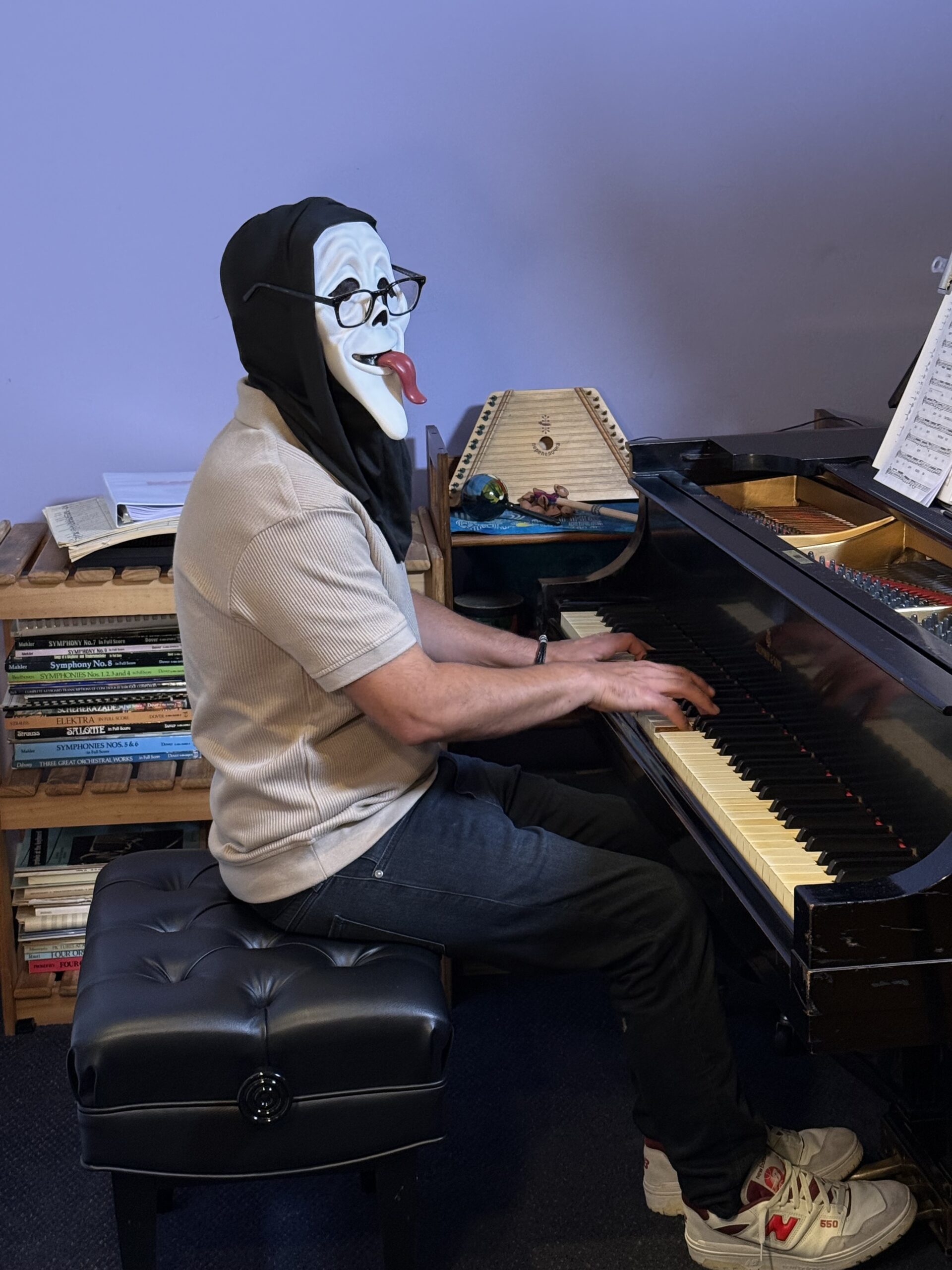

Why so serious when it comes to playing slapstick? That’s the question that Elmer Bernstein brilliantly answered by spoofing his own very dramatic approach for drama when it came to socking over the movie parody laughs of the PG “Airplane!” back in 1980. It’s a tradition applied since by composers taking less comedic routes to selling the whole genre of spoof pictures pioneered by that joke-a-second first flight, and now is proudly continued by Haim Mazar for “Scary Movie 6” – or “Scary Movie” as the new edition calls itself. Calling back much of the agelessly game cast of the the first 2000 picture for no-end of very R rated, up-to-the-second spoofery that shows very little has changed at all when it comes to how the franchise has hilariously shadowed the “Scream” franchise (it certainly helps that both bear the Miramax monicker). Sure enough, Mazar’s ferociously, not often smiling score plays the parodies for real stakes, with stabs at the styles of “Scream,” “The Substance,” “Sinners’ and “Longlegs” among many, many, many others. That the end result is shockingly cohesive as it thematically veers between raging orchestra, shoot em ‘up techno and vampire twang says much about Mazar’s steady rise in Hollywood that now threatens to go nuclear with a movie that’s kicked He’Man’s ass and then some. For a movie that assaults PC with an equal sense of sharpness and dumb fun, “Scary Movie’s” score shows the Israeli composer’s blunt intelligence at gravely playing for laughs.

Haim Mazar conducts “Versa”
Tell us about what interested you in music, and film music in particular when growing up in Israel? Did you view movies as a gateway to America?
I was drawn to music at a very early age, around five years old. I remember attending a birthday party where the entertainer was using a keyboard workstation and building songs layer by layer in real time. To most people it was probably just part of the party, but I was completely fascinated. Watching one person create an entire musical experience from a keyboard felt almost like magic. When I got home, I asked my parents for a Casio keyboard, and that was the beginning. Not long afterward, I started studying classical piano, and from there music gradually became a central part of my life. Interestingly, film music came much later. I attended Berklee College of Music as a jazz piano major and had no intention of becoming a film composer at the time. One night while working in the library, I came across a film scoring book while putting books away. I opened it to a chapter about John Williams, George Lucas, and the score for “Star Wars,” and something immediately clicked. Until that moment, I had always thought of my love of music and my love of film as two separate interests. Suddenly I realized there was a profession that combined both.
Growing up in Israel, movies certainly provided a window into a much larger world. American films introduced me to different styles of storytelling, music, and culture, but what ultimately inspired me wasn’t America itself. It was the realization that music could become an essential storytelling tool, shaping how audiences experience a film emotionally. Discovering film scoring at Berklee gave me a path that brought together everything I loved, and from that point on I knew exactly what I wanted to pursue.

How did you make inroads here?
My path into the industry really began on my first day in Los Angeles. After graduating from Berklee College of Music, I moved to LA and started working as an assistant to composer John Frizzell. It was an incredible opportunity because it allowed me to be close to the filmmaking process while also developing relationships within the industry. At that stage of my career, I was eager to compose, but like many young composers, I needed someone willing to give me a chance. That person was John. Beyond being a mentor, he became a strong advocate for me. When an opportunity arose to score the independent feature “On the Inside,” he encouraged the producers to hire me instead of taking the project himself. What made that gesture especially meaningful was that he told them if they weren’t satisfied with my work, he would personally step in and score the film himself. That’s a remarkable level of trust and support, particularly for a young composer just starting out. “On the Inside” became my first professional feature score and gave me the opportunity to establish myself as a composer. From there, I began building my own career one project at a time. There wasn’t a single overnight breakthrough. It was a gradual process of earning trust, developing relationships, and continuing to grow with each new opportunity.

One of your first scores was for the severe possession movie “The Taking of Deborah Logan,” which became an instant cult movie. Tell us about the experience of scoring a beyond scary movie.
“The Taking of Deborah Logan” was a particularly special experience for me, not only because it was one of my earlier projects, but because I loved collaborating with director Adam Robitel. Adam had a very clear vision for the film, and from the beginning it was obvious that he wasn’t interested in making a conventional possession movie. He wanted something that felt unsettling and authentic, grounded in reality rather than relyi
What made the film especially interesting from a musical perspective was its unique hybrid format. It was a found-footage film, but it also had elements of a documentary and a traditional narrative feature. That created an interesting challenge because the score had to exist within a world that was designed to feel real and observational. We couldn’t approach it the same way we would a more conventional horror film. The music had to be very selective, carefully supporting the tension without drawing attention to itself or undermining the documentary-like realism that made the film so effective. As a result, the score ended up being relatively minimalist, but I think that restraint ultimately worked in the film’s favor. Sometimes horror is most effective when the music isn’t constantly telling the audience how to feel. Looking back, I’m especially grateful that the film has continued to find new audiences over the years and has become something of a cult classic. It’s incredibly rewarding when a project continues to resonate with viewers more than a decade later, and “The Taking of Deborah Logan” will always hold a special place in my heart because of that.

Another breakout for you was scoring the mob hitman movie “The Iceman,” another very serious tour into demented psychology. Talk about going to that extreme.
“The Iceman” is another early project that remains very special to me because it helped elevate my career at an important stage. I was already familiar with the story of Richard Kuklinski through the documentaries and books about his life, so when I learned that Ariel Vromen was directing the film, I immediately became interested. The project had an incredible cast, and I was fascinated by the challenge of exploring the psychology of such a complex and deeply troubled individual through music.
Because the story is so dark, the score naturally evolved in that direction as well. I remember spending months almost completely immersed in the world of the film while writing the music. During that period, I was watching scenes repeatedly, studying the performances, and allowing myself to live inside that atmosphere for long stretches of time. Michael Shannon’s portrayal of Kuklinski was especially powerful because he captured both the menace and the unsettling humanity of the character. It was impossible not to be affected by that performance as a composer. What I found most interesting about the film was that it wasn’t simply a crime story. It was really a psychological portrait of a man living two completely different lives. As I worked on the score, I tried to reflect that tension and darkness without ever glorifying the character. Looking back, I think some of the emotional weight and unease that I felt while living with the material found its way into the music, and that’s one of the reasons the score remains meaningful to me all these years later.

From “Believe: Sea of Dreams”
On a happier side, you’ve had a continuing relationship with Disney parks and shorts. Could you talk about some of those projects and the challenges of writing for live events?
I’ve been fortunate to work on projects for the Disney Parks for roughly the last decade, and it’s provided a wonderful creative balance to my film scoring career. What I enjoy most is that every project presents a completely different creative challenge. Some involve original composition, while others require reimagining music from some of the most beloved films ever made. For example, when I was creating background music for Adventureland at Magic Kingdom, the score was entirely original. The challenge wasn’t simply writing music for a themed land, but designing it in a way that could coexist with the surrounding lands and create seamless transitions as guests moved through the park. The music had to function in loops and synchronize with neighboring areas so guests wouldn’t experience abrupt changes as they crossed from one land into another. In many ways, you’re scoring a physical environment rather than a film. You think about walking pace, atmosphere, and how music can become part of the architecture and storytelling of the space itself.
Other projects require a very different approach. On “, I worked with well-known songs from the Disney catalog and helped reimagine them for a massive nighttime spectacular. The challenge there was taking music that audiences already know and love and adapting it for an enormous outdoor venue with water effects, projection mapping, fireworks, and large-scale live performance elements. That often meant expanding the arrangements, increasing the scale of the orchestration, and finding ways to surprise guests with fresh interpretations of familiar material. The goal is not simply to recreate what people heard in the films, but to give guests a unique experience that can only exist within the Disney Parks.

What does Marlon Wayans comedy brand represent to you? And the Scary Movies in particular?
What I’ve always admired about Marlon Wayans is his fearlessness as a comedian and storyteller. His comedy is bold, unapologetic, and often pushes right up against the edge, but underneath that is a deep understanding of timing and audience psychology. The original Scary Movie films were incredibly influential because they didn’t simply parody horror movies, they helped redefine modern genre satire. What made them work was that they were created by people who genuinely understood and loved the genres they were poking fun at.
One of the most interesting things I discovered while working with Marlon is how much his creative instincts are rooted in sketch comedy. The Wayans family comes from that world, and sketch comedy operates very differently from a traditionally scored film. In a sketch, the joke is often the entire focus. There’s usually no need for music to help shape the storytelling because the comedy lives entirely in the performance and the writing. Film scoring introduces another layer to that process, and one of the interesting challenges was figuring out how music could support the comedy without ever getting in the way of it.
With the help of director Michael Tiddes, I gradually learned how Marlon likes to tell stories and how he approaches comedy. One of the principles that emerged early on was that the music should establish the mood, create the stakes, and then know when to step aside. Marlon would often describe it as “setting up the mood and clearing for the joke.” That became one of the guiding philosophies of the score. The music isn’t trying to compete with the comedy. It’s helping create the world around it. What made this latest “Scary Movie” especially exciting was seeing how much passion Marlon still has for the franchise. There was a genuine desire to honor what audiences loved about the originals while also evolving the formula for a new generation. As both a film fan and a composer, it was incredibly rewarding to contribute to a franchise that has had such a lasting impact on comedy and popular culture.

“Scary Movie” is your biggest picture to date, and your second collaboration with director Michael Tiddes after “Half Baked: Totally High.” Was it a done deal that you’d score this? Or did you have to prove yourself?
It was definitely a process. My relationship with Michael Tiddes actually began in the best possible way. He was a fan of some of my previous work on “Sneakerheads” and “Woke” and ended up using that music as temp score while he was working on “Half Baked: Totally High.” That eventually led to us meeting and, ultimately, to me scoring the film. I often joke that “Half Baked: Totally High” was like a first date for Michael and me, and fortunately we hit it off. Through that project we developed a great creative rapport. We shared many of the same musical instincts, had a similar sense of comedic timing, and quickly built a strong level of trust in one another.
Michael is also one of the most loyal and supportive people I’ve worked with. He’s always felt a bit like a big brother to me. Beyond that, he has a remarkably clear vision for his projects and a deep understanding of every aspect of filmmaking. As a composer, that’s incredibly valuable because he knows exactly what he wants music to accomplish and how it can support the storytelling. That clarity makes collaboration much easier and allows everyone to move in the same direction creatively.
Even with that relationship in place, “Scary Movie” was far from a done deal. Once the project entered post-production, I began writing music and developing ideas before I had officially been hired. Michael was incredibly supportive and championed my work throughout the process, sharing it with the studio, producer Rick Alvarez, and eventually Marlon Wayans. When the time was right, he arranged a meeting with Marlon that essentially served as my job interview. We spent time discussing the musical direction of the film, and Marlon listened to the material I had been developing. The meeting went extremely well, and he responded strongly to both the music and the overall approach. Between Michael’s confidence in me and Marlon’s enthusiasm for what I was presenting, I was ultimately given the opportunity to score the film. Looking back, I’m grateful that I still had to earn it, because it made the experience of joining such an iconic franchise even more meaningful.

Composer Haim Mazar and director Michael Tiddes (Photo by Jana Davidoff at Rhapsody PR)
How was your collaboration with Michael on “Scary Movie?”
One of the advantages Michael and I had going into “Scary Movie” was that we already had a creative shorthand. We didn’t spend a lot of time debating what the music should be doing because we were usually on the same page from the start. Because the film is a parody, the musical role of each scene was often very clear. The score needed to fully commit to whatever genre we were referencing while also knowing exactly when to get out of the way and let the joke land. A lot of our conversations weren’t about what the music should do, but rather when it should stop doing it.
Once I was hired, the experience honestly felt less like working on a major studio film and more like making an independent film with one of my closest friends. Michael created an environment that was incredibly collaborative and supportive. He has a very clear vision for what he wants, but at the same time he gives his creative partners the freedom to explore ideas and bring their own voice to the project. From the beginning, he trusted me to experiment, take risks, and find creative solutions, which is something every composer hopes for in a director.
Another aspect that proved incredibly valuable was the opportunity to have my music included in the film’s test screenings. That’s a luxury composers don’t always get. It meant we were able to watch real audiences react to the film and see firsthand what was working. Those screenings gave us valuable feedback, but they also gave us confidence that the musical approach was helping the comedy land the way we intended. By the time we reached the final mix, we had already seen audiences respond to many of the choices we had made, which made the entire process feel even more rewarding.

(Photo by Jana Davidoff at Rhapsody PR)
How did you find Marlon’s approach to underscore? And could you feel how important it was for him to reclaim his ownership over the franchise?
Marlon’s approach to underscore was very different from many filmmakers I’ve worked with because his instincts come from sketch comedy, where music often plays a much smaller role in the storytelling process. That made our conversations particularly interesting because we were constantly exploring how the score could enhance a scene without ever interfering with the comedy. Marlon had very strong instincts about timing and understood that music could be a powerful tool, but only if it knew when to step aside and let the joke land.
What surprised me most was how seriously he approached the filmmaking itself. People naturally associate Marlon with comedy, but behind the scenes he was incredibly thoughtful about every aspect of the film. He cared deeply about the storytelling, the pacing, the performances, and the overall audience experience. There was a level of precision and attention to detail that I think audiences don’t always see because they’re focused on the comedy. Working with him gave me an even greater appreciation for how difficult it is to make something genuinely funny, especially a parody. Having worked in virtually every genre throughout my career, I’ve come to realize that comedy, and parody in particular, can be one of the most challenging. It was also clear that this franchise means a great deal to him. There was a genuine desire to honor what audiences loved about the original films while also creating something that felt fresh for a new generation. Throughout the process, you could feel the passion and sense of responsibility he brought to the project. Whether we were discussing a scene, a joke, or a musical cue, there was always a shared goal of making the strongest film possible. That level of commitment was inspiring and had a positive effect on everyone involved.

In a way, you’re like Hannibal Lecter when it comes to getting inside composers’ heads that you’re taking off, whether it’s “Longlegs” or “John Wick.” Did you listen to a bunch of their scores before starting Scary Movie? And what did you discover along the way about what gives a composer an “identifiable” voice?
When it came to the parody aspect of “Scary Movie,” I was already very familiar with most of the films and scores we were referencing. Because of that, I actually made a conscious decision not to spend too much time revisiting the original music. There were a few moments where I went back and compared specific cues, but for the most part I relied on my existing familiarity with the material. I didn’t want to accidentally start copying anyone. The goal was never to recreate a score note for note, but rather to capture the essence of what audiences associate with a particular film or genre.
My guiding principle was something I jokingly refer to as “musical stereotyping.” I would try to identify the musical tropes, instrumentation, and overall sonic language that immediately defined a particular score. In other words, what is the one thing that makes this sound unmistakably like that film? Once I could answer that question, the path forward usually became very clear. For “Sinners,” it was the delta blues influence and the sound of the dobro guitar. For “John Wick,” it was the aggressive rock elements, distorted guitars, and driving percussion. As composers, those kinds of musical signatures already tell us a tremendous amount about the world we’re trying to evoke.
At the same time, I didn’t want the score to feel like a collection of disconnected parodies. Before diving into the various genre references, I made sure to establish thematic material of my own for “Scary Movie.” I wrote several core themes that could function as the musical backbone of the film. Once those themes were in place, I could filter each parody through the larger musical identity of the score. Sometimes that connection appears in the melody, sometimes in the harmony, and sometimes it’s just a few notes hidden beneath the surface. Even when the score is spoofing another style, there’s usually something linking it back to the larger musical world of “Scary Movie.” One of the things I discovered through that process is that a composer’s voice is often much simpler than people think. It’s rarely one specific technique. More often it’s a collection of recurring choices: certain harmonic tendencies, instrumentation, rhythms, textures, and ways of approaching emotion. The best composers develop a musical vocabulary that feels uniquely their own, and after a while audiences can recognize that voice almost instinctively.

On the flipside, talk about having fun with a lot of the clichés that film scoring has fallen into with any number of genres.
One of the most enjoyable aspects of scoring “Scary Movie” was that it gave me permission to embrace musical clichés in a way that most films don’t. Normally, as composers, we’re trying to avoid being predictable. We’re looking for fresh ways to approach a scene, subvert expectations, and create something that feels unique. On a parody, however, those familiar musical tropes become part of the storytelling language. The audience needs to instantly recognize the genre being referenced, so sometimes leaning into the cliché is exactly the right creative choice. What made the process especially fun was figuring out how far to push those conventions. Horror, action, prestige thrillers, elevated horror, supernatural films, they all have their own musical vocabulary. Whether it’s oversized jump-scare stingers, relentless action percussion, ominous drones, distorted guitars, or overly dramatic emotional swells, every genre has developed a set of musical shortcuts that audiences immediately understand. Part of the fun was identifying those elements and then deciding whether to play them straight, exaggerate them, or combine them with something unexpected.
At the same time, we were careful not to treat the score as a joke. The goal was never to make fun of the music itself. In many cases, the comedy actually became stronger when the score was completely committed to the scene. Some of my favorite moments are the ones where the music behaves as though it’s scoring the most important scene in cinematic history while something completely ridiculous is happening on screen. That’s really the magic of “Scary Movie.” The score takes the movie seriously, which often makes the comedy even funnier.

What do you think is the difference between “comedy” music and “serious comedy” music?
To be honest, I’m not entirely sure there is such a thing as “comedy music.” I think there are certainly musical styles, instruments, and techniques that audiences often associate with comedy. Certain sounds can feel playful, quirky, mischievous, or lighthearted, and when they’re placed within a comedic context, people naturally perceive them as comedy music. But I don’t think those musical elements are inherently funny on their own. Their effectiveness comes from how they interact with the story, the performances, and the filmmaking around them.
There are certainly films where you can hear the music working very hard to sound funny. You hear pizzicato strings, quirky percussion, plucky guitars, and other musical devices that have become associated with comedy over the years. There’s absolutely nothing wrong with that approach, and sometimes it’s exactly what’s needed. But personally, I’m not convinced that those choices necessarily make the joke itself any funnier. They may lighten the tone, lower the stakes, or signal to the audience that they’re in a comedic environment, but that’s different from creating comedy. For me, it’s really about context. It’s about the tone of the film, the world we’re creating, and the environment in which the story takes place. The score helps establish that backdrop and gives the audience a framework for experiencing the story. The comedy then emerges naturally from what’s happening on screen rather than from the music trying to be funny.
That’s one of the reasons I’ve always believed that the best comedy scores should be able to stand on their own away from the film. If you remove the picture and simply listen to the soundtrack, the music shouldn’t necessarily sound like “comedy music.” It should sound like whatever musical language the film requires, whether that’s orchestral, dramatic, suspenseful, action-driven, or emotional. The comedy comes from the relationship between the music and what’s happening on screen, not from the music itself. In many ways, that’s what made “Scary Movie” so much fun to score. The music wasn’t trying to tell the audience that something was “funny.” It was trying to fully commit to the world of the scene and allow the comedy to emerge naturally from the contrast between what you hear and what you see.

Even though you’re playing it straight, you can’t get too straight because then you get too serious. How difficult is it to walk that tightrope?
It was definitely one of the biggest challenges of the score. While our guiding principle was always to play the material seriously, there were certainly moments where going too far in that direction could start to work against the comedy. The trick was finding the balance between creating genuine stakes and reminding the audience that they’re ultimately watching a comedy. Sometimes that meant pulling things back and introducing a slightly lighter touch. Other times it meant doing the exact opposite and pushing the music so far into the genre that it became almost campy. The challenge was figuring out what each scene needed and adjusting accordingly.
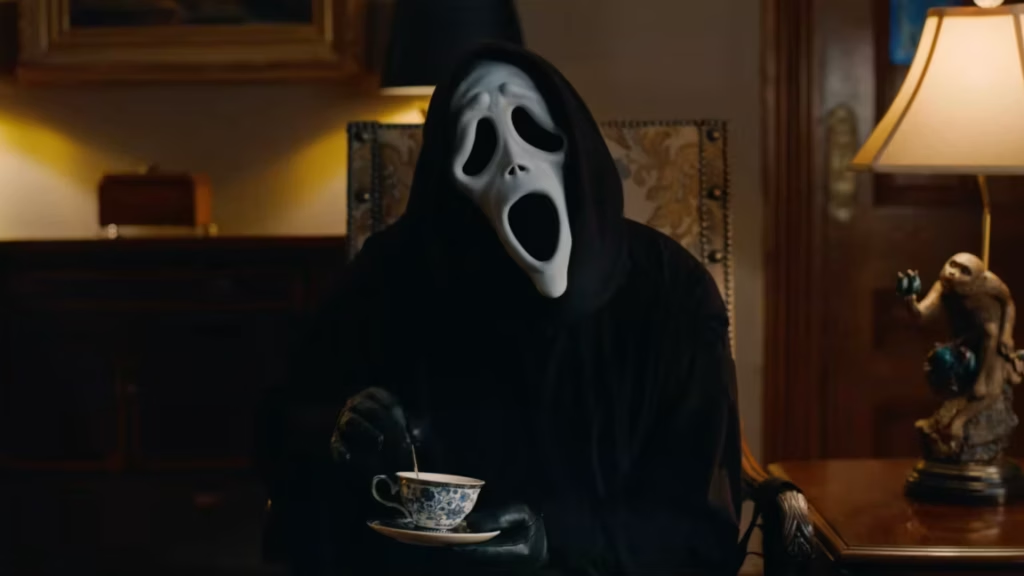
The “Longlegs” parody was actually a good example of that balancing act. The original film has such a dark and unsettling musical language that when I initially leaned too heavily into that approach, it started feeling like it belonged in a different movie altogether. The music was working on its own terms, but it wasn’t fully living in the world of “Scary Movie.” I had to find ways to lighten it up and bring it back into the tone of our film while still preserving the essence of what made the original so recognizable. That was a good reminder that parody isn’t just about imitation. It’s about adaptation. Ultimately, I think the “Scary Movie” score succeeds because it doesn’t commit to a single approach. Sometimes the funniest choice is to play a scene completely straight. Sometimes it’s to pull back. Sometimes it’s to go so over the top that the audience understands we’re in on the joke. Finding that balance was a constant process throughout the film, but it’s also what made scoring “Scary Movie” such a rewarding creative challenge.

What was your favorite film and score to parody?
That’s a difficult question because each parody allowed me to explore a different musical world, but if I had to pick a couple of favorites, I’d probably point to the opening sequence and the “Sinners” spoof. The opening was especially enjoyable because it gave me an opportunity to lean into the modern superhero and blockbuster action sound. For a brief moment, I got to pretend I was scoring a massive comic book movie, complete with oversized orchestral themes, big action set pieces, and all the musical confidence that comes with that genre. Those kinds of scores are incredibly fun to write, and because “Scary Movie” is a parody, I was able to embrace many of those conventions in a way that felt both sincere and playful.
The “Sinners” sequence was another favorite because it was such a departure from the rest of the score. Musically, it lives in a very different world, drawing from blues influences and a distinct regional identity that immediately sets it apart. As a composer, it’s always exciting when a film gives you an excuse to explore a completely different musical vocabulary, and that sequence allowed me to step outside the orchestral horror-comedy framework that defines much of the rest of the score.

How close did you want to get to the scores you’re satirizing and did that ever become a problem?
I wanted to get close enough that audiences would immediately recognize the reference, but not so close that the score stopped feeling like “Scary Movie.” Recognition is obviously an important part of parody, but I was never interested in simply recreating another composer’s work. The goal was to capture the essence of what made a score identifiable while still bringing my own voice and the musical identity of our film into the process. I was much more interested in what I would call the DNA of a score. What are the characteristics that make it instantly recognizable? Is it the instrumentation, the harmonic language, the production style, the rhythms, or simply the overall attitude of the music? Once I could identify those elements, I usually had everything I needed to evoke the original without relying on direct imitation.
The bigger challenge was making sure that all of these different musical worlds still felt like they belonged in the same movie. “Scary Movie” jumps between a lot of genres and references, but I never wanted the score to feel like a collection of disconnected sketches. Every parody had to serve the larger musical identity of the film. As much as I enjoyed visiting those different worlds, I always wanted the audience to feel like they were still watching “Scary Movie.” Hopefully that comes across in the soundtrack album as well. Even though the score explores many different styles, I hope it still has its own voice and remains enjoyable as a listening experience on its own.

For all of the spoofs here, the Scary Movies have a core “family,” with many returning here from the first picture, which has a hilarious reveal payoff at the end. Did that make it important to have a cohesive sound as such?
Absolutely. As much as “Scary Movie” jumps between different genres, references, and musical styles, at its heart it’s still following the same core group of characters. The audience may be visiting different cinematic worlds throughout the film, but emotionally they’re still invested in the same people. Because of that, it was very important to me that the score have a cohesive identity of its own and not feel like a collection of disconnected parodies. Early in the process, I wrote a theme that was originally intended specifically for Cindy. Very quickly, however, it evolved into something bigger and became what I think of as the main “Scary Movie” theme. That theme ended up serving as the musical backbone of the score and appears throughout the film in different forms. Whenever possible, I would find ways to weave it into the various parody sequences, sometimes very obviously and other times in much more subtle ways. You can hear that theme throughout the movie, but it becomes especially important in the finale, where many of the storylines and characters come together. By the end of the film, you can hear the theme in its full glory, which felt like a very satisfying payoff after developing it throughout the score.

You’ve done quite a few hip, urban-centric comedy pictures and series like “Woke” and “Sneakerheads” with no small amount of cannabis use. How did that attitude play into “Scary Movie?”
I definitely felt a professional obligation to do some research. I’m fairly certain that at least a few of the projects I’ve worked on may or may not have been written, reviewed, or discussed under the influence. It wasn’t always easy, but it’s the kind of sacrifice I’m willing to make in the name of artistic integrity and serving the audience.
In all seriousness, I do think my experience working on projects like “Woke,” “Sneakerheads” and “Half Baked: Totally High” helped me develop a musical voice that feels very natural to modern comedy. One thing I’ve always enjoyed is blending orchestral writing with contemporary hip-hop production techniques and borrowing sonic ideas from artists like Drake, Travis Scott, and modern record producers. Instead of relying exclusively on traditional film scoring tools, I might use trap hi-hats, 808s, processed percussion, or contemporary sound design alongside an orchestra. That hybrid approach felt especially appropriate for “Scary Movie” because the film itself is both contemporary and nostalgic at the same time. In many ways, it’s a movie about old heads meeting new heads. You have characters and audiences that grew up with the original films alongside a new generation experiencing the franchise for the first time. Having that same duality in the music felt helpful. The score could lean into classic orchestral film scoring traditions while also embracing contemporary production techniques and sounds that feel relevant to today’s audiences.
I’ve always believed film music should evolve alongside the culture around it. Just as previous generations of composers incorporated the sounds of their era, I enjoy finding ways to bring contemporary musical influences into a film score while still preserving the cinematic storytelling that makes orchestral music so powerful.
There are also some surprisingly fun thrash-rock cues in “Scary Movie.” Talk about getting that sound.
Those cues were largely driven by the “John Wick” parody. One of the things that immediately stands out about those films is their use of aggressive rock elements alongside electronic production and traditional score. That musical language has become such a recognizable part of the franchise’s identity that it felt important to embrace some of those same sensibilities in our version. What I enjoyed about those sequences was the opportunity to step into a completely different musical world. Much of “Scary Movie” is rooted in orchestral horror, suspense, and traditional film scoring, but the “John Wick” material gave me a chance to bring in distorted guitars, thrash-metal inspired drums, electronic elements, and a much more contemporary action sound. There’s a certain energy, swagger, and attitude to that style of music that immediately changes the feeling of a scene and helps sell the intensity of the action, even when the comedy is never far away.
What made it especially fun was that I wasn’t trying to recreate “John Wick,” but rather capture the musical DNA that audiences associate with those films. Once I identified those core elements, the writing process became surprisingly intuitive. The challenge, as always, was making sure those cues still felt like they belonged in “Scary Movie” and connected back to the larger musical identity of the score.

Where some composers keep a distance from pop culture, you’re an avid moviegoer and TV watcher, as well as videogame player. How do you think that helps you, particularly here?
I think it helps tremendously, especially on a film like “Scary Movie.” So much of the franchise relies on pop culture, movie culture, and the audience’s familiarity with the material being referenced. Many of the jokes only fully land if you understand the original films, the genres they’re commenting on, and the broader cultural conversations surrounding them. For me, consuming movies, television, and games isn’t research. It’s something I genuinely enjoy. As a result, I was already familiar with most of the films we were parodying and had my own opinions about why they worked, what made them memorable, and what audiences connected with. That familiarity became incredibly valuable during the scoring process because parody isn’t just about recognizing a reference. It’s about understanding what makes that reference meaningful in the first place.
In many ways, I think a composer working on “Scary Movie” needs more than just musical skills. You need to know movies, understand American pop culture, follow what’s happening in the world, and have an opinion about it all. You also have to be willing to laugh at it. A big part of parody is finding what’s funny, absurd, or exaggerated about the things we’re all familiar with and helping tell that joke through music.
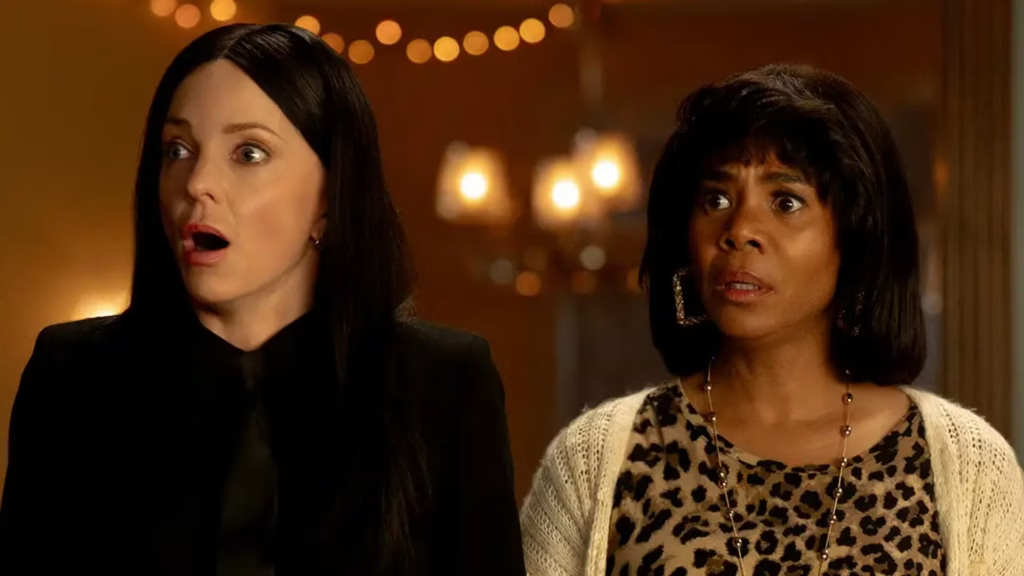
The Scary Movie series always goes up to the wire with having topical horror movie jokes. What was that last minute stretch like for you?
My scoring schedule was already pretty tight, with about three months from start to finish. On top of that, the film was constantly being edited and tested as the team worked to perfect the jokes and find the right balance between edgy humor and something that would still play well for a broad audience. There were definitely a few late additions and changes along the way that required us to stay nimble, but honestly, that was part of the fun. One of the advantages of modern scoring workflows is the ability to keep the process fluid and dynamic all the way through the final mix. On a film like “Scary Movie,” that flexibility becomes incredibly valuable because comedy is so dependent on timing and audience reaction. The test screenings were especially helpful because they gave us real-world feedback. We could see what audiences were responding to, what was getting the biggest laughs, and make adjustments accordingly. It made for a very active post-production process, but ultimately I think the film benefited from it.


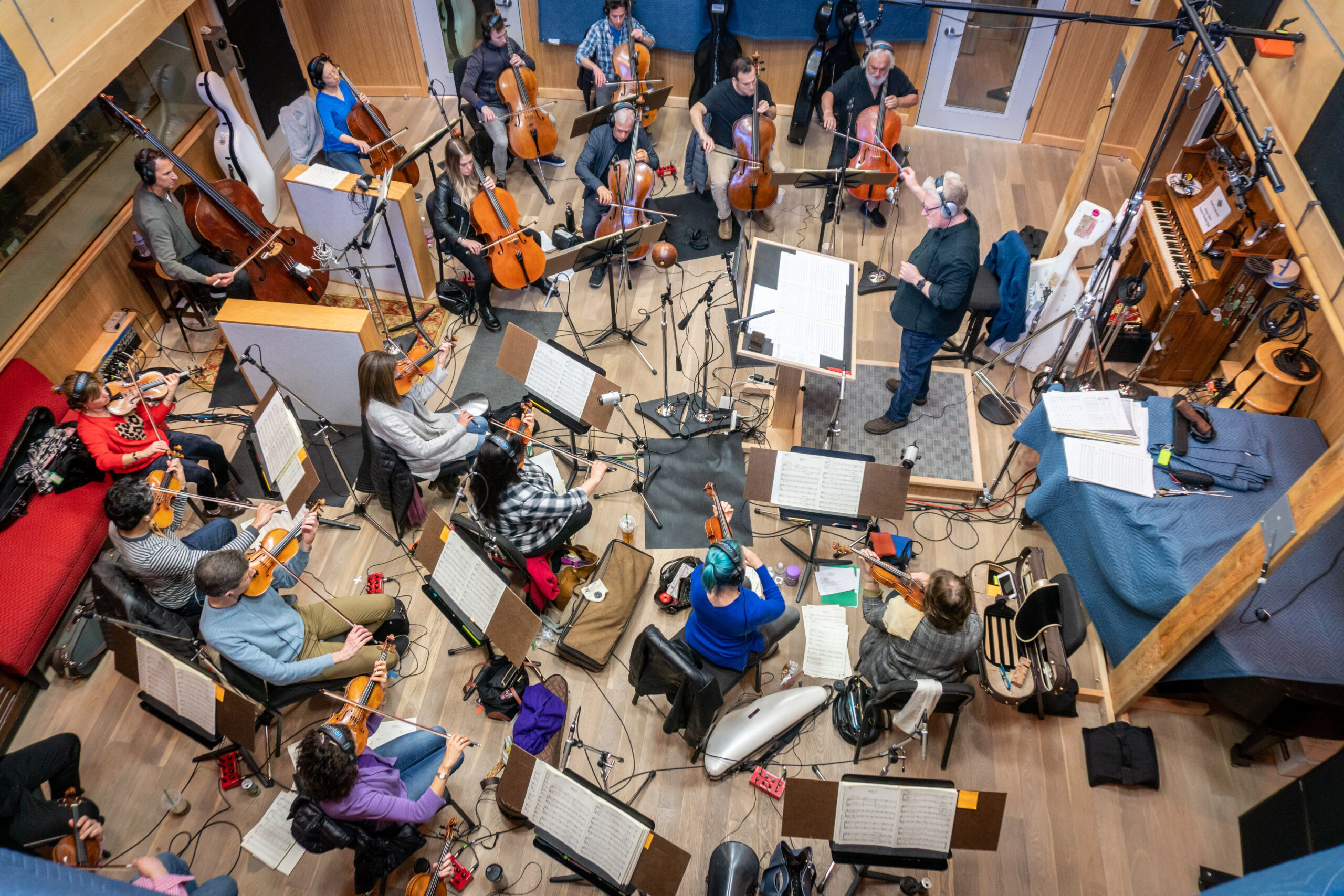
The Budapest Scoring Orchestra performs “Scary Movie”
You’ve got a rich, mainly orchestral sound here that has as much sonic quality as a “Scream” score. Talk about achieving that recording.
I’m very proud of the performances and the recording we achieved on this score. I recorded with the wonderful Budapest Scoring Orchestra over the course of two days, and from the very beginning it was important to me that the music sound every bit as rich, cinematic, and polished as the films we were parodying. To achieve that sound, I assembled a full symphonic orchestra comprised of a large string section, woodwinds, harp, brass, and percussion. In many ways, the instrumentation was very much in line with the classic horror scores that inspired the film, particularly the Scream franchise.
One of my favorite moments from the recording sessions was discovering that the Budapest Scoring Orchestra had also recorded the scores for “Scream 7,” “Get Out” and several other films that we were spoofing throughout “Scary Movie.” Suddenly there was yet another layer of meta commentary built into the project. The same musicians who helped create the sound of some of these films were now helping us lovingly parody them, which felt like a very fitting coincidence for a film like “Scary Movie.”

Comedies in general have very short cues. Tell us about putting them together for a “Scary Movie” album listening experience?
That was actually one of the biggest challenges of assembling the album. “Scary Movie” contains a lot of very short cues, starts and stops, and abrupt musical transitions that work perfectly in the film but don’t necessarily translate into a satisfying listening experience on their own. Because of that, I spent a lot of time shaping the album. In some cases I combined cues, extended certain tracks, and even included a couple of bonus tracks. The goal was to create something that flowed naturally and could be enjoyed whether you’ve seen the movie or not. Ultimately, I approached the album almost like a separate project from the film itself. The movie required the music to constantly adapt to the comedy, while the album gave me an opportunity to present the score in a way that flows naturally from beginning to end and highlights some of the musical ideas that might otherwise pass by very quickly on screen.

What’s it like for you to be part of a box office hit like “Scary Movie,” and what do you think it portends for your future?
It feels great. I’ve always wanted to be able to say I scored the number one movie in the world, and thanks to “Scary Movie,” I can finally say that. More than anything, I’m grateful for the opportunity to reach such a large audience around the world and bring people joy and laughter. I believe music and art in general have the power to heal, unite, and entertain. In this case, if we can give audiences a fun escape for 95 minutes, that’s a pretty wonderful thing. I’ve attended a few screenings, and hearing a packed theater laugh their heads off is one of the best feelings in the world. It’s a true communal experience, and something that only movies can really provide.
I also think the success of “Scary Movie” says something larger about audiences right now. People want to laugh. They want to go to the theater and have a good time together. If the film’s success helps encourage studios to invest in more theatrical comedies, that’s something I’m incredibly happy to be a small part of. The world could use a few more reasons to laugh.
There’s a good community of Israeli composers in Hollywood. What do you think that says about the talent that’s coming here? And do you think what’s happening strengthens that bond beyond the music?
There is indeed a great community of Israeli composers here in Los Angeles, and I’m proud to be part of it and to call many of them my friends. One thing I’ve noticed is that anyone who comes to the United States from somewhere else naturally brings a different perspective. In a way, you’re looking at the culture from the outside, almost like an observer. That can be incredibly valuable as an artist because it allows you to see the culture through a slightly different lens and bring your own point of view to the work.
Israeli composers in particular often come from very diverse backgrounds and musical traditions. Israel is a small country, but it’s also a fascinating melting pot of cultures, and I think that naturally finds its way into the music. You hear influences from both East and West, alongside a strong musical heritage that stretches from classical music to Broadway, popular music, and film scoring. Beyond the music, I do think there is a genuine bond. Many of us share similar experiences of leaving home, building careers in a new country, and finding our place in an industry that’s both exciting and challenging. There’s a real sense of camaraderie and mutual support, and I’m always happy to see fellow Israeli composers succeed. Their success reflects well on all of us and helps strengthen the creative bridge between our two countries.

(Photo by Jana Davidoff at Rhapsody PR)
What’s ahead for you?
I’m fortunate to have a few exciting projects in development, including one that I’m currently scoring that I can’t talk about just yet, but I’m very excited to share when the time is right. More than anything, I’m looking forward to continuing to grow as a composer and take on projects that challenge me in new ways. One of the things I’ve enjoyed most about my career so far is the opportunity to move between genres, whether it’s horror, comedy, drama, live events, or theme park experiences. Every project teaches you something different, and I hope to keep expanding that range while working with great filmmakers and storytellers. Right now, I’m incredibly grateful for everything that’s happened with “Scary Movie.” It’s been a remarkable experience, and I’m excited to see where it leads next. If the last few years have taught me anything, it’s that this business has a way of surprising you when you least expect it, so I’m looking forward to whatever comes next.

(Photo by Jana Davidoff at Rhapsody PR)
See “Scary Movie” in theaters, with Haim Mazar’s score available on Lakeshore Records HERE. Visit Haim’s website HERE
Special thanks to Jana Davidoff and Alix Becq-Weinstein at Rhapsody PR