

As the musically-inclined son of cult Hammer actors Ralph Bates and Virginia Wetherell (“Doctor Jekyll and Sister Hyde”), Will Bates has been anything but afraid of subjects dealing with good or bad vibrations. That makes it all the more of the challenge to audibly capture the thwarted musical savant Nikki (Leo Woodall) with bad piano note and safecracking detecting superpowers, a kid whose kryptonite is sound itself in “Tuner. This acclaimed indie character study-cum thriller directed and co-written by “Navalny” Oscar winner Daniel Roher proves an ingenious mash of genres for Bates to explore with the innovate alt. sound that marked his breakthrough scores with his band Fall on Your Sword (“Another Earth, “I, Origins” “Lola Versus”). A saxophone savant himself with a penchant towards the electronic possibilities of keyboards in his own numerous soundtracks for the likes of “Immaculate,” “NCIS: Tony and Ziva,” “Depraved” and TV’s “Nightflyers,” “Tuner” bends sound to self-possessed rhythmic effect, hip grooves and haunting old-school jazz bebop as the film uses the classic film noir trope of the need for medical care (here for lovable mentor Dustin Hoffman) dragging a good-natured kid into very bad company. It’s music that sings with the surreal sounds of hyper-focus of its protagonist and his buried desire to connect with humanity creating a score as uniquely intoxicating that continues to mark Will Bates as being every bit as unique (if definitely not as inadvertently put off by music) as The Tuner.

How did founding the alternative group Fall on Your Sword set the tone for your scoring career?
I’ve always had an unhealthy fascination with the relationship music has to picture. My first love has always been film scores. And despite various changes of course throughout my career, that’s always been the primary focus. Fall On Your Sword began as a video art project – mainly a comedic one, thanks to a certain William Shatner themed viral video of mine. And an early EP that was based around reimagining the 5 most significant death scenes in sci-fi cinema. Since then, FOYS has gone on to build elaborate interactive art pieces that explore that relationship. And in a way the film scoring, the art, the crazy videos; it’s all coming from the same place. The magic that music can bring to a visual. Whether it be counterpoint, tragedy or simply comedy!

“Tuner” director and co-writer Daniel Roher with Dustin Hoffman
This is documentarian Daniel Roher’s first fictional feature. Tell us about your collaboration.
I had scored a couple of movies for the same producers Blackbear Pictures with “Dumb Money” and “Immaculate.” They introduced me to Daniel. When we first met I was struck by his extraordinary energy. He’s always writing or drawing when he’s communicating. The edit room was filled with Daniel’s paintings and collages. It’s as if he can’t stop creating, and that energy is infectious. He and his editor Greg O’Bryant already had strong feelings about how the score should feel entirely unique. Heisty, but not cliched, emotional but not overly earnest or dour. Instrumentation was really important. The script had a lot of jazz references in it. And I think I got the gig by asking the question “What would it sound like if Bill Evans had access to all my modular synths?”
After the massive success of “Navalny,” Daniel wanted to make something totally different, “A movie-movie” as he called it. Something with energy and heart that he would want to be entertained by. Music is such an abstract thing to talk about, especially with new collaborators. It’s all about finding some kind of shared language, but sometimes just having something that exists to point to is a great starting point. I made the first batch of cues pretty quickly to get us started. I was struck by Daniel’s instincts, because he knew straight away if something was or wasn’t working. There was a lot of experimentation, and I became a little obsessed with uncovering unusual ways to give the story it’s kinetic energy and its heartbeat.
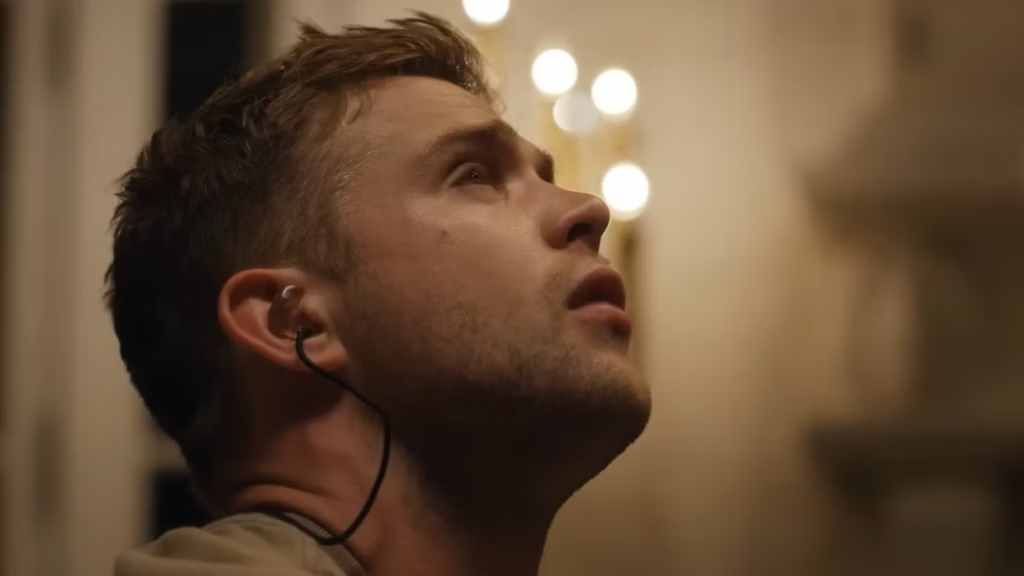
How did you want to literally play inside of Nikki’s head and capture the way he hears sound?
The score always needed to be from Niki’s point of view. Johnnie Burn’s sound design of course plays a huge part of that process. But the way the score needed to feel as if it was coming from Niki was very important to Daniel, and some of my sound choices came from that idea. I own this quite odd device called a Stimmgerat. It’s a 1960s East German piano tuner. It has 12 buttons on the front and I think the idea was that you’d rest it on top of the piano, hit one of the buttons and use it as a pitch reference. But it has this lovely wonky sine wave tone, and I started thinking of it has coming from inside of Niki’s head. I layered the tones up to make chords and a lot of those became the basis for the cues.
For a character for whom interacting is a real struggle, how did you emotionally see Nikki?
His condition has caused this isolation from the world. But there’s also a feeling that he’s given up on his dreams. He’s the prodigy who suddenly has his gift snatched away from him. As the story unfolds you realize this more and more. So there’s a deep longing in him as well as this seclusion. The first cue of the movie we called the ‘Lonely Boy’ theme. This was the first piece I wrote. And I wanted it to have an elegiac feeling. I wrote melodies on tenor sax, and despite being a sax player for about 30 years, writing melodies that way is something I tend not to do on a film score. And historically the sax is what directors tend to throw out of mine! So the night before Daniel and Greg came by the studio to listen to the first draft, my wife encouraged me to replace the sax melodies with synths; just to be on the safe side! But Daniel ended up wanting something more human, so I played him the original sax versions and that’s what we went with. My pal Thom Monahan leant me this gorgeous mic, made from the rescued components of Soviet era recording consoles. (apparently Lykke Li keeps asking to borrow it). I recorded the sax with that. Very distant for the first part of the movie, and it slowly comes more into focus as Niki finds himself. The melody gets to bloom as he meets Ruthie and then unravels as things start to go south.

I can only imagine hearing loss is the worst thing that can happen to a musician – let alone the shock of being hit by accidental speaker overload. How did these fears play into your score?
Someone said to me recently that if they had to choose they would rather be blind than deaf. I guess she felt that it would be harder to connect with a world that you can’t hear than a world you can’t see. And although Niki isn’t deaf, his hearing disability isolates him from the world. That’s something I thought about a lot when writing his theme. There’s a longing to connect, but he is defeated. I also thought about feedback and the crashing of sound waves. I ran the Stimgeratt through tape delays that I would manipulate using my fingers. The tape slip became our go to sound for Nikki in jeopardy.

Conversely, the score also has to play Nikki’s ability to meticulously hear the clicking mechanisms of an unlocking safe, let alone his ability to tune a piano. Talk about capturing those near-superhuman abilities.
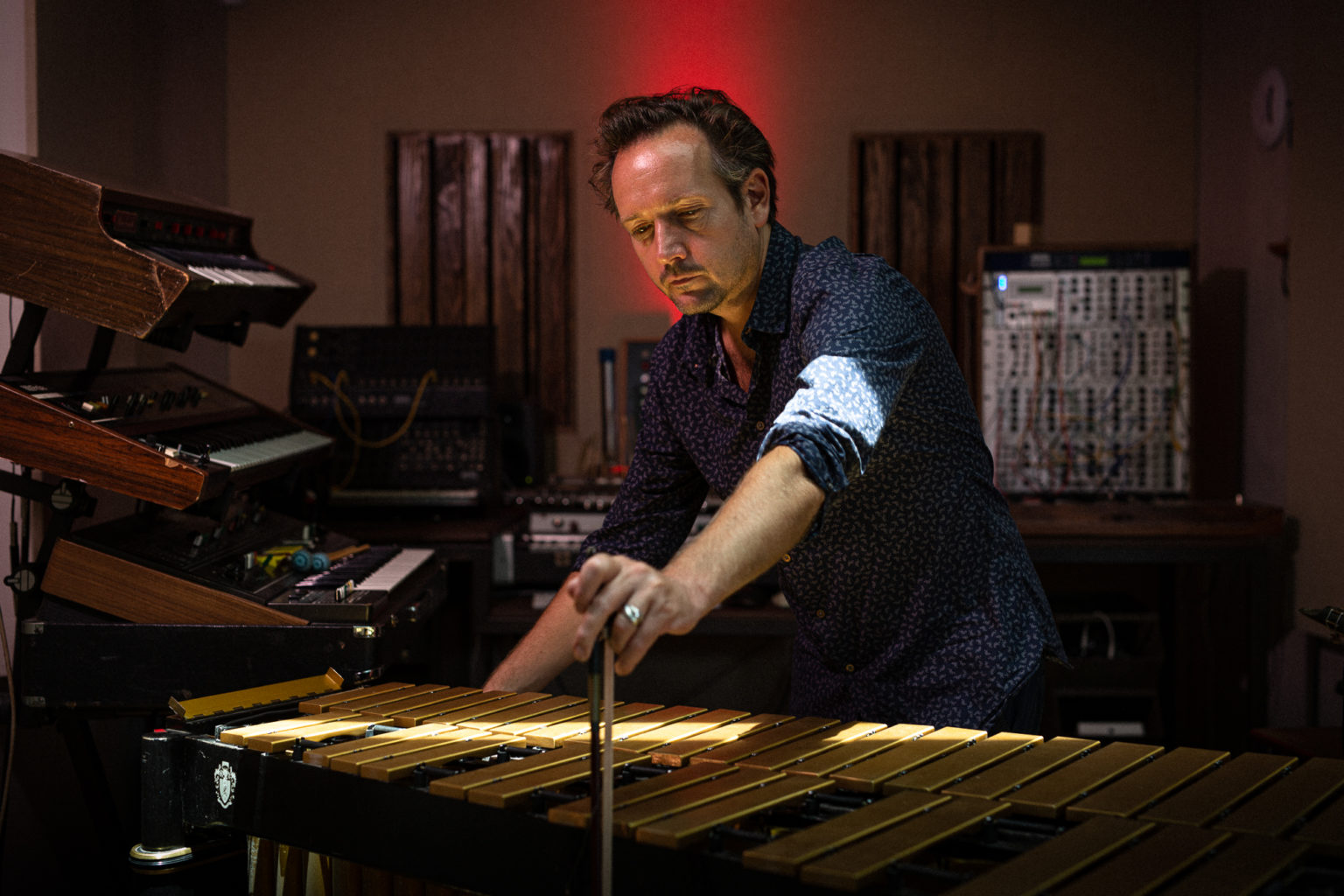
The safe cracking sequences needed that heist energy and a hyperreal sense of sound. I liked the idea of incorporating piano in the score, but in a way that wasn’t familiar. I own these mallets that are midi controllable and I mounted six of them around my lobotomized piano harp. They can play incredibly fast, in an almost inhuman, mechanical way. So the rhythms were created with those while I was dampening and un-dampening the strings with my hands. Those sequences have sharp turns in the cut to emphasize sound, it really allows for the silences to shine through and it’s Jonnie’s sound design that really elevates those scenes. He did such an amazing job with the mix and I was so thrilled to hear how he blended the score with the design.
“Tuner” neatly occupies a place between an indie drama about a remarkably gifted hero observing his “betters” like “Good Will Hunting” and a danger-filled film noir picture about an antihero using his skills for personal betterment like “Thief.” Talk about navigating those two worlds.
Melody is such an important tool in a story like this. And I wanted the narrative arc to be reflected through the altering context of a strong melody. I spend a lot of time at the start of a project, stumbling around until I find that melody! Sometimes it happens straight away, sometimes it takes a minute. But that is always the key for me. Finding this melodic identity that is unique to a character. A director once told me, you need the audience to own the melody early on, let them wrap their arms around it. Then you can use it as a tool, turn it upside down and manipulate it. So in terms of Niki, it was the isolation that evolves into romance and then building the danger around it. For the scenes that needed rising tension, Greg was really key to helping me unlock those. He would be able to pinpoint specific moments that needed a turn or an escalation. I love working with editors in that way, working with microscopic detail. They are the experts!
How did you use sampling here?
This score is analogue. No sampling. The only real electronic manipulation done was getting the tape hiss dialed back to just the right amount! Some of the later cues use electronic percussion from my trusty Soma Pulsar-23. I love that thing, although I find myself having to do a quick YouTube tutorial each time I get it out. A mess of crocodile patch clips always ensues.

I loved the film’s soundtrack of 50’s jazz standards that captured the generation of Dustin Hoffman’s mentor / piano player Leo. As a saxophonist yourself, how did you want your score to fit in and contrast with that nostalgic be-bop approach, and how do you think that added to the movie’s timeless noir vibe?
It’s also a love letter to New York. And nothing says New York City to me more than Wayne Shorter. When I first went to New York I was 18 years old, and driving in a cab entering the city via the Queensboro bridge I handed my cassette of “Speak No Evil” to the driver and asked him to play it while I smoked a cigarette out of the window. What a hopeless romantic! So that was why I think I instinctively wrote those melodies on the tenor, but they also needed to be simple. I’ve been working on the soundtrack album and was listening through to early takes and boy, there were a lot of notes at first! Finding the melody often requires a bit of a sledge hammer approach, boiling something down to its most articulate simplicity. And I think a little goes a long way with sax or even jazz in general. Because of the setting and the way the story is framed, that aspect of the score is almost a bit impressionistic. And I enjoyed finding ways to hint at fragments of the past in that way.
In contrast, did you want the score’s electronica elements to play into the raves that the hoods whom Nikki reluctantly works for, and always seem to be having when he goes to their warehouse? And in that respect, does it represent the “modern” world that he doesn’t want to be a part of in the first place?
Yes, that’s where the modular synths came in handy! I used a step sequencer to program those sequences. Giving the propulsive, angular intensity that contrasts with the more fluid and free cues. And again, a little goes a long way with that stuff. Just one or two electronic elements providing punchy low end. The cue where Niki is being forced to open the safe towards the end, I feel like I was able to lean into my dance music roots with that bass line! And the escalating danger coming from the feedback of the Stimmgerat. As the story evolves the romanticism is replaced by something more urgent and I used more electronics as the movie goes on. But the key was to not dip too hard into that pallet. Whenever it felt like it was veering too much into genre, Daniel and Greg would be there to help me reign it in!

Do you think the trickiest scores are for movies that are essentially about music, let alone for a savant?
I think there will always be more attention on the music given the subject. To have this kind of focus on a music driven story made me really consider the instrumentation. Every sound of the score was meticulously chosen. I think there are moments of minimalism that perhaps I wouldn’t have embraced as much if the story wasn’t so music-centric. In many ways it needed a light touch to compliment the music that the characters are playing on-camera. And being able to dip my toe ever so slightly into my jazz roots was wonderful.

Your score for “Rosemead” just came out on MovieScore Media HERE, and it’s certainly one of the more tragic films you’ve done about a dying Taiwanese mother doing what she can for her schizophrenic son. Did you read about the true story of the film before starting, and what struck you about it?
Yes, I had read the New York Times article and was familiar with the story. What was so interesting to me about the script was understanding more about Eileen and why she did what she did. Her commitment as a mother seems at first to be in stark contrast to what happens at the end of the movie. But she really feels that she is the only one who can save her son and knowing that she won’t be around for long she feels compelled as a mother to act, and with tragic consequences.
How did you find a dream-like approach for the score with filmmaker Eric Lin? While he has a strong background in cinematography, this was his first movie. What do you think that added to the process?
We talked about memory a lot and I think that’s really important in the way Eric frames the story. Joe’s memories of his family when he was younger, and the way his schizophrenia distorts those memories. It’s often a bit hallucinatory visually. And the score at times shares that swirling feeling. The editor Joe Krings did an amazing job of reinforcing that idea. I think of the opening memory of the motel and the escapism of Joe and Eileen at the beach talking about skipping school. There is a lush, harmonious sense of freedom.

You’ve scored no end of insane characters in your past scores, but what do you think made capturing schizophrenia here different?
It’s interesting that we’re talking about this with Tuner, they are so different but one thing that they share musically is a strong point of view. Daniel wanted the score from Niki’s point of view, and similarly with “Rosemead,” a lot of it needed to be from Joe’s perspective. The confusion that his schizophrenia is causing is the source of the moments of dread and darkness. Again, I felt that melody was important. A grounded harmonious simplicity that then gets turned upside down by Joe’s condition.
In a way, “Rosemead” reminded me of a horror film, where a person is irrevocably turning into a “monster” and only their loved one can stop him. Did you get that feeling in a way?
Yes, the score opens as the movie does with a sense of peace. Joe and Eileen have already been through so much loss when we first meet them, and there is such strength in their bond. A shared memory of the way things once were. The desperation that Eileen starts to feel, the panic. The movie takes a sharp turn part way through, and we go to this sense of extreme urgency. Eileen believes she must save her son and save those around him before he does something unthinkable. So in a way the horror doesn’t stem from her’s or Joe’s actions. Her desperation as a mother and Joe’s schizophrenia are where it comes from.

When you’re doing a super-small-scale movie like “Rosemead,” do the limitations become an advantage, particularly when it come to your Fall on Your Sword sound?
I think this score was never going to be a big orchestral one. I tend not to consider limitations of any kind though when I work on something new. I just get my head into the project and get on with the writing. Sometimes it’s having a new instrument of some kind that helps spur a new sound. For “Rosemead,” I had recently acquired a String Harmonica which is a bit like a glass harmonica. It has 12 midi controllable e-bows arranged around its strings. It sounds almost ghostly and seemed like a perfect way to balance the lyricism and sense of memory with the movie’s later intensity. My frequent collaborator Spencer Cohen provided the percussion. He’s amazing, he gives the last act of the movie its propulsion but in a layered and colorful way.

Severin is putting out a massive 4K of Hammer writer-director Jimmy Sangster’s work called “Sangster Directs Hammer” HERE, featuring your father Ralph in three of his iconic performances with “The Horror of Frankenstein”, “Fear in the Night” and “Lust for a Vampire.” You’re on the extras talking about him. What was it like revisiting his work for this edition, and how do you think his Hammer legacy endures?
I’m so thrilled these movies are getting a new release. And I was honored when Severin asked me to be involved. Jimmy was my godfather, and I remember him and my dad laughing together all through my childhood. I think that’s the thing that stuck with me the most. Making art with your mates and having the best time while you’re doing it. I think I still try to bring a lot of that with me when I’m working. And it seems that the more time that goes by, the more Hammer is revered. When I was a kid, my parents just talked about it as a job that they’d done a bit of when they were young. They were always looking ahead. But watching those movies now you see the love and talent that went into them. It’s so great that people are enjoying them again.

On a completely different note, what was it like capturing the lives of Ben Stiller’s parents in “Stiller & Meara: Nothing is Lost?” And what was it like working with Ben on such a heartfelt project?
I loved working on that project. It was so personal to Ben, and he took a lot of care in making the tone just right. When we first met, I spoke a little bit about my parents and being a kid in a household of performers. Obviously on a bit of a different level to his! But we did share that similar childhood of actor-parents and the inevitable ups and downs. It’s amazing all of the content he had access to, all of Jerry’s home movies. And the story was being put together as I was providing music. It needed a light touch, and I worked very closely with editor Geoff Richmann, getting that sense of memory and family.

Another impactful documentary you’ve scored is “Knife: The Attempted Murder of Salman Rushdie.” What was it like capturing the madness of religious extremism and its horrific attack against the author who’s challenged it?
I’ve done many projects with Alex Gibney over the years, and I think this one might be one of my favorites. It’s such a personal story and so relevant and wide reaching. Growing up in London during the 1980s, Salman was on TV a lot. And although I knew about the Fatwa it wasn’t until this movie that I truly understood the full story and its implications. Much of the work scoring the unseen footage of the attack was very disturbing. But the story of Salman’s life is such a rich tapestry of beauty and love. The score had to have that kind of range. He’s a very inspiring man, and I got to have dinner with him in Sundance!

What’s up ahead for you? And how do you see your sound developing?
Right now I’m scoring a movie that my wife made. It stars me, a bunch of my friends and my mum; dragging her out of retirement! It’s a 1920s set Vampire movie. So it’s a bit weird scoring myself. (Lots of slide whistle)And juggling that with a few other projects, constantly trying to find a new sound. I’m just very grateful that I’m able to continue on this mad adventure.

See “Tuner” in theaters, and visit Will Bates’ website HERE
Special thanks to Jana Davidoff and Alix-Becq Weinstein at Rhapsody PR