

One of the pleasures of any Oscar category is the come-from-nowhere surprise, the kind of underdog that in its true win turns one onto the work of an artist and a film in particular. For even while “Sweet Dreams of Joy” will outrageously not be performed on the show itself (with only two tunes being given the chance based on hoped-for ratings popularity), this Best Song nomination will put composer Nicholas Pike and “Viva Verdi” on viewers’ radar to learn its connection to the Italy’s beloved composer.\
Hailing himself from England, Nicholas Pike has certainly contributed noteworthy scores in his four decades in Hollywood after taking a ride from a vampire cabbie in 1986’s “Graveyard Shift.” Distinguishing himself in any number of fictional genres, it was a documentary that got Pike an Emmy nomination in 2013 for HBO’s “In Tahrir Square: 18 Days of Egypt’s Unfinished Revolution.” Now it’s a far more joyful exercise in real life that’s shone a whole other level of acclaim on his work with “Viva Verdi!” and an opera-themed song captivating melody has caught the ear of an Academy no doubt contemplating their Autumn years.

Written and directed by Yvonne Russo (“Vow of Silence”) and produced and co-written by Christine La Monte (“Ai Weiwei’s Turandot”), “Viva Verdi” is a charming entry in a documentary genre dedicated to showing how senior citizens never say die, especially when housed in an Italian retirement community whose construction was opera composer Giussepe Verdi’s most determined work while on earth. Located in Milan and opened in 1902, Cassa Verdi is its founder’s way of paying his good fortune back to working musicians, most in their final, yet vivacious act. “Viva Verdi!” takes a look at diversely talented residents – among them a Japanese opera singer, Italian jazz drummer and opera voices hailing from England to Italy. It’s a touching, enervating mosaic of senior citizens (with a few surprisingly younger residents among them), the realization of mortality, and above all the need to maintain and pass along one’s musicality.
Nicholas Pike responds with an enchanting, often poignant score that not only captures these diverse personalities, musical styles and the countries that birthed them, but the magic of Italy itself, as possessed by the spirit of a legendary composer. “Viva Verdi’s” highlight for Oscar night is the song “Sweet Dreams of Joy,” as performed in the film by soprano Ana Maria Martinez. Her gossamer voice rises from a whisper over solo piano, gently performing the life-affirming lyrics as lush strings join the ultimately soaring melody. It’s a gorgeous tune caught between song and opera performance, and markedly different than its other contenders in its construction. For just as the other songs summon up K-Pop and R&B, “Sweet Dreams of Joy” wonderfully captures what the opera-themed film and its attendant score are all about. ‘Tis the pity that viewers in need of art won’t get to hear it on air, though the nomination itself is a long-awaited spotlight for a composer who’s dedicated himself to the craft with the same passion as “Viva Verdi!’s” subjects.

Tell us about your musical career, and what led you to scoring?
I started off in music when I was seven years old, my mother sent me to Canterbury Choir School in England because she thought I might have some talent! As I got into my teen years, I had a dual life as an improvisational modern jazz player and a classical flute player. When I was 17, I went to Boston to Berklee College of Music and then to New York, continuing to perform and compose for my band. It was very difficult to make a living in that world, and I considered getting out of music altogether, but then some remarkable things happened that led me down the road to scoring films.

You began in the horror genre with scores for such cult favorites as “Graveyard Shift,” “Freddy’s Nightmares” and “C.H.U.D. II: Bud the Chud.” What do you think it was about your music that made you in demand for the genre?
I don’t really have an answer as to why I fell into that genre! I don’t even particularly like horror films. But what I do like is scoring them. I love the intensity of the music and horror films give you such a wide-open palette to play with that it’s incredibly exciting and rewarding to push the sonic boundaries.

One of the more interesting genre projects you scored was “Michael Jackson’s Ghosts.” Tell us about that experience.
Working with Michael was incredible! One of the highlights of my career to date. Originally Mick Garris was directing the video, but the video got put on hold for a few months and when it started up again, Mick wasn’t available, so Stan Winston took over directing and doing all the visual effects. I called up Stan and said that Mick had wanted me to score it and I hadn’t been signed up, but I would love to compose for it. He said, “send me over some material,” which I did, and the next day he called me at 8 AM. I was still asleep and said, “This stuff is great – come on in, let’s talk!” It was a huge production and still the most expensive music video of all time, I believe. I had a 90-piece orchestra, plus choir and no expense was spared to make it an epic event. I spent several days in my studio with Michael, just the two of us, and at first all I could think was I’m sitting here with Michael Jackson, I’m sitting here with MICHAEL JACKSON!!! But after 10 minutes, we were just two musicians in the room and it was an amazing collaboration.

Two genre auteurs you’ve collaborated with numerous times are Mick Garris and William Malone. With Mick’s “The Stand” given a recent Blu-ray remaster, and Bill’s “Parasomnia” given a new director’s cut, how do their collaborations stand out?
I can answer that best by telling you how each of them communicated with me. Mick Garris always has a word to describe how the music should make you feel. For instance, on “The Shining,” the word was “dread.” Bill Malone on the other hand, his mandate is always “You know it can’t be too weird for me!”. That gives you some idea about the wide-open palette. Somewhat unrelated but Bill and I are toying with an opera version of “Parasomnia.” It would be an aural and visual feast!

You started making inroads at dramas with such notable films as “Telling Lies in America” and “Return to Me.” What do you think those pictures brought to your work?
I think what they brought to me was the opportunity to spread my wings in terms of melodic content and emotional writing. Something that started to grow on me as my career moved along. When I was younger, I loved hard hitting, muscular writing but now I really enjoy fleshing out emotional arcs with compelling themes.

You won an Emmy for your 2013 documentary score “In Tahrir Square: 18 Days of Egypt’s Unfinished Revolution.” How do you reflect on that award, especially given the recent, brutally crushed revolt in Iran?
That is a documentary that I’m very proud to have been associated with because it documented an extraordinary time when the power of the people overcame a brutal regime and change for the better flourished for a while. It seems now that the world has retreated back into paranoia but perhaps that film can serve us a reminder of how to move forward in a more civilized way.

Perhaps the most popular documentary you’ve scored is “For the Love of Spock.” How was it playing an iconic actor trying to get past an iconic character?
That was an interesting opportunity because the score vacillated between big orchestral adventure music to smaller more intimate music as we got to know Leonard Nimoy and more of his life as a man and as a father. As it turned out, I’m not sure he was ever able to move away from that character because Spock was such a complex and righteous individual. A hugely influential and positive role model for that generation of young men growing up with Star Trek.

L to R, Christine La Monte, Yvonne Russo and Nicholas Pike
How long was “Viva Verdi!” in production for, and how were you brought onboard it?
Viva Verdi! was in production for 12 years! Not uncommon, especially in the documentary world, where it takes a long time to shoot the footage, dig up the archival footage, develop the story and then put it all together into a compelling feature-length movie. And almost always, money is a constraint and so it can be a real battle to finish it. A good friend of mine Allan Rich introduced me to Christine La Monte the producer of the film and told me that it was a film about Verdi and his legacy. Of course that sounded really intriguing. Christine sent me a 12-minute teaser that Yvonne Russo the director had put together and it was so deeply moving and compelling that I immediately sat down and composed “Sweet Dreams of Joy.”

Did you have any particular love of Verdi, or Italy before scoring the film? And once you got the assignment, did you take a deep dive into his music?
I certainly had an appreciation for Verdi and Puccini (and an Italian great-grandmother!), which started at a young age when I was actually in productions of “Tosca and “Falstaff” as a choir boy. So I was certainly familiar with some of Verdi’s most famous work. I actually didn’t think I needed to do a deeper dive into his work for the purposes of the score because I didn’t want the score to conflict with his masterpieces. I wanted them to support the scenes emotionally and in a way that was simpatico with the overall texture of the film.

Tell us about your collaboration with director Yvonne Russo, and what she wanted the score to achieve.
Well, it was very different to working on a dramatic feature film. Because there were no real time constraints, months might go by between composing cues for the film. So our working relationship was very much one of Yvonne cutting together a scene or a sequence and then sending it to me to work on. I would write something and send it back and sometimes it was just right, other times it required some finessing and sometimes I got replaced by Verdi! And because the picture was very much in flux as our editors Federico Conforti and Dariana Cardilli worked and reworked it to tell the story, cues might get adjusted timing wise and sometimes completely rewritten. In terms of what she wanted the score to achieve, the mandate was always about helping to tell the stories of these fascinating residents, who had such colorful lives.
Given that Verdi is in the public domain, how did you want to excerpt his themes for this? And how did you want to convey the idea of a place centered around classical music and opera in general?
I actually didn’t reference any of his music in the score. All of his music in the film is licensed from existing recordings. I think I was in favor of letting his work stand alone, because it does. So whatever I did was purely to support emotional content and to bridge scenes but done in a way that was centered in more of a classical sound, but just not impinging on his work.
Beyond Verdi, how did you want to capture the old school magic of Italy itself?
Well at its core it’s emotional. When you think about traditional, old school, Italian music it has a soul to it that is steeped in history and a long and sometimes bitter evolution from warring city states to eventual unification. And for me that soul is in that music, so I tried to instill my contribution with some of that sense of yearning, tempered with a touch of melancholy.
You deal with many different types of musicians in “Viva Verdi!,” from singers to jazz drummers. How did you want to capture their specific specializations, as well as the countries they came from?
Where I needed to, I tried to give those individuals a theme or sound of their own. That sound might reference their personality, or it might reference their heritage. For instance, the Japanese soprano, Chitose Matsumoto, who endured racism and exclusion, she has a rather haunting theme with a slight Far East vibe to it, played beautifully on the violin by Elizabeth Bacher. Anthony Kaplen, a lovely character with a fabulous sense of humor, his theme has a sort of jaunty bass clarinet vibe to it! He exhibits such a joie de vivre and a ‘living in the moment’ outlook that is truly inspiring.

Given that many of the subjects in “Viva Verdi!” are expatriates, could you identify with that?
You know music to me in all its forms is always only about the music, so I don’t really focus so much on where the characters are from. What is much more of interest to me is how their heritage may have influenced the music they compose or how they play it.

Did you have a favorite resident to play?
One of the main characters, Claudio Giombi, is definitely a bigger than life personality! And even though outwardly he has this grand persona he is also a man of great depth with a lot of personal sadness in his history. He was basically abandoned by his father at a young age, which I think influenced his journey as an international tenor. So there were a lot of emotional areas to mine in scoring his character, which of course makes it very interesting as a composer.
It’s surprising to see that far younger people like there as well and take master classes from the residents. In that way, did you get to work with any of the older greats as a young musician. And if so, how did that inspire you?
I’m always somewhat envious when I hear some of my colleagues talk about studying with people like Nadia Boulanger in Paris! My formative years were spent in the relative backwater of Cape Town South Africa. However, I did have some amazing mentors and number one on that list is a consummate composer, piano player and jazz man Merton Barrow, who after I left South Africa, started a jazz school and ran it for 25+ years. He is the ultimate mentor being incredibly supportive, has a vast understanding of music and was always available to consult and play music. Additionally, I had a young German flute teacher named Conrad Huenteler who brought me into the Symphony orchestra to sub for the second flautist when needed. This experience gave me most of my training in orchestration!
The theme of many movies, and documentaries when dealing with senior citizens is that “You’re never too old.” How do you think the film, and your score capture that?
Where I most addressed that is in the song, “Sweet Dreams of Joy.” It was my intention that it would be full of life, energy, and hope. And yes, I think if these elements are in place then you are never too old! Of course, when you reach a certain age, the desire to keep doing it has to be there. I certainly hope that I keep doing what I’m doing for the rest of my days!

On the other hand, there’s also a melancholy that comes from being in a rest home, no matter how nice it is. Talk about capturing that quality?
As you say that melancholy exists no matter what. There’s still a feeling that this is your last stop, which can’t possibly be pleasant to contemplate. I think I consciously avoided underlining that because that feeling already exists – however much in the background it is in the film. The great Claudio Giombi addresses it briefly near the end of the film saying that he knows it’s coming, but he does not fear it. That is probably the ideal so that you can still stay in the moment and live a productive life.
Tell us about the production of the song “Sweet Dreams of Joy.” How did you want it to capture both Verdi’s essence, and the spirits of the residents paying it forward to the future? Is that where its title comes from?
I think the title, “Sweet Dreams of Joy” encompasses both the present and the future, in terms of the possibilities as an artist and the joys of creating something beautiful. What I set out to do was capture the overwhelming celebration and joy of living a life through music, as the residents have, as Verdi did, and as I do – an atmosphere that is palpable in Casa Verdi.

Ana María Martínez and Nicholas Pike
I particularly liked how the song brings on strings, when you think it might all be solo piano. Where did that orchestrational idea come from?
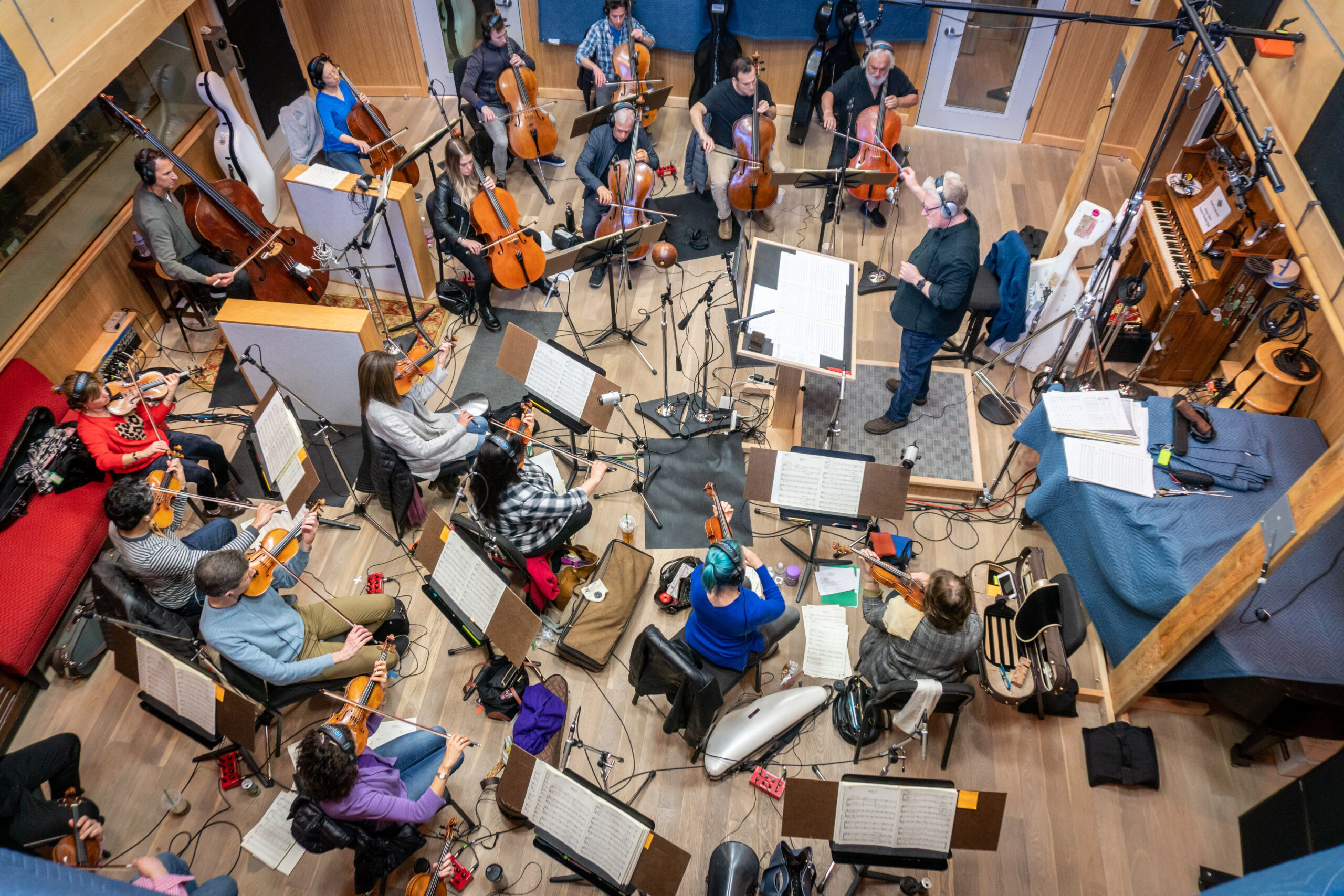
The strings ended up being recorded later, although I had always planned that the second half of the piece would have strings. And actually, I had sampled strings initially. I like the sparseness of the piano and voice to begin with because I think it really establishes the beauty of those two instruments together, especially the soprano voice – it really allows you to hear the nuances of Ana María Martínez’s performance. For the second half I felt like the addition of strings helped take it to another level in terms of power and emotion and the overall arc of the song. It also allowed me more melodic interplay, questions and answers if you like, between the soprano and the strings. Overall, it creates a gradual build in grandeur.
Tell us about your collaboration with soprano Ana María Martínez. What do you think her voice brought to the song?
Well, I can tell you that the first time I heard her singing it I was overcome with a massive hit of goosebumps and tears in my eyes! The power, the sensitivity and the control over those two was just off the scale. So initially I had no notes at all because I was just floating on a cloud of pleasure and wonder! After a while, I came back to earth and made a few phrasing and dynamic suggestions, but all very minimal.

Your Oscar nomination for “Sweet Dreams of Joy” from Viva Verdi! comes as a real intimate surprise, especially considering the epically produced contenders from giant-budgeted non-documentaries that could have been nominated. What was your reaction to the nomination, and why do you think the song made the Oscar cut?
Well of course first I was thrilled to have a contemporary operatic aria nominated! There were no creative directives at that point, just the purest form of writing – a musical rendering in the most visceral way of the joy, inspiration, and possibilities at Casa Verdi. Coupled with that, the aria evolved in more of a classical vibe, and so it naturally brings a deeper level of complexity and finesse that I think appeals to the sophisticated members of the Music Branch – the men and women who have given us most of the film music over the past 40 or 50 years.
What kind of attention do you hope that “Sweet Dreams of Joy” brings to “Viva Verdi!”? And what do you think the reaction might be from viewers who might have never heard of the film, but now want to see it because of the nomination?
My hope is that the film brings into focus the value of our older generation. They have a lifetime’s worth of experience and knowledge to share – if we are willing to listen. There is a mentality, especially in this country that once you reach a certain age, you are no longer relevant, and I think that is a mistake. In the case of Casa Verdi, it all revolves around music, but I think the blueprint is appropriate anywhere.

What’s ahead for you? And any classical composers you’d like to have the opportunity to spring a song from next?
Beyond the joys of scoring films, I am particularly interested in writing an opera or maybe several! I have two that are ready to be developed and written, but I don’t want to create them in the vacuum of my studio. So I am looking for commissions that will see them produced. I am specifically concerned with attracting new patrons under the age of 40 who can help maintain the continuum of opera and concert music and so the works will feature elements that will appeal to all generations.
How does scoring “Verdi!” make you reflect on your own mortality?
Of course you can’t help but look at your own mortality. I think for me most of all I don’t want to feel like I’ve left something undone. Whether it’s writing a piece of music or some other accomplishment, I would like to know that whatever I’ve set out to do had been fulfilled.
Watch “Viva Verdi” on Jolt.Film HERE, and listen to Nicholas Pike’s soundtrack and Oscar-nominated Song on NicPik Records HERE.
Special thanks to Rebeka Alper at Costa Communications