

MIKEL HURWITZ hears the battle for the SOUL OF A NATION
Where nations understandably remember a Day of Infamy, most vile and violent attacks have a long path towards their sneaking catastrophe, no more recently so than Hamas’ October 7th onslaught of Israel. But as the documentary “Soul of a Nation” soberingly proves, the wind up to a massacre was a long time coming to Israel’s blind eye – no matter the warning shouts were yelled. Because even louder was the screaming of a country at catastrophic odds as expatriate Jewish / Venezuelan director Jonathan Jakubowicz (“Hands of Stone,” “Resistance”) proves through his affecting first-person narration and interviews – proving his point about how much easier it is was for terrorists to wreak havoc under cover of an Israel rent asunder.

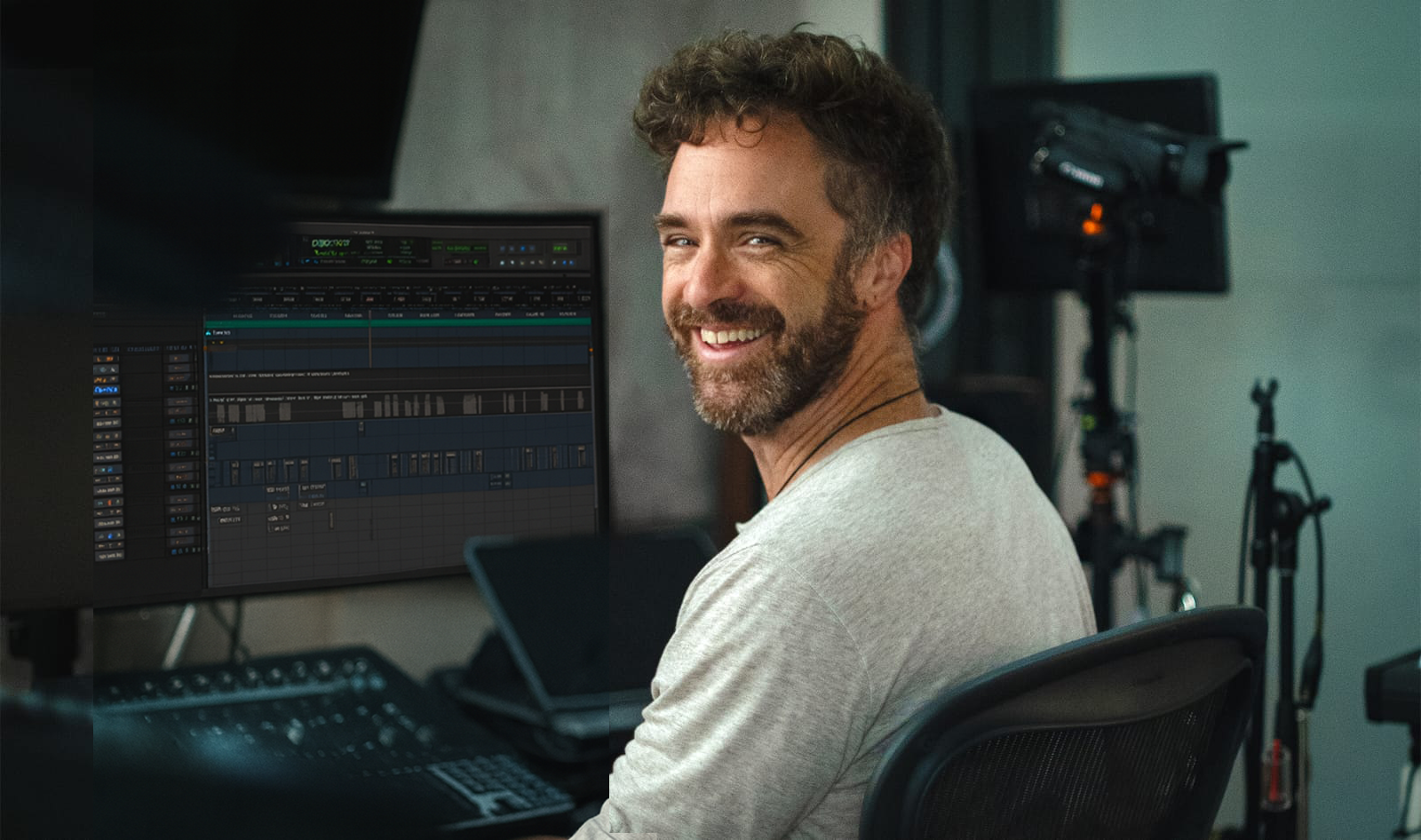
Making the musical approximation the chain of protests that led to a world-changing Jewish / Israel-hating blowback is composer Mikel Hurwitz. Having assisted Danny Elfman on such scores as “Fifty Shades Darker,” “The Grinch” and “Dumbo,” Hurwitz became a prolific solo composer on innumerable rom-coms and Xmas fare from “A Royal Corgi Christmas” to “Betty’s Bad Luck in Love” and “My Dreams of You.” To say that his score for “Soul of a Nation” is a jolting change of dark pace is an understatement, as much as it is a very effective one. Playing far more like an ominously patriotic and exotic suspense movie than a documentary elegy, Hurwitz combines a dire orchestra with Middle Eastern instruments and subtle Hebraic rhythms. Multiple styles for eerie voices, solo piano and pulsing electronics resound, often at the same time in a given cue. The result is as tragic as it is menacing, a pertinent warning given impassioned musical form that plays like dominos collapsing, as the film and score’s ticking clock inexorably progresses towards a horrific zero hour – the score swinging between viewpoints that determinedly won’t just get along. A soundtrack that’s a creatively vibrant, alarmed warning, “Soul of a Nation” shows a powerfully unexpected and personal side of Mikel Hurwitz for a documentary with a lesson far beyond Israel itself.

Tell me about what led you to composing?
If we’re talking music for music’s sake and not composed to picture, I think what really drew me in was a love for music and how it can make you feel. I grew up with lots of different music around the house, and I guess my music education and life path had me straddling the classical/orchestral, jazz/improvised music, and more electronic/hip-hop line somehow. While I was playing in orchestras and bands, I would endlessly improvise at the piano, and it’s all led from there: through different eras of jazz, avant-garde 20th century composers, the studying the scores of the greats. But ultimately, I think I just wanted to hear the sonic textures I heard in my head outside my head.
Now, if we’re talking about composing to picture, that’s a completely different story. What leads you to that is falling in love with film and how music functions with the visual medium. It’s being moved by movies emotionally and realizing that you are being moved emotionally half of the way because of the music. I can’t begin to tell you about my VHS collection growing up, but I know that the great composers were in that collection: John Williams, James Horner, Elmer Bernstein, Max Richter, Jerry Goldsmith, Danny Elfman. It’s pretty remarkable.

Tell me about your experience working for Danny Elfman on such films as “The Circle,” “Alice Through the Looking Glass,” and “Dumbo,” and what do you think you learned the most from that experience to set yourself up as a composer?
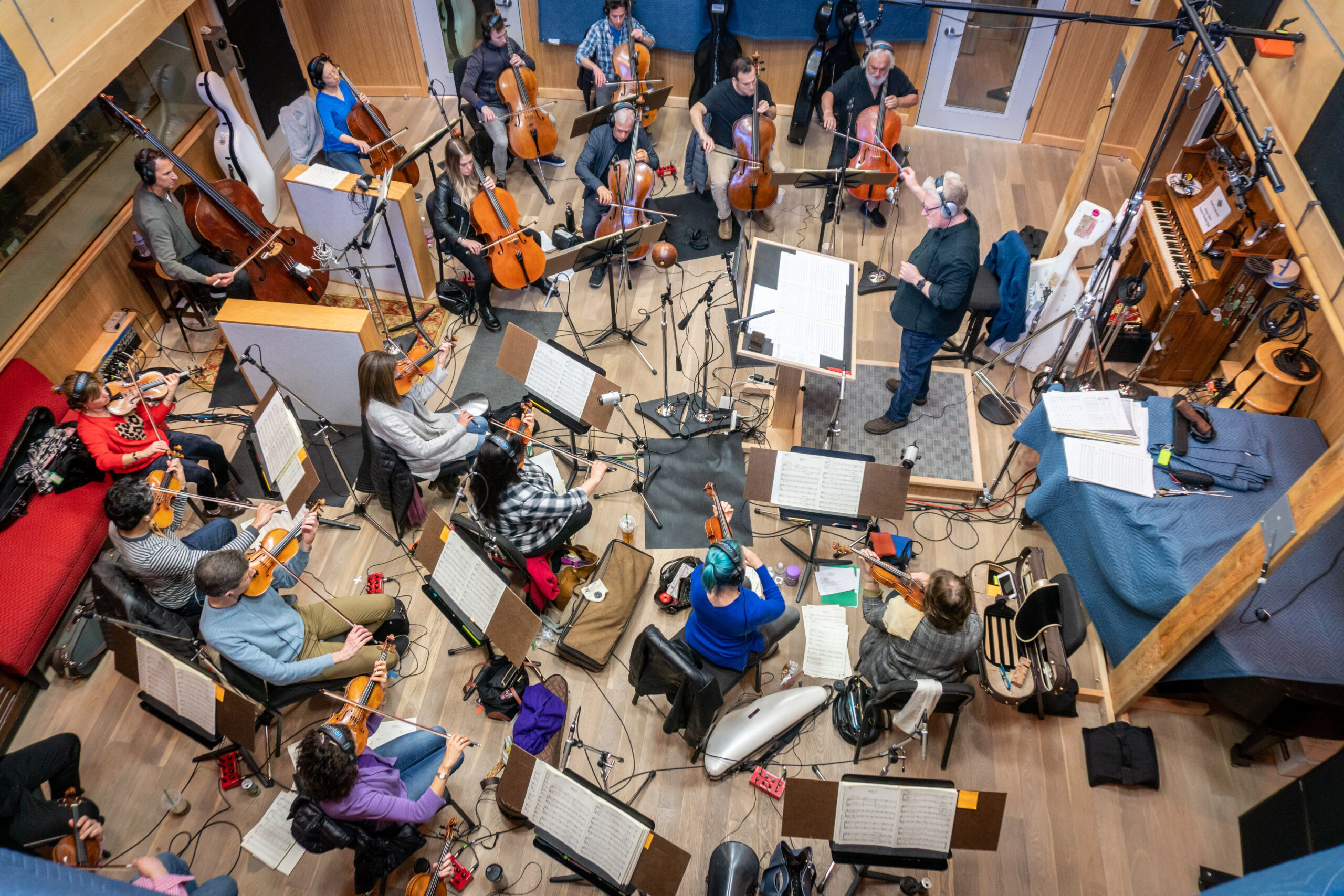
Shortly after I moved to LA in 2015, I got connected with Danny’s studio to build custom sounds for a Tate Taylor film he was working on called “The Girl on the Train”. It was roughly around that time that his technical assistant was moving to another job, and I ended up taking over. It started mostly as running the technical side of his operation: everything from cleaning up and prepping his cue files to go to the orchestral recording stage at Warner or Abbey Road, for example, then it kind of evolved into different creative tasks like orchestration and synthesizer programming, building sounds for Danny to use in films, etc.
I’d say that experience working with him for five years taught me so much about the process of film scoring: from spotting sessions to composition to orchestration to recording and mixing, I kind of consider it like my PhD in a way, but ultimately it enabled me to be able to work as a composer in my own rite very efficiently and productively; I value that experience in my life tremendously.

Your past credits have a wealth of feel-good Christmas movies and rom-coms in them. “Soul of a Nation” is definitely a radical change for you. How did this project come your way, and were you looking forward to doing something with a lot more weight?
Radical change to say the least! You know it’s funny, as much as I love scoring these films that make people feel good (a seemingly scarcer commodity in today’s world…), it makes me crave working on darker, more non-linear, hard-hitting films that can make an audience think more deeply, and that might sit with you for a while and potentially spark conversation. “Soul of a Nation” was the film I’d been wanting to work on and the score I wanted to write for a long time. So, when one of my dear friends suggested that I meet two of her friends who make films, I was blown away by what they’d come up with, especially something so timely.

Tell me about your collaboration with director Jonathan Jakubowicz and what he wanted your score to achieve.
Jonathan is a student of film and is the director’s director. He has an immense knowledge of music, and the way that he edited the temp music score with Santiago Garcia was, I thought, brilliant, and that I believe is truly what made me want to do the film. He wanted the score to cover a lot of ground and a lot of different emotional moments. It goes without saying that some of these images and footage were incredibly hard to feel like the music that you could write for it would be worthy of such weight. The tricky thing about scoring a film like this, as is the case in most contemporary documentaries, is obviously not directing the audience in one bias or another. But what was interesting in what we were trying to achieve was scoring scenes with Netanyahu, for example, as a shark as much as Hamas.

How do you think the deeply personal structure of Jonathan’s first-person narration affected the score, as opposed to something that just presented the facts?
The deeply personal structure of this documentary, I think, is what made it so unique. Having the window into to Israel-Palestinian conflict from the perspective of a Jewish Venezuelan writer and director is something I can’t say that I’ve seen in either traditional media or social media since the war began 2 years ago or before. We didn’t score it in a traditional way where ‘every character gets a theme’ but instead using vein cutting emotional strings, violin and piano for the deeply emotional parts, and a more electronic driving score for everything else. I think it was an interesting duality and approach.
Also, part of the film is deconstructing the West’s idea that all of Israel is comprised demographically of white European colonizers, which simply isn’t the case. We felt it important to utilize instruments of the region historically, like the lyra harp and shofar, the solo violin to represent the Ashkenazi, and the Oud, Darbuka, and Sarod to represent the Sephardi and Mizrahi Jews that historically never left the region and had a distant diasporic experience.
The movie starts off in director Jonathan’s home country of Venezuela, which is now very much in Trump’s regime change crosshairs. How did you want to capture that setting, and the lessons learned there?
It certainly is in the crosshairs, isn’t it…
We chose to capture that setting not in a way that was over-the-top Venezuelan music, per se, but we included several percussion instruments in the texture of the heavy brass, strings, and drums. In fact, on a deeper level, we also were intentionally not trying to capture that setting through the music: Instead, we were trying to capture the tragedy and chaos that comes out of a deeply divided country with an autocratic leader that is stealing from its people on such a level, to say that it could really happen anywhere.
The film makes its point that October 7th was allowed to happen because of the internal divisions in Israel that took their eye off the Hamas ball. How do you think this makes the score different than if it was centered around the Hamas massacre?
I think if this film was about October 7th and the massacre itself, it would have been a score that might have been more action cue-based… perhaps. As a result of this film really centering around the lead-up to October 7th and the deeply divided country having its guard down, I think we could score parts of that story in a much more subtle way that was also in some ways more of a thriller score than just pure action. I suppose there were more opportunities to cover a wide range of emotions.

Tell me about capturing the metaphor of the “ticking clock” to October 7?
I’m guessing you’re talking about that countdown timer on screen that we’ve seen throughout the film, leading up to October 7th? If so, yeah, it’s tough to really say that I captured it with the music, but I do believe in some ways the whole score is supporting this building behemoth throughout the second and third act of the film. That’s until we lead to the war footage that’s in the middle of the third act and the aftermath footage of worldwide anti-Semitism starting on October 8. It all kind of builds to these moments and then exhales in our final scene.

How “Jewish” or “Middle Eastern” did you want to make the score?
I kind of alluded to this in the previous question, but the “Jewish” being separate from the “Middle Eastern” is a bit of a misnomer that I believe needs to be unpacked by a good percentage of the Western world, who have not visited Israel. Jews are originally from Judea, very much in the Middle East. Though many had a diasporic experience for hundreds of years, there were also others that lived in Iraq, Iran, Syria, Lebanon, Egypt, etc. that never left the region. In fact, without giving a history lesson, these were also the Jews who were kicked out of those countries after the Second World War and found a homeland in the modern state of Israel.
That all said, with the score itself I wanted to capture elements of traditional Middle Eastern instruments like the lyra harp, sacred instruments like the Shofar, “diasporic” European instruments like the violin, strings, and orchestra, and modern instruments like the synths and drums; then blend them all together in a messy but beautiful way into the texture.
There are a lot of stylistic elements happening in your score, from orchestra anguish to hard core electronics and rhythmic suspense – sometimes all at once. How did you determine your orchestrational approach? And did you want to go for a feeling of music clashing – in much the same way the Israeli political groups do?
I answered this a little bit in the previous question, but yes, you’re not wrong. I wanted them to all sit together in this sort of hybrid orchestra electronic world, much like the way that Israel is a patchwork of cultures, religions, history is and political groups. Specifically in the orchestration itself, I felt it was important to orchestrate in such a way that the orchestra could leave room for the electronic elements to either be prominent in the mix or for them to take a back seat and allow the orchestra to take the front seat in the texture of the moment.

Given that Israel’s situation is one of survival at every level, how did you want to get across the military aesthetic into the score, especially when running into more “humanitarian” views?
Yeah, I think there were those moments of optimism and humanitarianism throughout, specifically, I’m thinking of the young female protester and how we scored that in a beautiful and optimistic way, and I think that truly contrasted with the way that we scored, for example, scenes of Hamas doing military training. I also think that one of the more interesting cues of the score was the child soldiers’ cue, where I used this sort of childlike creepy voice and sampled it and turned it into something just very eerie, almost like from a Tim Burton movie scored by Danny Elfman. Then, when the war started a few weeks after October 7th, that footage we scored truthfully just in a tragic way, and used it as a variation of the disengagement in 2005 from Gaza that happened earlier on in the film. I think it was quite interesting to connect those two because it shows how the polarization is tearing people from their land and livelihood on both sides.
Were you scoring this film when October 7th happened? And what was your reaction? Whom did you hold to accounts as such?
I started scoring this film about four months after October 7th happened. Seeing the world turn on Israel and Jewish people before they began their military operation in Gaza, and how that all played out on social media, made me feel as though I wanted to contribute something to the conversation that wasn’t a fleeting set of echo-chamber social media posts. I wanted to help tell a story with music that might have a more lasting impact on the discourse and communication of nuance in the region to people around the world.
My reaction to Oct? It was a tectonic shift in my politics. I didn’t truly understand how deep the hatred of Jews and the Israeli state goes.
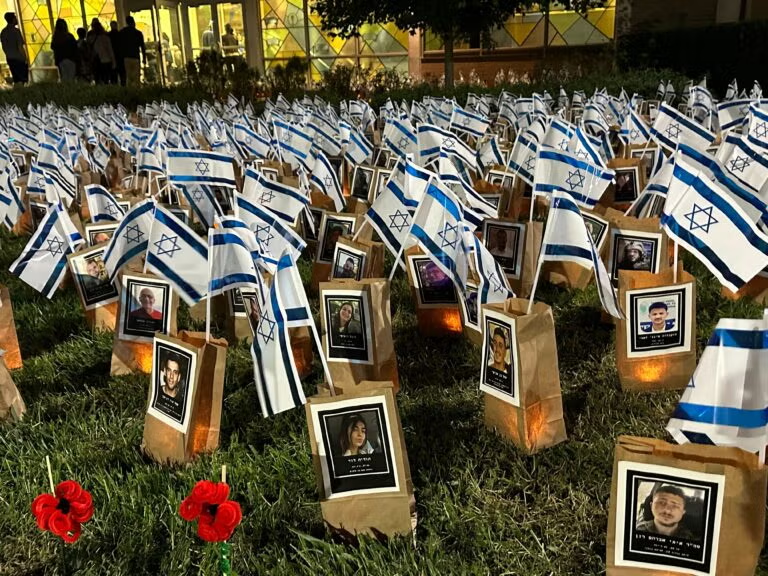
How did you want to score the October 7th attack?
That scene was the hardest scene that I’ve ever scored in my life. The first two days of looking at it, I couldn’t stop crying. I was paralyzed. I had no idea how I could possibly create music worthy of the weight of what was on screen. We just scored it in a very thematic, tragic way, and that’s very much what it was. The theme that we came up with, which has several variations throughout the film as its main statement, is here, in the 10/7 attack scene.
Where all scores, fiction or not, are there to “manipulate” the audience, was making an overt musical point something you wanted to avoid or go for?
I think it depends on the moment: I completely agree that we can so easily manipulate an audience with the musical choice, and it’s something that I was so hyper aware of throughout scoring the whole film. It very much wasn’t an exercise of “let’s score the Israelis as the good guys and happy and the Gazans as evil,” rather that there are sharks and guppies on both sides of the fence (and on the same side of the fence as well). There were certainly moments though that we wanted to dial up the emotion, and whether you think about that as manipulation or not. The disengagement in 2005 of Israelis from Gaza, for example, was one such moment that we wanted to highlight the tragedy of the situation for the Jews that lived in Gaza and how horrible an experience that was for them to have to leave their homes. It’s to be said that what exists mostly in Western media is the storytelling of Palestinians being kicked out of their homes by Jewish settlers; not that often do we hear stories of the other side. And this all gets at the heart of the matter, where the film is truly about the evils of polarization rather than the evils of one group or another.

How important do you think it is for a documentary score, and this one in particular to play it as a “fictional” film in its level of energy and suspense and not something academic? If a listener had no idea this was from a documentary, they might mistake it for a tragic war-suspense score.
I think that there’s a lot of information in this film, and I think the modern experience of going to a theater or watching a film on streaming is such that it must hold people’s attention in a particular way, especially with this topic. If we chose to score the entirety of this film in more of an ‘academic’ way, I think we would have run a major risk of it being incredibly overwhelming to understand and follow. I think that we were able to use the concept of telling the story of a documentary with cinematic and ‘fictional’ storytelling devices like high energy and suspense, is exactly because truth sometimes is stranger than fiction.
Do you wish the film had held off for the release of the hostages, or what did you think that possibility even was while you were scoring?
I think along the way, I always wished this film would come out at any particular moment. I wanted it to come out before the Iranian-Israeli conflict, I wanted it to come out on the 1st anniversary of October 7th, and I just wanted it to have an impact as soon as possible, I suppose… And what I realized through that is that there’s never a good time or a bad time to come out with a film like this. I’m not sure delaying it until after the hostages were released might have had either a positive or negative impact on the film’s life and or the situation in the region.
And to answer your question about the hostage release? No, I didn’t think that possible at all – I thought they were all killed, frankly.

Do you think there’s prejudice against films like “Soul of a Nation” that take a nuanced approach to Israel and October 7th as opposed to something that’s just waving a flag for Gaza – particularly when it comes to documentaries?
Absolutely 100%. And that ironically is the point of the movie – to not become more polarized and to see nuance and keep listening to our neighbors in questioning our own prejudice and the roots of our intolerance. It seems like everyone now wants to put anyone else in one box or the other, and there’s no room for nuance in the conversation. Simply because this film is from an “Israeli” perspective, that does not mean that it’s anti-Palestinian.
What do you think of the attempt to ban Israeli-based projects and artists from festivals to competitions and sports events?
I think that banning any kind of artist, musician, or athlete based upon their passport or country of birth is absolutely counterproductive. It only fuels more hate from the groups that are banished and confirms the biases of those who are doing the banning. It’s so superficial. In what world does an Israeli Philharmonic performance of Mahler in New York have to do with Israel’s state military policy? Is the Russian defenseman on the Olympic hockey team informing the IDF’s policy? We should be able to exist as athletes in the Olympics, and Israelis and Palestinians should be able to participate in Eurovision. Perhaps the only country that should not be allowed to participate in Eurovision is Australia’s…? (how are they in Europe??)

Have you encountered any anti Semitism in your own life, or in trying to get scoring jobs?
Not to the extent that my grandparents experienced, thankfully, but I am hyper aware of the anti-Semitism that is everywhere, walking around Toronto, Canada. Professionally, what I have sometimes experienced is not being offered work that is outside of my “culture” and have ended up being the ‘Jewish composer working on the Jewish film’ rather than the human composer working on the human story. If we’re all meant to only work within our cultural groups, how are we supposed to tell a human story?
What do you think of artists who take place in these boycotts, especially Jewish ones?
In few words, I don’t understand it. I think they might want to be on the ‘right side of history’ or something – or maybe in a more sinister way, they are placating to the mob mentality? I think they might think they are doing the altruistic thing but are just standing on a sea of half-truths.
How do you think the lessons of Israel’s in-fighting apply over here? And when one group’s views are so diametrically opposed to the other, how can one find a way to even “unify” and prevent an enemy from attacking who hopes for their universal annihilation?
I think it just teaches us, if anything, that war happens when diplomacy fails. And not just in the way that diplomacy is relegated to the political class. Diplomacy also means having difficult conversations with people on the ‘other side’ that disagree with you, continuing to listen despite them transgressing what you might believe or your worldview, and after an intense, polarizing debate, realizing that we are all human.

Do you think this is only the tip of the iceberg?
I tend to think things come in waves and a pendulum swing. I hope in the polarizing times that we seem to be living in that we might understand how important it is to step back from the abyss. At the very least sure it’s easy to think that the world is falling apart and we are all at war with each other physically and mentally, but it also should teach us the importance of continuing to listen and questioning where our biases come from. As the film says <spoiler> “are our neighbors truly as bad as we think they are, or is that the product of our own indoctrination?”
How do you think this film, and score might change people’s minds?
I hope it changes people’s minds by understanding how complex issues are and thinking twice before jumping on a bandwagon of support, independent of what side you might happen to agree with. I hope it causes people to learn more, to talk more, to listen more, and to explore deeper connections with the biases that they codify within their worldviews.

(Photo by Getty Images)
How has scoring “Soul of a Nation” psychologically affected you?
I think it’s made me understand the power of music and film on a much deeper level. Because it’s such a nuanced story, it really showed me how scoring any particular scene in one way or another can impact the bias, or if you choose to score two sides of the same coin in a similar way, how it can cause us to take a more macro view of a particular scene or issue. That is all, of course, in addition to the fact that my therapy bills are through the roof.
What’s up ahead for you? And after this, do you hope it’s Hallmark?
I’m working on a show for a Canadian procedural drama right now, and indeed scoring Hallmark films is a bit of a balm on the heaviness that I had for so long while working on “Soul of a Nation.” It’s funny because I was concurrently scoring “Soul of a Nation” when I scored three different Hallmark films at various times throughout the year and I would open files for “Soul of a Nation,” the attack scene for example, and almost be in tears, then open a Hallmark cue and feel like a woman who left her career in the big city truly could fall in love with the small town boy she used to have a crush on in high school.

Watch “Soul of a Nation” on streaming with its soundtrack available on Cinemastasia Music HERE. Visit Mikel Hurwitz’s website HERE
Special thanks to Maddy Myer at Impact24 PR