


In a world desperate for connection, Japan (a country renowned for its eccentric social practices) just might have the most audacious agencies when it comes to hiring fake relatives, girlfriends, and just plain pretend acquaintances for special or long-term engagements. Such eye-raising monetary social engineering proves the gist for the uncommonly spiritual and poetically low-key “Rental Family.” Directed and co-written by HIKARAI (along with Stephen Blahut), whose impressively character-driven work includes “37 Seconds” and episodes of “Beef” and “Tokyo Vice,” “Rental Family” tells the story of an American expatriate actor (Brendan Fraser) who’s been a fish in the water way too long in Japan. Suddenly the once notorious toothpaste commercial man finds himself in demand as a Gaijin of a thousand faces who have nothing to do with the movies – but everything to do with “reality” as he knowingly impersonates a newlywed husband, a long MIA dad and a writer interested in the twilight career of a famed movie star. The latter two roles are unbeknownst to the sprightly girl Mia (Shannon Gorman) and the elder Kikuo (Akira Emoto). Putting on Oscar worthy performances, the lonely Philip experiences his own rebirth, but potentially to disastrous effect of the “daughter” and father figure who are unaware that he’s been hired to put on the ultimate show.

One might imagine the screwball emo antics that might have been made from this, especially had the idea been transferred to America. But it says something about the captivating, cultural poignancy of “Rental Family” that the story takes on a Zen resonance – especially in the hauntingly poetic score by Jónsi and Alex Somers. The latter is an alternative musician from Iceland best known for his work with the band Sigur Rós, while Somers hails from Baltimore. Finding themselves kindred musical spirits in the island’s capital of Reykjavik, their score collaborations contrastingly range from the lullaby-like “We Bought a Zoo” to the ticking dread of the atom bomb in the TV series “Manhattan.” On his own, Somers has provided the uniquely atmospheric and rhythmic scores to “Captain Fantastic,” “Honey Boy,” “Charm City Kings” “Nickel Boys” and even the delirious noir of “Holland.”
Now cast beautifully adrift into a human-packed nation that can be impersonal and emotionally needy enough to necessitate the business of “Rental Family,” Jónsi and Somers expound upon the ethereal and enchanted sound of “We Bought a Zoo” (another film about an unlikely clan) to hear “Rental Family” as a state of tone poem mind. Gossamer fusions of orchestra, electronics and reverberating angelic voices become walls of transfixing sound that don’t really play onscreen action, let alone Japan. Yet it’s thematically ephemeral music that has everything to do with people trying to overcome a disconnect. Echoing tinkertoy piano, rhythm that goes from joyous to deliberate and walls of Haiku sound become the longing of child too old for her years, the sadness of man being consumed by them and the need for an outsider without bonds to discover his own worth. It’s a religious score as such without being religious, which very much captures the hypnotically gorgeous ethos of Jonsi’s work with Sigur Ross as much as it does Somers’ way of hearing the bonds of eccentric family units. Think the equivalent of cherry blossoms falling on an ancient, now beyond modernized society and that’s the spiritual, environmental beauty of that rarest of movies that’s about the good that humanity can find within each other. “Rental Family’s” score makes a final sale with beauty and innovation to spare – no more so than from this scoring duo’s own expatriate who found himself.

What drew you to music, and what was it like finding yourself as a Baltimore musician in Reykjavik, Iceland? Do you think there’s something which makes that country’s composers particularly unique?
I was drawn to music from an early age. I loved to listen, I still do. Listening and harmonizing to music around the house as a kid set me up to be curious about music and harmony and by the time I was 11 I got my first guitar. Piano, drums, and any noise makers I could get my hands on soon followed. There’s nothing that feels more expansive and connecting for me than making and listening to music.
Moving to Reykjavík as a foreigner was a life changing experience for me. The music community and all the family and friends I made were so welcoming and I learned so much from Icelanders. The music makers in Iceland inspire me so much. I think compared to many other music scenes, the artists in Reykjavík are less precious, more instinctual, less seeking praise, and simply making for the sake of making. Iceland is a tiny island, and no one expects anything. The weather is brutal and cold. There is very little daylight for parts of the year and to be creative seems like a lifeline at times.

Tell me about how you first joined with Jónsi. Why do you think you were in sync as collaborators?
Jónsi and I met on the street in Boston outside of Berklee College of music in 2002. I was there studying music and Jónsi was on tour with his band Sigur Rós. I moved to Reykjavík in 2005 and it was then that we ramped up making music and artwork together. We both moved to Los Angeles in 2017.
It’s hard to say exactly why he and I are so in sync as collaborators. We see and hear the world so similarly. We have the same feeling in our stomachs when a chord progression is just right. It stretches beyond music to really everything… How we each move through the world and absorb and block out reality. How we receive the world and distill it into something new. It’s a special feeling to have and know.
How do you think your work together contributed to your own voice as a composer? And would you say that mesmerizing alternative sound is part of your scores?
Collaborating with Jónsi radically altered my attitude about making music. He taught me so much but never with words, just with his actions. He taught me to be less precious and to think less and do more. He also taught me a lot of basic engineering and music production techniques that became foundational to everything I do to this day. Jónsi is so modest and so passionate about whatever he is making. He doesn’t look back, only forwards and he’s influenced me in infinite ways. I’m very grateful.
The sounds we create within film music and outside of film are certainly related. Each film gets its own sonic world. We love to dive deep into the textures and soundscapes of the music and those things are equally as important as the notes. We first established that outside of film music but we certainly carry that philosophy into music for film.

The idea of eccentric families have often factored into your scores like “Captain Fantastic,” “Honey Boy” and “Nickel Boys.” Are you drawn to that theme of oddball people joined together?
I’ve never drawn a thread between those, but I suppose I am : ) I love strong characters.

HIKARI Credit: James Lisle, Searchlight Pictures
Tell me about working with the filmmaker HIKARI. What were her tastes like in music, and what did she want your score to express?
We love Hikari. She’s a wonderful person and full of life and color and ideas. She gave Jónsi and I a lot of space and freedom to first create what we felt would be right to tell this story through music. After we created a lot of music for the film, we three worked together tweaking and revising everything to fit just so. We even asked Hikari to sing with us for the choir piece we wrote for the funeral scene in the movie.

How have past scores you’ve done with Jónsi worked, and was there anything different about your collaboration on “Rental Family?”
It’s been a long time since Jónsi and I co-scored a film! I think we tend to have a similar approach which involves us becoming totally immersed in the film, its characters, and the music we are creating for it. We work instinctually and play a lot of the instruments ourselves. We like to keep an element of chance always open and work a lot with processing recorded tracks and making alternate versions of themes through experimenting with computers and analog tape.
If you’ve ever been to Japan before, what were your impressions of the country and people like, especially musically?
I am obsessed with Japan. I have been several times and it’s so beautiful it hurts. I love the Japanese people and love so many of the Japanese ways. I love Japanese food and nigori saké. I love Japanese slippers and tiny cups, bowls, and plates. Hello Kitty, Zelda, Haruomi Hosono’s “Watering A Flower”, indigo dyed fabrics, Ikebana, it’s really endless! I also love Japanese teas and am a member of a Japanese tea house here in Los Angeles, haha.
 Tell me about how you saw Phillip’s character and his music?
Phillip is so lost at the opening of the movie. He has no belonging and no community and sense of worth. We wanted the music to reflect his deep loneliness. It’s a universal feeling and a very human feeling. Throughout the story he finds more and more purpose through connecting with people. By the end of the movie, he knows his worth and we designed our music to follow his character arc.
Given that you and Jónsi are not Japanese, how do you think it played into capturing Phillip’s “outsider” eye, and ear to Japan?
Good question. I don’t think Jónsi and I considered that angel. We never feel like outsiders inside of music. I think his story is very human and universal.
Contrasting that, how did you convey the humanity that ties these characters together?
We hope that the music injects the path of the loneliness to finding community and purpose. We made music that is low and fragile, and we made music that is joyful and playful. We found it incredibly useful to work primarily with instruments that had character and soul and were old and worn sounding. Instruments like the Optigan, Mellotron, Celeste, Piano, and Voice convey humanity with few notes.

Tell us about playing the “father-daughter” relationship between Phillip and Mia, and how it evolves over the film?
The relationship between Phillip and Mia was a challenge for us. It needed to span playfulness, longing, false hope, loss, and eventually true connection. We had much guidance from Hikari in order to land all these musical developments you hear in the final version of our score.

How did you want to play Phillip’s relationship with Kikuo, especially when it comes to his pride and his realization of mortality and memory loss?
Our favorite character while working on the film was Kikuo, played by Akira Emoto. He is such a beautiful character and to score his drift into memory loss and eventual death was one of the most rewarding parts of scoring “Rental Family.” We used voice to explore his fading memory. It somehow seemed to tap into the feeling of memory and memory loss.
How did you want voices to work in the score from its more magical aspects to a hauntingly poetic sense of ennui?
Yes exactly. Voices appear to lift us out of the ordinary throughout the film. When something beyond the physical realm happens, we hear voices. From love to memory, loss to death, the voices carry us from what we see to how it feels.

I loved the dream-like sound of “Rental Family.” Tell us about the instrumental ensemble that achieved that?
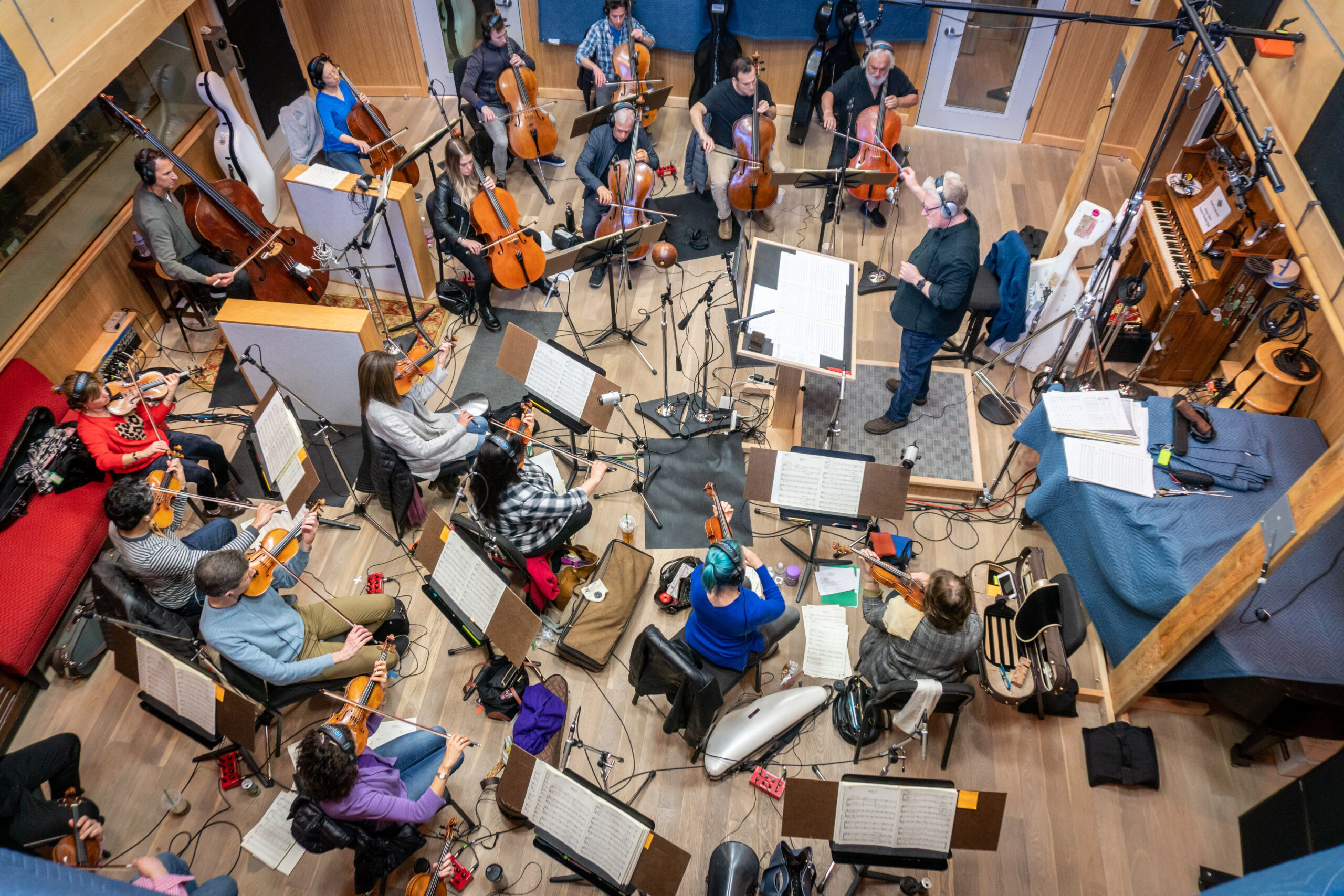
We started by writing on an old instrument called the optigan. It was made by Mattel (the toy maker who makes Barbie etc.) in the early 1970s. We started there because we wanted use instruments that had grit and character. We love acoustic instruments and samplers and dubbing sounds to tape and slowing them down etc. The recording studio really is an amazing place to just make up sounds and new musical terrains. Other things we used include Piano, Prepared Piano, Celeste, Mellotron, Vibraphone, Type Writer, Samplers, Percussion, Music Box, Micro cassette, and Vocals.
There’s an essential “dishonesty” to “Rental Family” in that these bonds are paid for, and not “real” as such – something that definitely causes the employees a conflict over what they’re doing. Could you talk about that musical element?
We personally didn’t view anything as fake or dishonest and didn’t feel the need to consider that component. We think if the music is following how our characters feel then it’s closer to the reality we wanted to illustrate musically.

Talk about the “Zen” Buddhist aspect to “Rental Family,” particularly in its last shot.
In the final shot of the film, Brendan Fraser’s character Phillip returns to the shrine that Kikuo previously took him to. The first time Phillip declines to go up the shine. At the very end of our story Phillip is a changed person and enters the shrine to see that it’s just a mirror and himself starring back. In this moment he realizes that he is enough. The music swirls up around him and gives us the sense of fulfillment and wonder.
Amidst a sea of films that can be quite dark and violent, “Rental Family” is unique in that it’s one of the few movies about people overwhelmingly being nice to each other. Was that feeling of the inherent goodness of the human spirit a major appeal to you and Jónsi to score the film? And do you think that quality will win over audiences?
That’s a nice observation! I am drawn to the darkness in us as much as I am to the lightness. I think this story does indeed focus on the transformation of one lost soul into someone who is found and wants to do good in the world. We liked the potential for a musical transformation to occur. Music that moves us from broken to whole. Yes, of course we liked the positive nature of this story too. People are good and sometimes it’s nice to be a part of those stories. We hope that people connect to the characters and enjoy the movie!

If you joined Rental Family, what do you think your biggest selling point would be in Japan?
Hahahah I would play with your pets and make you delicious food!
Watch “Rental Family” in theaters, with Jónsi and Alex Somers’ soundtrack on Hollywood Records HERE.
Visit Alex Somers’ website HERE
Special Thanks to Sarah Roche at White Bear PR