
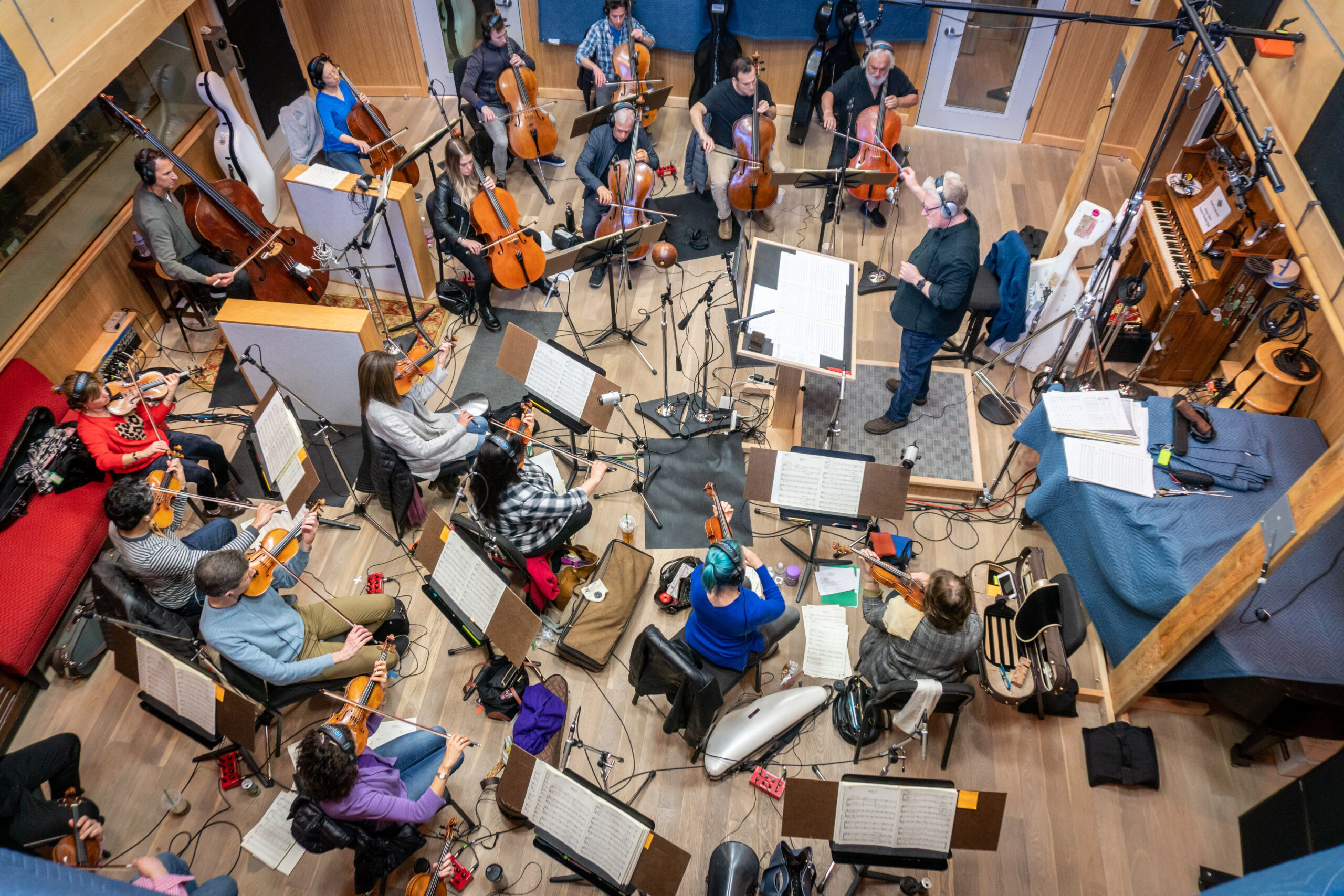
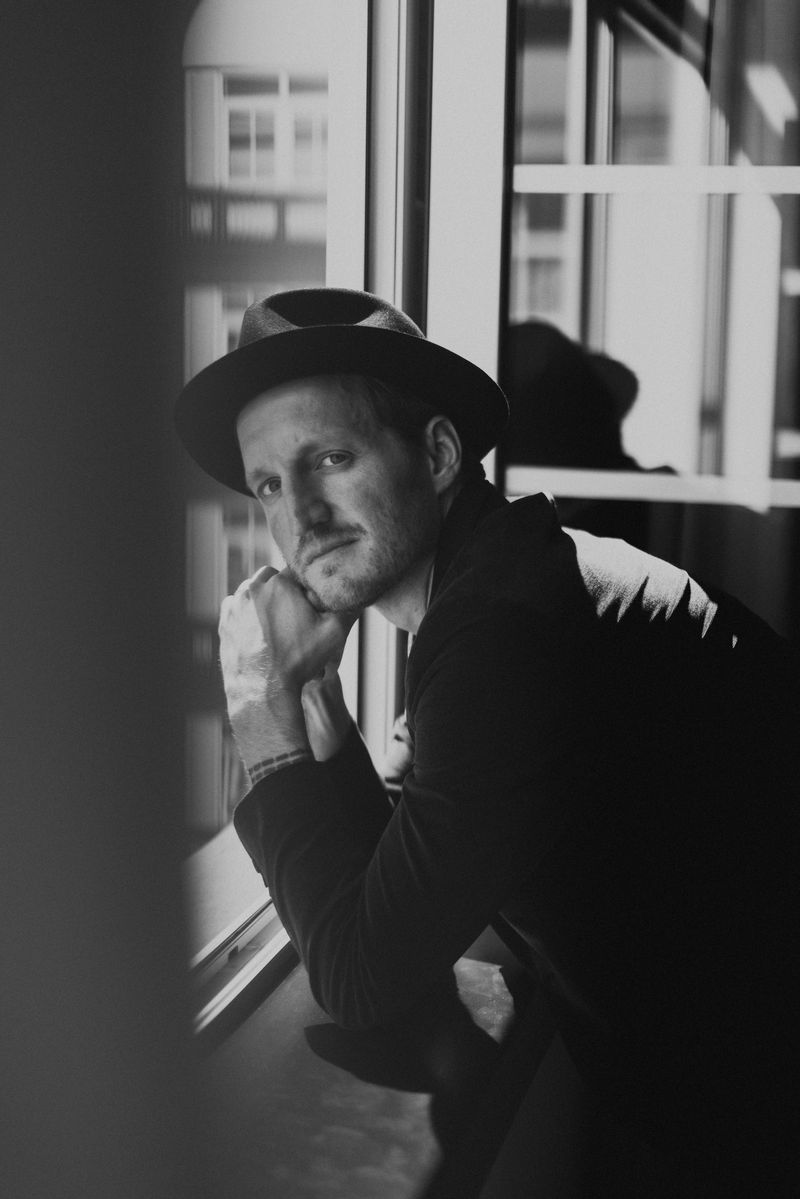

No small number of alternative rock artists are making the transition to film scoring. And while some traditionalists might want to stop that march, it’s a do-or-die race that’s brings is a breath of fresh air to composing, especially when it comes to unconventional melody and ways of conveying emotion under stress. They’re two elements that impressively factor into Lumineers’ member Jeremiah Fraites’ one-two punch with The Long Walk and Deliver Me from Nowhere. Both are united in fiction and truth at conveying young characters’ absolute conviction to reach the end goal – in one case teen contestants dropping like ants before a dystopian governments’ anti-race to reach a monetary prize, and the other an acclaimed, hard rocking singer’s attempt to create the last acoustical album his fans would expect – or that his labels wants. In his score for Francis Lawrence’s spin by Stephen King on Hunger Games long before that was a youth-slicing thing, Fraites creates a rural-tinged score for young brotherhood under stop-and-you-die fire, weaving musical camaraderie with poignancy in spite of fear. For Crazy Heart‘s Scott Cooper’s defiantly anti music biopic take on Bruce Springsteen, it’s using equally affecting, sombre melodies for strings and piano that weaves a portrait of a mentally afflicted artist striving against the business and himself to explore new acoustical paths in the tone poem album Nebraska. Fraites creates a sound unlike The Boss’ anthemic hits, yet absolutely in tune with his artistic drive to face demons both creative and personal. Both The Long Walk and Deliver Me from Nowhere couldn’t be further from the scoring norm, yet succeed in the craft’s goal of gripping the viewers in their characters’ plight – as crafted by a musician bringing his distinctive, offbeat craft to a whole new cinematic stage in a way that guarantees he’ll be standing there for a long while.

Tell us about your musical start, and what led you to The Lumineers
When I was little, my mom bought us, me and my older brother, two cassette tapes. She got me this cassette tape of Beethoven Piano Sonatas, and she got my brother a Mozart cassette tape. It had these nature sounds in the background. I listened to my Beethoven cassette tape every night for a decade. I remember that the cassette tape was starting to go clear because I had listened to it so much.
Me and my brother would argue about who was better, Mozart or Beethoven? I still think I’m on team Beethoven, but that was sort of my first introduction to having a deep connection with music. I always had asked for drums for Christmases and birthdays, but never got them. So I made my first drum set at one point using Tupperware and Folger’s coffee cans with chopsticks as the drumsticks.
I was in multiple bands in high school and then at some point, 20 years ago, I co-founded the band The Lumineers with the singer Wes Schultz. He had come back from graduating university, and he was going to start a band with a guy, a mutual buddy named Justin. Justin and I were making music, at the time already and we all blended all together, so that’s sort of what led to the formation of The Lumineers.

Francis Lawrence director Mark Hamill in The Long Walk
How did you make the transition to film scoring?
The transition to film scoring honestly just really came about this year. I’ve been wanting to score films since high school; I’ve always been very deeply attracted to that. A while ago, The Lumineers had done a song called “Gale Song,” which was for the Hunger Games movie soundtrack. I think it just ran during the end credits, and that’s when I first met Francis. I was a big fan of his work, not only from the Hunger Games franchise, but also his work on I Am Legend.
Francis and I kept in touch, and I remember sending him a song of mine a long time ago by email. He was like, “Oh, this is cool, have you ever thought about scoring films?” At the time, I had come out with my two solo albums, Piano, Piano, and Piano 2 and I sent him a vinyl. Then oddly enough, I had met with a bunch of different people in LA a few years ago, one producer in particular, a guy named Roy Lee, who was putting together The Long Walk. He said, “I know that you’ve established this rapport with Francis and I think that you’d be a great fit for this to be your debut film score,” I obviously jumped on it.

Tell us about your main themes in The Long Walk?
The two main themes that jump out is “Olsen” and then “The Long Walk” theme. The Long Walk theme is the sort of that intense military-style string idea that I wrote. I felt like that would bring the audience into this world of a serious movie where the stakes are very high. Francis wanted to shine a light on these boys’ relationships and how they were forming in the most unlikely of places. I think that this idea that the movie could then morph into this sort of Stand by Me story coming-of-age film. “Olsen” came out of me on a synthesizer, and I didn’t know how Francis was going to react to that because the initial conversation was piano and strings, which a lot of the score I think is. Not every character gets something that’s as melodic or as evocative as the Olsen theme. I couldn’t write a big cue for every death, but the big ones obviously needed to be serviced. There was something about Olsen death that hit me the hardest, the way he died, the way it affected all the other boys.
How did you want to convey the characters’ hopes, as well as their youth?
The music was trying to not only convey, a character death, it was also trying to have that yin and yang aspect of the film. Trying to have a little bit of levity, a little bit of lightness, a little bit of joyfulness while the characters were talking about their hopes and dreams. To remember that these guys are really young and playing off of that.

The Long Walk takes place in a rurally desolate post-war future. How do you think your music contributed to that sad, rustic feeling
I think for me the thing that really drew me to The Long Walk was just how unbelievably minimalistic and simple the plot is. The number of limitations that gave to me I feel like was ironically inspiring. I knew there was flashbacks because obviously I’d read the script and the novel so I knew the usage of flashbacks was going to be very instrumental in what I would compose and what I would convey with Ray McGuire’s relationship with his father. But what really drawn to the project were the limitations of the visuals that it was mostly going to be dialogue driven with an ensemble cast walking along this stretch of highway and desolate rural roads.
Talk about musically playing the “warning” the contestants are given?
The warning theme again was born out of how minimalistic the whole long walk was. Those four staccatos, or rather pizzicato notes, are merely trying to do what a warning sound is like – a grim and dire warning in real time and how would that convey a level of sheer terror for the audience.

The Long Walk has savagely graphic violence – one factor that separates it from The Hunger Games. How did you want the music to contribute to the shocking feeling that those gloves were off?
I read something that Francis Lawrence said which was really interesting – that in The Hunger Games everybody’s trying to kill each other, while in The Long Walk people are actually ironically trying to save each other. The walkers was a brotherhood between the boys, one for one; one for all. I mean even to the point that they nicknamed themselves “The Four Musketeers.” So instead of being very bleak, I wanted to find the light in the darkness, which was a collaborative decision between me and Francis. On the initial phone call, he told me that he wanted to show the love between the boys – even though they know that only one person can win.
Francis Lawrence also said that The Long Walk can be considered graphic and violent, no doubt, but I don’t think it ever gets to that gratuitous level that maybe other horror films or super violent movies give the audience. So I wanted my music on this debut film score to feel like the gloves are off and that this was going to be a no holds barred edgy score. One cue that’s a great example where one of my favorite characters Markovich, whom Charlie Plummer is just so brilliant as, ends his life with a spoon to his throat. It’s really the grimmest aspect of the book and the movie, so I tried to write that part which was mostly strings to convey the absolute amount of anxiety and fear.

What level of Springsteen fan were you before getting Deliver Me from Nowhere? And was scoring an iconic rock figure a challenge that was daunting, or something you couldn’t wait to do?
I was born in 1986 in New Jersey, so Bruce was already The Boss. So I didn’t really have much of a sense of discovery of his music in that way. I think at some point in my 20s I had heard his Nebraska album and fell in love with it. It was such a huge shift from the hits that I had known Bruce for, and I was really shocked at what an incredible level of artistry and versatility he had as an artist. He could strip everything down to an acoustic guitar and a harmonica, and these songs just poured out of him. I could relate to him being an artist being in a band from New Jersey and having dealt with depression in my own life.
The director Scott Cooper said there’s no “Boss” in this movie, which really drew me to the film because it was about such a specific time period of a living legend. I could go behind the curtain of what an artist goes through, not only to write an album but to deal with things off the stage. I think sometimes when you blow up and you become a successful band or successful musician all the stuff that happens on stage and in the studio is sometimes the easiest part, as opposed to the trauma that can happen off stage.
Funnily enough, I only felt any pressure when I was on the red carpet at the New York Film Festival – at which point the film was completely done! I was deeply flattered that I was picked as the composer and it was an incredible opportunity and incredible experience. I just tried to write music that would convey the story. I really loved how Scott almost wanted to demystify the process, like in showing how mundane the normalcy is of writing in a bedroom or in their kitchen – just twiddling and fiddling away until something comes along instead of this overexaggerated Hollywood depiction of how “lightning strikes.”

How was your collaboration with director Scott Cooper?
This is my first collaboration with Scott Cooper. I’ve been a big fan of his movies and wrote music that I thought it would be a good fit. I think that the collaboration was really seamless. It really felt like a collaboration between me and my music editor Jason Ruder and the wonderful picture editor Pamela Martin, and then of course Scott at the helm.
Did you have any interaction with Bruce while scoring the film?
If there was any sort of interation with Bruce about the score, I was left out of that, probably for the better. I had gotten the green light and the approval from Bruce and his manager John Landa. They were both very flattering and said that they loved the score meant a lot to me.

Did you want to draw from the “Nebraska” era that this takes place in for your sound?
I kind of wanted to avoid what “Nebraska” sounded like, but I wanted to score to be like what Nebraska felt I think what I mean by that is Nebraska is obviously a heavily acoustic guitar album I didn’t want to have a lot of acoustic guitar, so I didn’t want the audience to misinterpret an original score for a Nebraska outtake or B side. So I drew inspiration from when Bruce has these great story intros on his live sets where there’s just a simple piano. I wanted my piano on the score to sort of echo that sentiment, to feel like performances much like Nebraska felt like and not these overly polished cues.
Your score mainly is orchestral, but intimate in a way that is its own style removed from Bruce’s.
I felt like to a degree that I was “method” composing what it feels like to be an artist struggling, always wondering what the next step will be. After The Long Walk, I got in the habit of writing my cues longer than I knew the editing team would need. it’s always a good way to have some security, because the music can be edited down. I wrote the opening cue on a fender Stratocaster guitar for the black and white flashback of Bruce riding his bicycle. Fast forward to present day Bruce and it’s this sort of beautiful montage. Then that music repeats itself when Bruce is calling his mother who’s now now in California and you know dad is not doing so well so the cue is a repetition that’s really effective. Then there’s a really big montage scene where Bruce and his fictional girlfriend Faye and her daughter on the boardwalk. It’s very New Jersey, very reminiscent of my own childhood of just playing ski ball, eating cotton candy and being near the ocean. The music just sort of poured out of me in a way that felt that deep almost painful nostalgia of childhood and innocence. That’s one of my favorite scenes in the whole movie. one of my favorite scenes of the whole

How did you want to play the pivotal father-son relationship, especially during the flashbacks. Was it difficult to find sympathy for the dad, who puts so much crippling fear into his kid?
I found a lot of sympathy for the Dad. He was going through all those things there was so much less known about mental health. It was a time when both men and women were not encouraged to talk about what they were going through, so I feel like while things could have been different for Bruce’s childhood, I think that everybody’s fighting their own battle. It was really sad to see that portrayed but I think I was impressed that Bruce allowed Scott Cooper to not really hold any punches back and to show how intense that must have been. For me that was really the heart of the story. The end of scene where he tells his dad that he’s never sat in his lap is really heartbreaking. I mean you can’t make that stuff up, which made it the hardest scene for me to nail. And it’s one of my favorite cues I the movie.

How do you think you’ve established yourself as a composer with The Long Walk andDeliver Me from Nowhere? And what kind of projects and challenges would you like to be getting?
I don’t want to speak on behalf of all composers, but I imagine that a lot of artists want to be versatile. After being known for a band for two decades, starting with a Stephen King/Francis Lawrence film and Bruce Springsteen movie with Scott Cooper, Jeremy Allen White, and Stephen Graham, has been a dream come true. The type of projects I’d like to be getting are important stories. It doesn’t matter how big or small they are, because I want to be a part of storytelling through the medium of film. Working with the likes of and caliber of Francis Lawrences and Scott Coopers of the world, I’m excited to see what my third film project might be. For now, I feel like my cup is full with these two scores under my belt.
Listen to Jeremiah Fraites’ score for The Long Walk on Milan Records HERE and his score for Deliver Me From Nowhere on Milan Records HERE
Special thanks to Jamie Bertel at Sony Music