

Body horror has rebirthed itself the world over to become a whole new shape of rage in the genre to pull in sensation-hungry Gen X’ers in such gleefully mutating pictures as “The Substance,” “Malignant” and “Titane.” But few literally nail the metaphoric nail on the head, then into arms and eyes while doing a vice-press with such perverse enjoyment as “Together.” Michael Shanks makes a very auspicious feature debut as writer and director for this tale of a couple coming apart at the seams before getting crushed together whether they like it or not, with every yucky organic and sexual extreme of course acted on for maximum mass theater screaming and laughter. Shanks certainly couldn’t have imagined a better couple than real life cohabitants Dave Franco and Alison Brie as an ennui-filled musician who’s yanked to the sticks by this way perkier mate – only to be thirstily cursed by cosmic forces determined to be the ultimate matchmaker.

But if there’s a real perfect fit to “Together,” then it’s a devilishly creative musician whose talent has pulled him from down under into the ever-increasing orbit of Hollywood. With a particularly twisted talent for fusing together experimental sound design, sampling and way more recognizable harmony, Cornel Wilczek had already scored numerous projects in Australia before his head-slamming, percussive work for The Philippou Brother’s on the truly terrifying talk-to-the-hand picture “Talk to Me, “propelled its ghastly, and very clever social media spin on “The Monkey’s Pawn” into an A24 on-brand indie hit. Wilczek’s unearthly, yet transfixing sound played an even sicker, reality based health influencer on Netflix’s “Apple Cider Vinegar” before the Philippou’s beyond punishing look at bereaved mother taking unholy measures in “Bring Her Back.

Where Wilczek’s scoring has encompassed any number of close your eyes scenes, his most inventive work yet is opening them by force for “Together.” But what makes this unnerving score all the better is the way more satiric, and script-driven nature of what his music is accompanying. Eerie, singing saw-like atmospheres mix with voice, God knows what sampling rises from the orchestra and breath percussion (neatly recalling his ancestor Graeme Revell’s breakout “Dead Calm” score) convey the panic of a neo-Lovecraftian fate that represents a pansexual generation that can’t begin to commit. Veering from stabbing dissonance to Cthulu-summoning moans, mesmerizing harmonies, sardonically frenzied orchestral chases and mind-ripping percussion, “Together” is a score that’s all over the freaky, fleshy place, given an echoing guitar particularly apropos for Franco’s sad sack musician who can’t get his music or his relationship shit together. It’s an at once witty and scary score that is its own distinctive music / anti-music animal in a way that typifies Wilczek’s hypnotically bizarre talent, one that truly fuses horror score nightmare fuel with approachable melody to make him one of the genre’s most distinctive and rising voices – here with two fiendish smiles made into a scarily fun whole.

How did you get into music, and composing?
To be honest, I’m not really sure—I feel like music was just always there. I had three older sisters all into different things—metal, pop, rock—then Dad would be blasting classical music and Wendy Carlos, and Mum would be spinning Al Martino. I honestly couldn’t tell the difference between Kiss and Stravinsky as a kid. It was all just music. So when it came time to think about what I wanted to do with my life, the decision had already made itself. I was going to make music.
Australia has yielded notable genre composers from Brian May to Graeme Revell. How would you describe the music scene there, and what’s the key to crossing over into international waters, let alone Hollywood ones?
I think our distance from Hollywood and the bigger international scenes creates a kind of creative hunger. For people like Brian May, Graeme Revell—and even myself—it never really started with a goal to “break into” the industry. It started from a place of pure nerd-ery. Deep research, late-night experiments, making weird sounds just because we could. And then at some point, filmmakers started seeking us out—not to copy something else, but because they wanted what we do. That’s always felt important to me. I’ve got my own weird little agenda when it comes to my career, and it doesn’t involve doing things I don’t believe in.
As for the scene here… honestly, I’m not sure there is a defined one for composers. But maybe that’s a strength. In a way, Australia is the perfect place to be a composer because there’s no burden of a “scene” you have to conform to. You can go deep into your own world and wallow in it for a while. That can be a superpower. It gives you a sound that’s truly yours—and eventually, if you’re lucky, that sound starts travelling, and before you know it, you’re scoring Hollywood films.

Do you think there’s an inherent darkness, let alone insanity, to your work? Or do you welcome punishing genre films?
I definitely like to explore the darker corners of myself. That might sound a bit pretentious—or like the back cover of a metal album—but it’s true. As a kid, I was obsessed with horror films and fascinated by how far music could go in expressing complex, even unspeakable ideas. Visuals can only take you so far. Music—and sound—have the power to tap into something deeper. They can stretch beyond the immediate moment and suggest a much larger, stranger world.
It’s a paradox, really. Music is a temporal medium, but it can break time. With careful planning—using motifs like premonitions, echoes, or portals—you can bend perception, blur reality. That’s why I think scoring for film can go to darker, more unhinged places than just writing music on its own. It’s not just about mood—it’s about unlocking hidden dimensions of the story.

You’d been composing for quite a bit before you and the Philippou brothers came to my, and quite a few people’s notice with the instant horror classic “Talk to Me.” Tell us about working with them on that particular score.
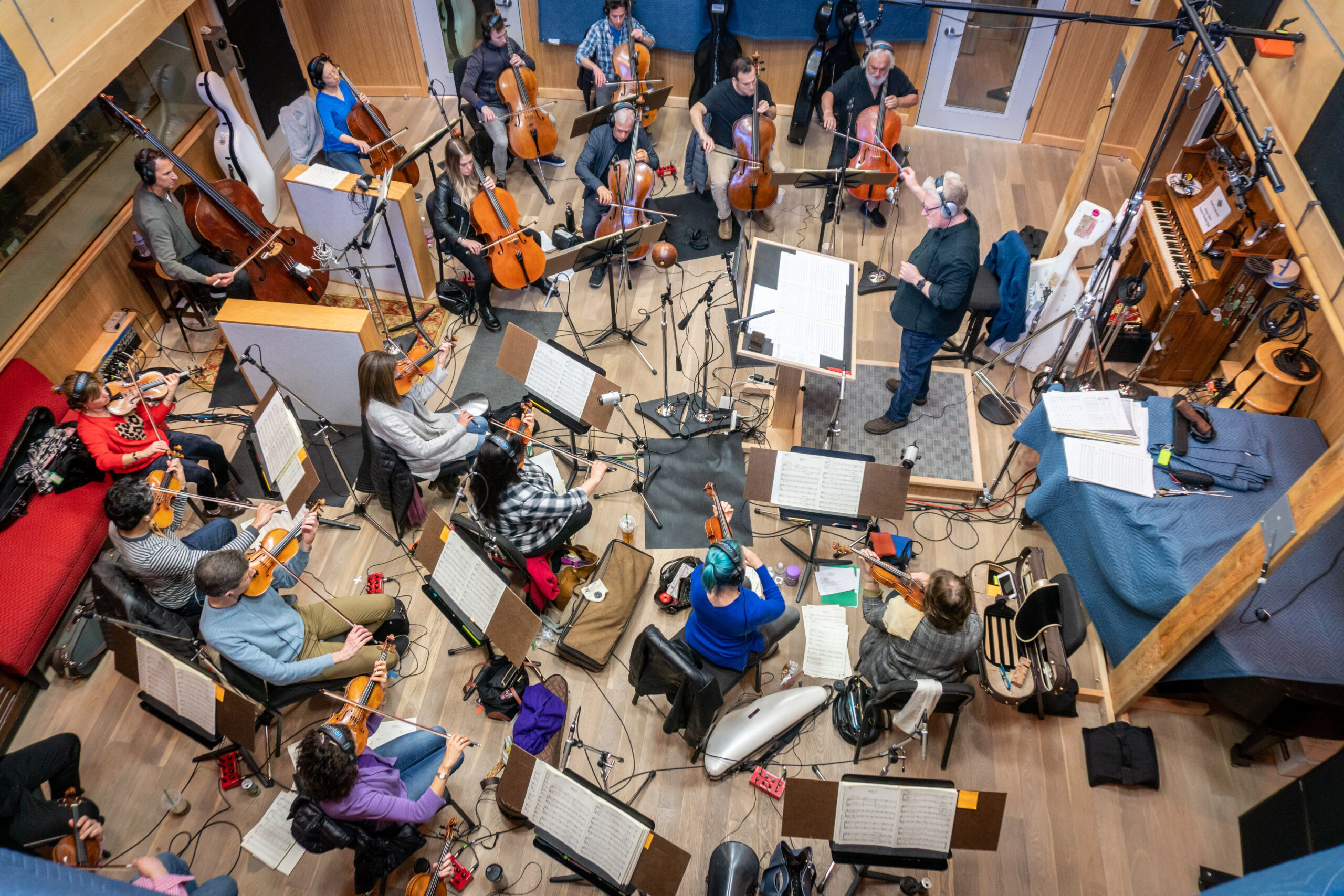
It was an absolute joy—but also a total pressure cooker. The whole score, including recording and mixing, was done in under three weeks! When you’re working that fast, there’s no time for overthinking. You have to trust your instincts and run with them. I watched the edit as it stood at the time, read the script, and started jotting down a ton of chaotic little notes—scribbles about how it felt, where the tension was sitting, what it needed emotionally. And then I just… did it. The upside of a tight deadline is that you end up with something very direct and cohesive. There’s no time to second-guess or over-polish—it’s one clear thought, pushed through to the end.

Tell us about working with Steven’s directing daughter Destry on “Please Don’t Feed the Children?”
When I first watched the film, I was struck by how simple and resourceful it was. I’d expected something bigger and more sprawling, but what I found was a small-scale story with real clarity—and I instantly connected to it. Working with Destry was fantastic. There was a lot of trust from the very beginning. She already knew my music and wanted me to just do my thing. We had some great conversations to get a feel for tone and direction, and once I felt I understood where she wanted to take it emotionally, I just dove in. When I delivered the first draft, I braced myself for a flood of notes—it was a pretty intense score, even by my standards. But she didn’t have a single change. She loved it. That was it—one draft, straight to recording. That kind of trust is rare, and honestly, it’s a dream.

Another notable project of yours to be released in the States this year is the Netflix miniseries “Apple Cider Vinegar,” which is about the real horror of being fatally misled by a social media influencer. Tell about scoring that.
That one was a lot of fun. The whole concept of the score was to explore the mechanics of lying—how to fabricate total bullshit, but still fully believe it yourself. We knew early on that it needed to be a harsh, electronic score. That felt right, especially as a contrast to the kind of lush, acoustic sound world you’d typically associate with the wellness industry. The showrunner really understood the psychology behind the lies—how they’re constructed, how they seduce you—so she was a great guide in helping shape when to push the score, and when to pull back. It was less about scoring drama, and more about scoring delusion.

In a similar vein, you recently scored with Thomas Rouch the HBO documentary “Surviving Ohio State” about a coach’s ongoing abuse. What to you is the biggest difference between scoring a fictionalized version of real-life criminality and a documentary about it?
The biggest difference is knowing when to be sensitive—when not to speak musically. With “Surviving Ohio State,” it had to step back and let the story and the voices carry the weight. These are real people, recounting deeply traumatic experiences, and there’s no way I could ever fully understand what that was like.
In fiction, you’re interpreting—you can push, dramatize, shape the emotional arc. But in a documentary like this, it’s more about respect. I wanted to support, not intrude. Sometimes the most powerful thing you can do is say nothing and let the silence carry the truth.
Quite a few of your genre scores are between musical sound design and more traditionally melodic music. How do you find that “sweet” spot, or decide to veer from one to the other?
Excellent question. In genre scores, I often make that decision with tempo in mind—not musical tempo, but the rate at which the story unfolds and information is revealed. When the pacing is slower, when the audience is still absorbing details or sitting in uncertainty, a more sound-design–based approach tends to work best. It’s more about atmosphere and subtle guidance. But as the story builds and information becomes denser, that’s when I find it’s time to shift into more musical territory. Melody and harmony carry weight—they have direction, intention. They can handle complex emotional and narrative ideas in a way that’s incredibly efficient. Music is a language, but it’s also a kind of multidimensional data stream. When used right, it can say a lot very quickly.

Tell us about your collaboration with Michael Shanks, who makes a very impressive feature writing and directing debut with “Together.”
Michael is a genius—truly. His knowledge of film is second to none, and he has a razor-sharp sense of tone and storytelling. We had lots of conversations throughout the process and met up many times, but interestingly, the first drafts of the score didn’t really change much. He had a clear vision, and I felt connected to it right from the start. He spoke a lot about his influences early on, and I immediately got a sense of his aesthetic. Honestly, like with a lot of great films, the notes I scribbled after first reading the script ended up becoming the backbone of the final score. The script was that good—clear, layered, and emotionally precise. It gave me everything I needed.
“Together” is as notable for Michael’s dead-on dialogue between Tim and Millie as the makeup effects that happen between them. How did you want to work with the script?
At its core, the score is built around their romance. If you strip it all back, the main theme is actually a romantic, melodic one. That became the foundation—I used it as the raw material to bend, stretch, distort, and reshape throughout the film. The first pieces I wrote were for Tim and Millie’s interactions, and that started as early as the script stage. Their dynamic was so clear and emotionally rich that I could begin sketching ideas before a frame was even shot. That romantic theme echoes in a lot of unexpected ways throughout the score—it warps with the story, but it’s always there underneath.

Where you’ve scored more than your share of straight-up horror movies, there’s a level of ironic humor in “Together” that makes the movie far more enjoyable, and the effects even ghastlier. Is that bleak satire something you want to acknowledge, or play straight?
With “Together,” we absolutely chose to acknowledge the farce! When the film leans into being an absurd, enjoyable romp, I was more than happy to follow it there—and to me, that’s a testament to the filmmaking. It was all in the rhythm; the film wanted that tonal swing, and musically it soaked it up. It felt like a breath of fresh air.
Those moments nod to the great horror-comedies of the ’80s, but the film does more than just reference them—it elevates the form in a really smart, deliberate, and genuinely fun way. It’s not a tone I’d always go for, but in this case, it was built into the DNA of the film. I felt it in the script from the start. It needed to get colorful. It needed to embrace the absurdity. And I’m really glad we did.
With Tim being a rock musician who just can’t get his act together, did that give you the idea to bring an electric guitar in as an element to the score? And how does having a character who’s a musician inspire you?
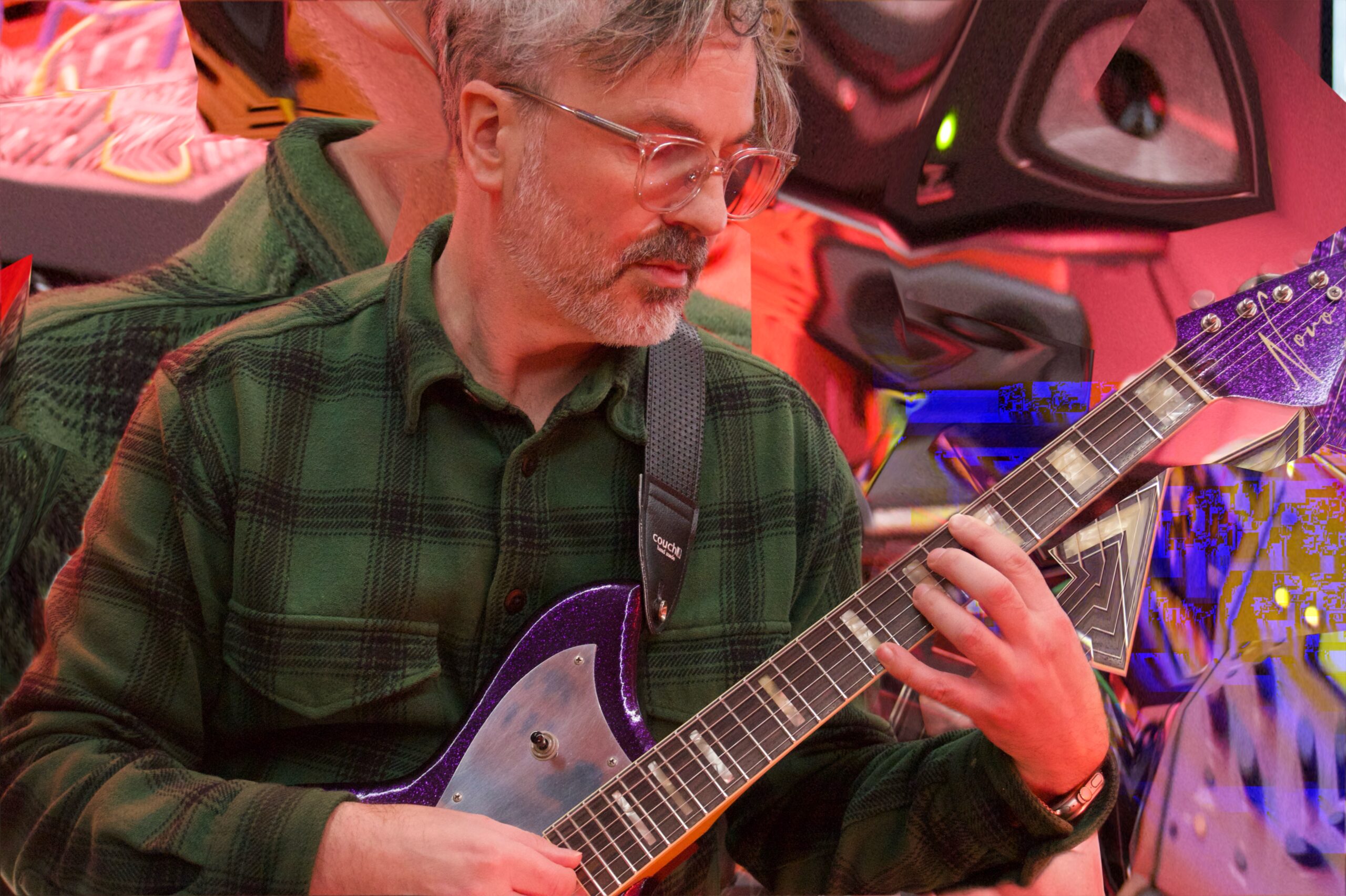
At first, I wanted to avoid using guitar—it felt too obvious. But in the end, it just fit. I’m a guitarist, and I used this one instrument I have that’s wired up with weird electronics and an embedded mic, which gave me a lot of sound design options. It ended up shaping a big part of the score, even if it’s not immediately recognizable as guitar. Having a musician as a character only matters if it means something in the story. In Tim’s case, the guitar symbolized something he’d lost in himself. Using it helped us hear things from his point of view.

Tell us about creating the sampling on “Together.” I particulary liked your use of the female voice and a sort of “singing saw” sound.
Ah yes! Shanks was really keen on having voice in the score, so early on I recorded a bunch of vocals—myself, some friends, and my collaborator Alex. Strangely enough, her voice and mine blended really well, so I built a sample instrument that let me stretch, bend, and merge the two together. It’s a bit on the nose—two voices weaving together for “Together” —but it totally worked. I spent a lot of time in Kontakt learning new scripting tricks to make it feel fluid. And funny enough, most of that gliding, eerie “female” voice? That’s actually me.
How do you score the literal idea of attraction?
For me, it’s about carefully choosing sounds and instruments that feel like they’re courting each other—gently converging, circling, pulling in closer. There’s always a bit of playfulness, a sense of tension and release. And underneath it all, a hint of romance. In “Together,” the main theme that keeps coming back is basically a soppy love song—it’s just been twisted and stretched in all sorts of directions.

The mythos that results in Tim and Millie’s “condition” is somewhat explained here, but a lot isn’t. How did you want the music to reflect that there’s something even more cosmically unholy at play here? It’s an idea of a bigger malevolent force that definitely informs “Talk to Me” and “Bring Her Back” as well.
I like to hint at mythology rather than spell it out. In “Together,” that sense of something bigger is set up early in the cave scenes—those sounds carry weight. Later, when those same motifs show up in more normal settings, it feels like something otherworldly is leaking into reality. With “Bring Her Back,” the mythology had clearer rules. Once I understood them, the score became a way to reinforce them and make the supernatural feel inevitable.
Do you yourself have any fear of committed relationships that you could identify with? And if so, how do you think that affected “Together’s” score?
Hah—yeah, I did. But I’ve given in. I am Tim and Millie. That dynamic felt very real to me, and I completely identified with it. I think anyone who’s been in a deep relationship and decided to take it further will relate. As for the score—it helped me tap into the emotion with real clarity. The hesitation, the intensity, the push and pull. I felt like I could commit to both characters equally, which made scoring their journey that much more personal.

Given that you score so many “severe” sequences, how do you protect your mental health? Or does all of the grotesque scenes become blasé to you?
I’m definitely not immune. My trick is a hotkey on my keyboard—when a scene gets too disturbing, I hit it and the video shrinks to a tiny thumbnail. I can still see movement and contrast, but not the detail. Sometimes I’ll watch a scene once, take notes, set up markers… and never look at it again. That’s enough!

What’s up ahead for you?
Next up is a really fun horror score which is much more colorful and musical than anything I have done. It is a little more psychedelic. I can’t say what yet – but soon. And then a really interesting TV show in Australia that explores the life of a very interesting person. More on that soon!
Would you warn first dates, let alone committed couples off from seeing “Together?”
Not at all. If you don’t know what you’re getting into, then you probably shouldn’t be considering or in a relationship.
Watch “Together” in theaters, with Cornel’s soundtrack available on Lakeshore Records HERE. Visit Cornel’s website HERE
Special thanks to Kurt Nishamura